
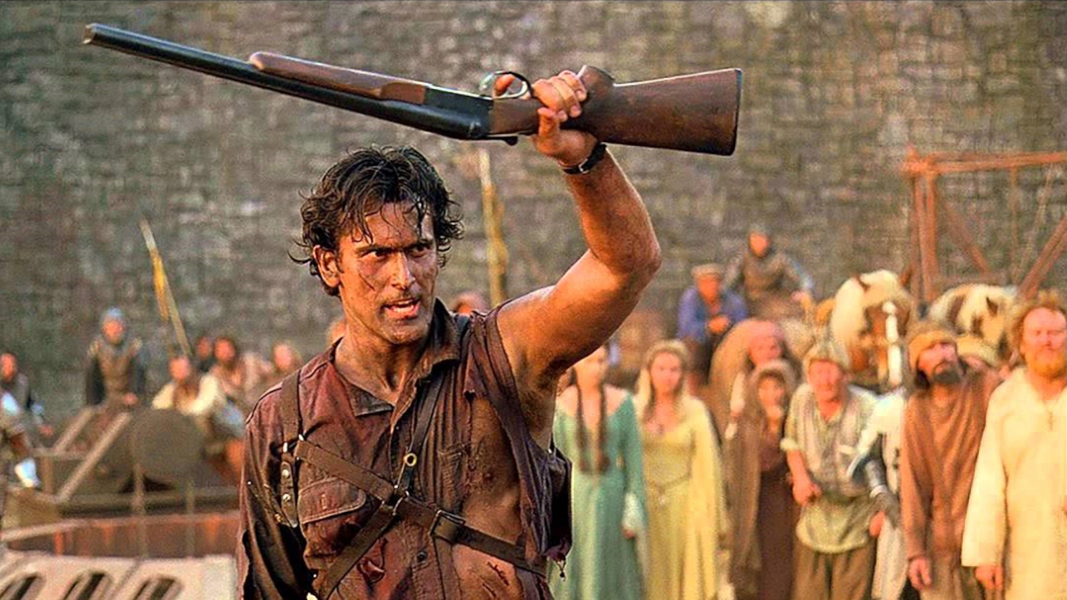
Franchise Expansion (Or Implosion): ‘Army Of Darkness’
by Ben Martin
Franchise Expansion (or Implosion) is a column that looks at franchises that have new installments or releases forthcoming. In looking at a franchise, each entry in a franchise will be given a review and then be examined as part of the bigger franchise. (i.e., Was this sequel a worthy expansion of this franchise or was it an implosion of sorts?)

Horror franchises are notorious for losing their edge once enough sequels are produced. This quality is especially true for the horror series of the 1980s, many of which went from being horror to flat-out comedies by the conclusions of their respective runs. However, going from screams to laughter was never the true intention. That is, with one true exception — The Evil Dead franchise has not only mixed horror and comedy but it’s also vacillated between these genres more skillfully and with the same creative team involved on some level. Moreover, this franchise has also played with timelines. Or time periods, for that matter, in the case of the most contested installment-Army of Darkness (1992)!

A lot of sequels repeat themselves. Others repeat themselves while innovating and doing something different through that repetition; The Evil Dead (1981) and Evil Dead 2: Dead by Dawn (1987) being the absolute epitome of that. Then there are those sequels that go for something completely different. So, with its predecessors being indie film innovators, it’s only fitting that Army of Darkness (1992) entirely different — including being a studio picture. In fact, I can’t think of a sequel that could be more different in the breath of a franchise than the movie review.
Following the success of Sam Raimi‘s first release through Universal Pictures, the quasi-superhero flick Darkman (1990), the studio wanted to be in the Raimi business. As such, Universal agreed to let the director make his long-desired third Evil Dead film. Thanks to that greenlight, Raimi and company were finally going to get to make what they had initially wanted Evil Dead II to be. They were going to torture the series’ hero Ash Williams (Bruce Campbell) by sending him to the Dark Ages to bring us “The Medevil Dead!” Even if they would not ultimately get to utilize that punny title because the studio did not find it marketable enough…
This threequel, ultimately titled Army of Darkness, would need far more financial backing than its predecessors. As a result, the film carried a production budget of $12 million. Universal financed half the budget, with returning producer Dino De Laurentiis (1919-2010) supplying the remainder. Considering Darkman grossed over $48 million worldwide for Universal Pictures on an estimated $14 million production budget, I’m surprised Army of Darkness didn’t get a bigger budget to go medieval. Then again, Raimi consistently proved throughout his career that he will bring a picture in ahead of schedule and under budget.
Raimi originally wanted to reunite with his Evil Dead 2 writing partner, Scott Spiegel (Intruder [1989]). Unfortunately, he was unable to commit as he was in the early stages of co-writing the screenplay for the nearly-forgotten 1990 Clint Eastwood picture, The Rookie. So, Raimi decided to re-team with his brother, Ivan Raimi, with whom he had co-written Darkman. Army of Darkness marked Ivan’s first foray with Deadites, but it wouldn’t be the last time a Raimi brother would be involved. One returned as a primary writer on the TV series Ash vs. The Evil Dead (2015-2018). But before Ash Williams could make his way from the silver screen to the television set, he would go even further back in time than he did in Dead by Dawn.
Army of Darkness picks up where Evil Dead 2 left off: finding Ash in the Middle Ages, specifically 1300 A.D. Despite the situation, our hero is filled with even more bravado than the last time. Granted, it helps that the Middle Ages people are understandably astonished by Ash as a man from the future … and one who arrived just in time! Those who reside in the Middle Ages find themselves threatened by Deadites, with whom Ash is all-too familiar. To return to his era, Ash agrees to retrieve The Necronomicon to win the battle against The Medieval Dead!

It would be a severe understatement to say Army of Darkness is a stark departure from its predecessors. So much so that I feel this third film could function as a one-off just as efficiently as the original Evil Dead. Aside from Ash and his undead enemies — brought to life once again by KNB EFX founders Robert Kurtzman, Greg Nicotero, and Howard Berger — Army of Darkness shares almost nothing with the previous Evil Dead entries. On the contrary, it very much strikes me as Raimi and company’s attempt to introduce Evil Dead to mainstream audiences in a new, fresh, and more comedic way. This approach was only bolstered by the fact that the film was initially intended to be a Summer movie with broader appeal. Mind you, this was back when being released in the summertime really meant something.

To that point, the movie was made with the intention of securing a PG-13 from the MPAA. Not only was that Universal and Raimi’s desire, but it also seemed like an easy goal since Army of Darkness is completely different from what came before it in tone and violence (or lack thereof). Despite making various cuts, the Motion Picture Association of America Ratings Board kept slapping this movie with an R. Finally, the studio acquiesced, accepted the rating, and proceeded with marketing and releasing the film. Army of Darkness is among the softest R-rated movies ever, and no doubt should have been granted a PG-13 rating. While I wasn’t a part of the process, the ratings board was primarily motivated to restrict the film due to it being part of this notoriously violent franchise and nothing more.
Despite the film inevitably being given an R-rating, those valiant initial efforts to make a more broadly-appealing picture sum up the third film in this series. No matter where you come down on it, Raimi and Co’s ambition to do something so vastly different from the earlier entries is admirable and, in my estimation, deserves respect. However, that doesn’t necessarily mean this dramatic shift in tone will suit everyone, myself included. Army of Darkness is one of those movies I respect more than I enjoy, despite being a unique genre-mashup-screwball-comedy. It’s not that I necessarily dislike the film, though. In fact, it’s more complicated than that.
I’ve never been overly fond of the Middle Ages from a historical or cinematic standpoint. Thus, my distaste for the period also extends to fantasy and the sword and sorcery subgenre therein. Nevertheless, I have become more appreciative of Army of Darkness after watching every cut of the film for this column. I’ve seen it several times, and in previous viewings, it felt like an obligation. Army of Darkness is a good film; it’s simply not to my taste. Therefore, I could never disregard it when doing a franchise rewatch. However, in the five or six times I’ve seen it in the past, Army of Darkness always felt more like a chore where I cracked a few laughs here and there. This time around, though, I felt a little differently about the film as I watched it not merely from a fan perspective but more of a critical lens.
In finally watching Army of Darkness as more than just a fan, I can see what a gutsy, sharp turn this film is for the franchise. If nothing else, it is a showcase for the evolution of Raimi, Campbell, and producer Robert G. Tapert (Don’t Breathe); The Three Stooges-inspired goofballs from Michigan who started it all! Sure, Darkman showcased this growth in craftsmanship to some degree, but Army of Darkness is the prime example. The fact that Evil Dead started this crew’s respective feature film career and that eventually brought us to where we are with “The Medieval Dead” is astonishing! And that’s even if you take the stepping stone that is Evil Dead 2: Dead by Dawn into account.
With this filmmaking evolution comes versatility, which can be seen in the craft and the complete stylistic change from the previous two films. There are no dark woods to be found in the Middle Ages. On the contrary, Army of Darkness is a film filled with sunshine. Moreover, director of photography Bill Pope (Ant-Man and the Wasp: Quantumania) captures the cinematic look and feel of the Middle Ages and the sword and sorcery subgenre, which this film embraces in favor of its more horrific, rustic roots. The same can be said of the production and costume designs by Tony Tremblay (Timecop: The Berlin Decision) and Ida Gearon (Tales from the Darkside: The Movie), respectively.
While this subgenre isn’t my favorite, I’d be remiss not to admit the successfully immersive environment created for this film, a quality that certainly helps sell the conventions employed. Of course, the exterior scenes were shot in Bronson Canyon and at Vasquez Rocks Natural Area Park, which gives us in a tangible environment. Ironically, despite that old adage of “More money, more problems,” Raimi directs all of it masterfully while seemingly experiencing fewer bumps in the road than his previous Evil Dead endeavors. Our leading man, Bruce Campbell, also fully embraces the setting and subgenre to carry his performance as Ash Williams to new heights of the pompous-but-lovable hero. Much like this story, there is no real horror or fear left for Ash to face. Nevertheless, Campbell is still entertaining as hell to watch here.

My personal viewing history with Army of Darkness is undoubtedly a mixed bag. But I’ve now settled firmly on how I feel about the film. Army of Darkness, or “The Medieval Dead,” is an entertaining subversion of the established Evil Dead franchise. It will undoubtedly appeal more to some fans as much as the Horror-centric installments that preceded it, myself included. However, like it or not, Army of Darkness is undeniably a Franchise Expansion. Sure, it won’t suit everyone, but Army of Darkness takes this series in a whole new direction while putting the ever-growing skill sets of the filmmakers on display.
Army of Darkness is also one of those rare movies that has a variety of different cuts. Some versions of these serve as franchise expansions in various ways. Army of Darkness has four cuts: an 81-minute US Theatrical Version, an 88-minute International Version, a 96-minute Director’s Cut, and an 88-minute US TV version. All of these are available on the Scream Factory Collector’s Edition Blu-ray & 4K UHD releases. For the most part, these cuts are similar, except for the endings. If I had to choose, my preferred version is the 96-minute Director’s Cut. This is mainly because of the ending, which would have set up a post-apocalyptic fourth film had the franchise gone that way. However, the ending of the Director’s Cut is not considered canon because it would (presumably) negate the direction the series took following this film.

That moment would lead from the silver screen to the TV screen with Ash vs. The Evil Dead (2015-2018). The television series served as a direct continuation of the film franchise, finding our hero, Ash Williams — again portrayed by Campbell — now residing in Florida. Through Ash’s misadventures in the Sunshine State, among other locations, Ash vs. The Evil Dead incorporated the original Raimi trilogy into its three-season run as a part of the then-fledgling original series lineup on Starz! However, it was when the TV series later made its way onto Netflix that it gained the attention of an already ardent fanbase. Because let’s face it, Starz has never grabbed as many eyeballs as some other premium pay channels turned streamers. But more on that to come next time!

Army of Darkness is available on streaming, 4K UHD, Blu- Ray & DVD!

Join me next time for what is presumably Ash Williams’ final horah (in live-action anyway) with a review of Ash vs. The Evil Dead (2015-2018)!