
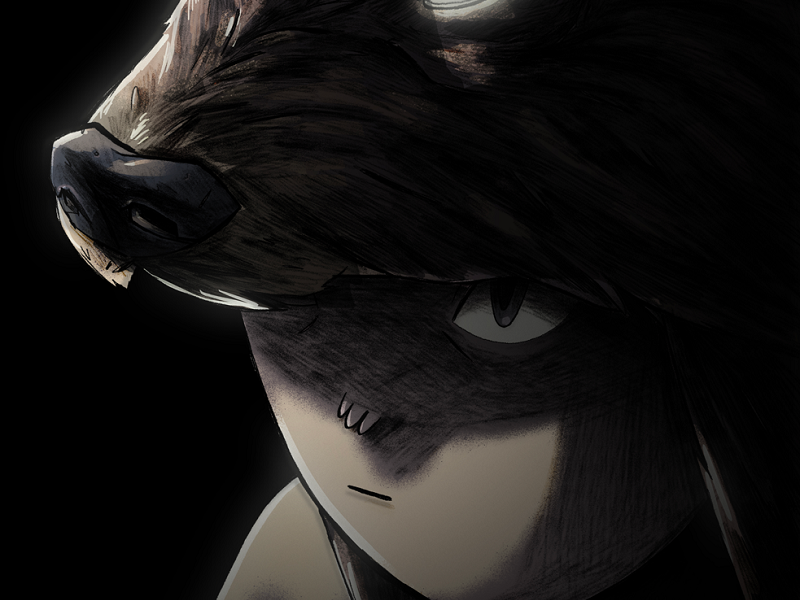
Crowdfunding Comics: Talking ‘The Weakest Fish’ With Bryan Wizemann And Edgar Camacho
by Rachel Bellwoar
Tim knows his mom is seeing one of her co-workers. Once his dad finds out, however, Tim’s life will never be the same in writer Bryan Wizemann and artist Edgar Camacho‘s new graphic novel, The Weakest Fish. Currently crowdfunding on Zoop, here’s what Wizemann and Camacho had to say about the title and setting Tim’s story in the 1960s:

Rachel Bellwoar: On the campaign page, Bryan, you explain that The Weakest Fish started out as a screenplay you’ve been working on since 1999. Why did you ultimately decide to tell this story as a graphic novel?
Bryan Wizemann: Well, yes, the first draft was completed in 1999 in Ithaca, NY, where I lived on Cayuga Lake in a house not meant to be lived in over the winter. That initial draft was full of fantasy and dream sequences and admittedly not very good. But the central idea always drew me back, so every year or so I would invariably open up this script and tinker around on it. What resulted was all the fantasy elements being stripped away, leaving a simple narrative that still has some lyricism and otherworldliness around the edges. I also had the (bad) idea back then to have illustrations along with the script, and my illustrator at the time tried to convince me to make it a graphic novel. I didn’t back then, but the idea has always been in the air for this project.
Bellwoar: How early into the process did you come aboard, Edgar, and has the story changed a lot since you first read Bryan’s script?
Edgar Camacho: Bryan had already worked on his script, and he cut down a bit on the final version that we ended up working on. I remember that the story was already very well-defined, and a few minor changes were made. When I arrived at the project, Bryan was very clear about what he had in mind.

Bellwoar: Without having read the book, the cover image of Tim wearing a wolf skin might come as a surprise going by the title, The Weakest Fish. Did you consider multiple titles and covers or did you always know this was the direction you wanted to go in?
Wizemann: We didn’t really explore other covers, I knew it would always be some version of this. Tim being alone in the woods, and having to eventually do something for warmth, gave rise to this image of him wearing a wolf hide. I like the confidence it brings and the way it feels anachronistic as if he’s a Viking exploring a lost land. The title refers to an evolutionary theory that the fish that left the water and evolved into human beings was the one that couldn’t compete in that environment. Our own evolution results from desperation and inability, not some kind of grand design. Tim’s father tells him this story once he realizes his wife is leaving him.
Bellwoar: Usually when you think of the sixties it’s the colorful version seen in pop culture. What was it like getting to show a different side of the ’60s and was The Weakest Fish always intended to be a period piece
Wizemann: It wasn’t always a period piece, but a friend suggested that setting it in the past would solve most of the script’s problems. The themes and tones certainly do reveal themselves better in the past, especially the section in rural Mexico. Most of my scripts are present-day, so it was nice to not have to deal with cell phones and other modern annoyances in a script.

Bellwoar: So much of the storytelling in this graphic novel is achieved through nonverbal cues. How did you manage to hone in on body language so acutely?
Camacho: I love to solve scenes without dialogue, where only the graphic narrative tells you the story. In my particular case, it is very difficult for me to express my ideas or stories only with text, in a script. I think I express myself better by drawing than by speaking or writing, so when working with Bryan, I sent him sketches of the scenes, very schematic sketches, with notes of what was happening, instead of a comic script.
Bellwoar: A lot of the tension in Tim’s parents’ marriage is conveyed through how each panel is oriented, too. Do you spend a lot of time on layouts, Edgar?
Camacho: Yes, to sketch each page it took me a considerable amount of time, even more than the pencils and final color, because it involved thinking about how to go from the written script to comic scenes and have them have a fluid narrative.

Bellwoar: Tim picks up a number of survival skills over the course of this graphic novel. How much planning went into establishing those skills early?
Wizemann: I love the idea of Tim’s father having been a Vaudevillian huckster magician, someone who had the whole knife act with an assistant strapped to a spinning target. The story implies that his wife Julie was that assistant in some distant past, and walks with a limp because of it. Tim, looking up to his father, wants to emulate him and develops knife-throwing skills for real. There’s a nice scene where his father shows him that it’s all stagecraft, that the knives come out from the back and nothing is ever really thrown. Tim also tries to learn to survive by watching and learning from the heron encounters, but of course, his efforts often fail.
Bellwoar: Superstition also plays a large role in this story. Why did you want to play with otherworldly elements?
Wizemann: Julie is certainly superstitious, and in the opening scene she throws some spilled salt over her shoulder for luck. My wife is from Eastern Europe and often has small rituals or behaviors learned from her grandmother that have a basis in some kind of superstition. It’s very subtle, but those beliefs when coupled with a habit are hard to shake. I also think it reveals something about a character when they put their faith, however small, in something like magical thinking. Given the whole story has dreamlike qualities even though everything that happens does happen, I feel the superstitions situate nicely within that larger narrative environment.
Bellwoar: Thanks for agreeing to this interview, Bryan and Edgar!
The Zoop campaign for The Weakest Fish runs until December 6th. Click here to contribute.


