
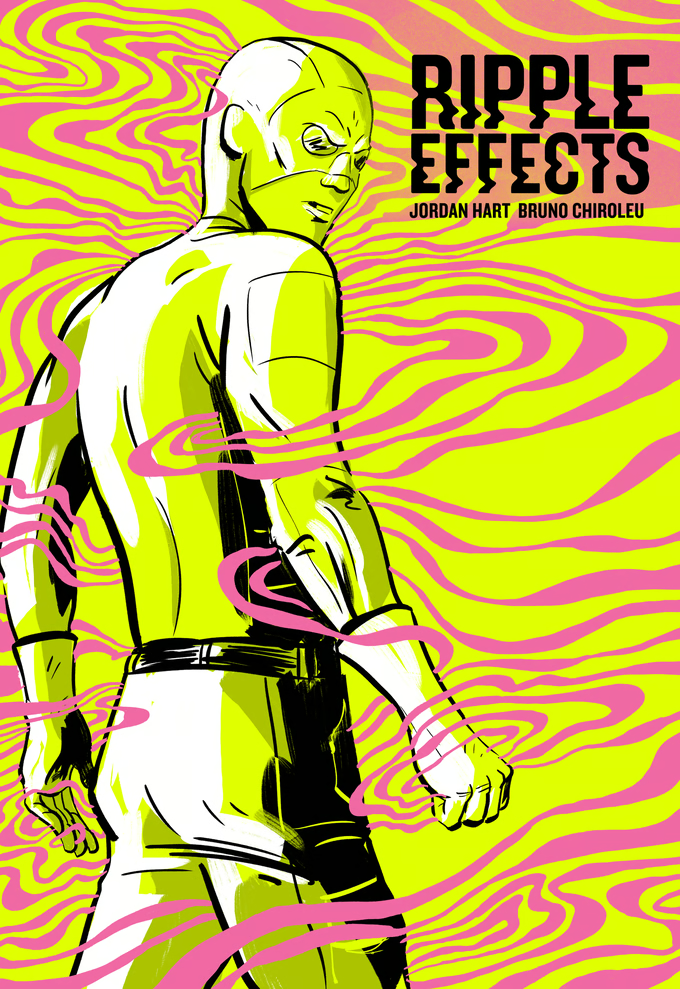
More Than A ‘Very Special’ Comic: Reviewing ‘Ripple Effects: The Deluxe Edition’
by Austin Gorton
Overview
Ripple Effects successfully attempts to tell a compelling superhero story and impart a “Very Special” message. Despite some occasionally shaky art, it succeeds in both by crafting a compelling arc for the main character and tying its message to the metaphor at the heart of its story.
Overall
9/10For the last several years, I have podcasted about “Very Special” episodes of TV, those times when the regular plots and character arcs of your favorite series are interrupted to present a story with a heavy-handed message, like the time Punky Brewster‘s friend got trapped in a refrigerator or when Sean joined a cult on Boy Meets World.
This storytelling format has also found its way into comics, either through something like Amazing Spider-Man #96-98 (in which Stan Lee semi-famously published a three part story involving Harry Osborn getting hooked on drugs without the Comics Code seal of approval) or X-Men: Heroes for Hope, a special one-shot creator jam issue intended to raise money for famine relief in Africa.
In nearly all these cases, these kinds of stories struggle to function as both a vehicle for their message and an entertaining story in their own right, one which can stand beside similar stories of the genre while delivering their message. Too often, the desire — certainly well-intentioned — to serve as a cautionary or informative tale overrides the basic elements needed to also tell a good story.
At first glance, Ripple Effects, out now in a deluxe hardcover collection from Fanbase Press collecting all six issues of the crowd-funded series, would seem to fall into the same bucket as these other “Very Special” stories, in the way it sets out to tale a story intended to educate readers about the struggles of people with invisible illnesses or disabilities.
But Ripple Effects succeeds because in addition to having something to say, it’s also a deeply entertaining superhero story, one which elegantly wraps its message into its storytelling in a way that elevates both.

The main character of Ripple Effects is George, one of a mere handful of people who possesses super-powers. In George’s case, his power is invulnerability to any external harm, a power which does nothing for the acute case of Type 1 diabetes from which he also suffers. After a chance encounter with the Superman-esque Salvadora, George is drawn into the world of superheroes and supervillains as he tries to use his power to help others while grappling with his invisible illness.
Created by writer and colorist Jordan Hart, who himself suffers from an invisible illness (thrombophilia, an incurable blood-clotting disease), Ripple Effects sets out to both tell an entertaining superhero story and shine a light on the tales of those people who, like George and Jordan, deal with an invisible illness every day.
Ripple Effects works as both a message book and a story in its own right thanks to the way Hart elegantly blends the two motivations together, specifically the way he ties the message to the metaphors at the heart of superhero stories. The concept of a hero having a specific weakness — their kryptonite — is so ubiquitous that “kryptonite” has entered the modern lexicon as a general term for a weakness or specific counter-agent.
In Ripple Effects, George’s invisible illness, his diabetes, is his kryptonite, the one vulnerability from which his superhuman invulnerability can’t protect him. His kryptonite is built in. Superhero stories are escapist fantasies, wish-fulfillment stories, in which powers are a reflection of the character’s desires or personalities (and through them, the readers’). Yet gaining invulnerability — a perfectly understandable desire of someone suffering from a long term illness — doesn’t allow George to escape his disease.
And just like, say, Daredevil gains superhuman abilities at the cost of his sight, there is often a cost associated with superpowers: in Ripple Effects, not only does George’s power not protect him from the effects of diabetes, using his powers to help others puts him MORE at risk of the disease. Thus, the “Very Special” message of the story, the desire to inform and educate about the invisible illnesses born by people all over the world, is woven directly into the plot, characterization and themes.
The story doesn’t need to stop, turn, and look to the reader in order to deliver its message before returning to the narrative business at hand, because the message and the narrative are one and the same.

Furthermore, Ripple Effects succeeds because George is a compelling character on an arc. It is an origin story, in the sense that it involves the protagonist adopting a heroic mantle amidst various growing pains, but it pointedly doesn’t begin with George gaining his powers. It begins after that event. This is a key distinction.
Ripple Effects isn’t the tale of how a superhero got their powers; it is the origin of George learning to embrace being a hero and not have his life dominated by his invisible disease. As the story begins, George isn’t a bad guy by any means — he is generally affable, has a strong moral compass, and feels guilty about all his parents have sacrificed for him. But there is an understandable selfishness to him, and as much as Ripple Effects is the origin of the superhero called Ripple, it’s also the story of George overcoming that selfishness.
That it’s not a straight line from George being recruited by Salvadora to becoming a superhero makes the story all the more compelling and relatable. He backslides, he messes up his priorities, at one point he dives even deeper into selfishness, adopting a “Well, at least I’ll get mine!” attitude. In short, George reads like a regular person, someone for whom heroism isn’t easy, but hard, but he ultimately chooses to be heroic regardless.
If Ripple Effect stumbles anywhere, it’s with the art. Artist Bruno Chiroleu is certainly a capable storyteller — the action throughout the book is clear and easy-to-follow, and the synthesis between art and script is strong; Hart rarely has to step in and use dialogue or a narrative caption to make clear something the art has muddied. But the actual figure work gets a little sketchy sometimes, with characters’ appearances shifting ever so slightly from panel to panel, anatomy being off (arms too long in this panel, legs too short in this one), facial details appearing and disappearing depending on the focus of a shot, etc.
As solid as the visual storytelling is, it also lacks some visual punch: it lands the moment-to-moment beats, but never really contributes the kind of big, iconic, larger-than-life images that are superhero comics’ stock in trade. That said, Chiroleu’s design work is strong: all the costumes of the various superheroes a fun mix of various visual superhero tropes (like belts with pouches, something the story humorously hangs a lampshade on at one point).

In addition to all six issues of the original Ripple Effects series, this deluxe edition hardcover collection comes packed with extras. There’s a new foreword by writer Gail Simone and study guides by educator Tim Smyth and comic literacy advocate Creators, Assemble!
Intercut between each issue of the series is an “Unseen Ripples” essay, written by individuals with invisible disabilities and illnesses who relate the events of the preceding issue to their own lives, both adding context to the story and furthering the impact of its message. Finally, there is an art gallery in which young artists who have invisible disabilities and illnesses provide their own superhero characters, which are subsequently reimagined by comic artists like Liana Kangas, Ray-Anthony Height, Don Aguillo, and Manuel Martinez. These are utterly delightful expressions of imagination and fun.
All in all, Ripple Effects: The Deluxe Edition succeeds in both its explicit goals, to teach readers about the struggles of people with invisible illnesses and disabilities while telling a cracking good yarn. By intertwining the two — by tying its message to the metaphor at the heart of the story — it avoids the pitfalls of far too many “Very Special” stories, of having the message overpower the narrative, the story becoming more of an over-earnest lecture rather than anything entertaining. In George, it crafts a compelling, relatable character whose arc forms the spine of the series. While it is George’s invisible illness which makes the character, in terms of superhero stories, unique, it is his journey towards super heroism that is familiar yet compelling. It is what makes Ripple Effects sing.
Ripple Effects: The Deluxe Edition is available now digitally on Hoopla.

