
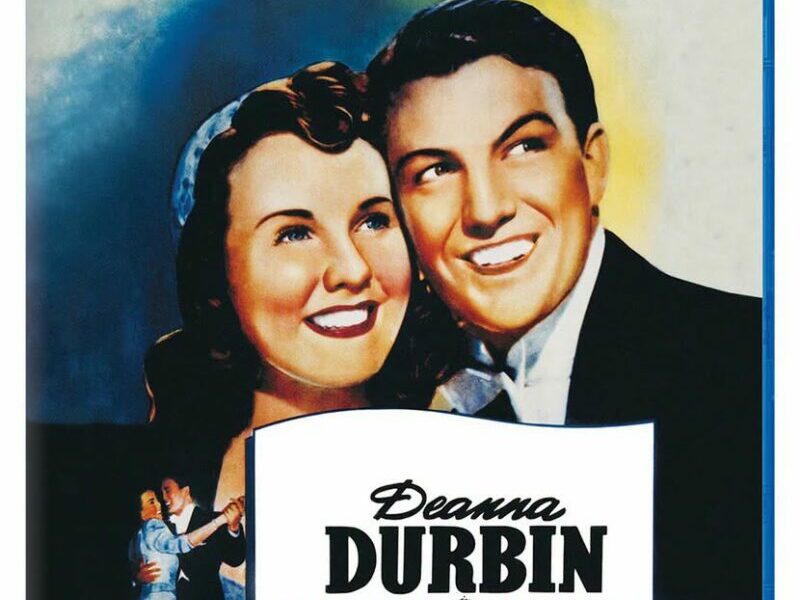
Deanna Durbin Double Feature: ‘First Love’ And ‘I’ll Be Yours’
by Rachel Bellwoar
In both of these films, Deanna Durbin winds up in New York City, yet the paths they take from there couldn’t be more different. If you’ve never seen a Durbin film before, they’re similar to Shirley Temple movies or Judy Garland‘s films with Mickey Rooney (like Garland, Durbin had a voice beyond her years). While all of these films are wrongly dismissed sometimes for being too rose-tinted or cheesy, don’t knock ’em till you’ve tried ’em, because Deanna Durbin was huge in her day (if not as well known now), and she will win you over.
Henry Koster‘s First Love (1939)

Harsh isn’t a word that comes up too often when describing Durbin movies, but First Love is more than Deanna Durbin’s Cinderella. Plotwise, yes, there’s a lot of Cinderella in Durbin’s orphan, Connie, who, after graduating from school, gets sent to live with her aunt and uncle (Leatrice Joy and Eugene Pallette) who couldn’t be bothered to attend the ceremony. In a lot of versions of Cinderella, though, the evil stepmom and sisters are cartoon characters. I don’t mean literally – the film doesn’t have to be animation – but they’re caricatures of ugly people. With First Love, this is one of the most damning portrayals of the rich I’ve ever seen, and it’s a “little Deanna Durbin movie” that’s doing the calling out.
Unlike many of Durbin’s films [see I’ll Be Yours coming up] where the crotchety characters ultimately have their hearts melted by her influence and are given redeeming qualities, Connie’s family in First Love don’t change. Maybe a “secretly nice guy” arc is attempted with Uncle Jim, but “nice” is him coming to Connie’s defense by being a physically abusive husband and father. It’s a warped vision of “nice.”
Still, outside of Connie’s cousin, Barbara (Helen Parrish), who does go out of her way to make Connie’s day worse, these aren’t deliberately evil characters. They are just so wildly spoiled and thoughtless that it never occurs to them to feel guilt or remorse for their actions. It’s a level of nastiness that tracks but is shocking to see in the context of a Durbin movie, which makes it all the more fascinating.
It would be a crime not to acknowledge Durbin’s brilliance, too. As the put-upon but not broken Connie, this is a Cinderella who’s not afraid to stand up for herself, and the way she plays off Connie’s social faux pas, as her being completely unaware that she’s making them, isn’t ditzy or naive but endearing. Her Prince Charming (Robert Stack) might not be worthy of her affections, and the special effects (like Durbin talking to herself in a mirror) might be crunchy, but who cares as long as Durbin’s star power is on full display?
William A. Seiter‘s I’ll Be Yours (1947)

Unlike in First Love, where Durbin’s move to New York is a nonfactor, I’ll Be Yours actually shows Durbin’s Louise having to adjust to the big city. A single woman on her own, making do with a budget, it’s Mary Tyler Moore decades before The Mary Tyler Moore Show premiered, down to Louise meeting her love interest (Tom Drake) when her hat flies away and he retrieves it.
The first half of this film is a lot stronger than the second half, with Durbin sharing a number of scenes with William Bendix’s would-be restaurateur, as they try to help each other get a leg up. Where it starts to go sour is with the introduction of Adolphe Menjou’s millionaire, whose casting couch behavior is played for laughs. While Louise’s first instinct is to spurn him, she changes her mind when she thinks she can use him to help her love interest’s career. Trouble is he proves as unworthy of her love as Stack was in First Love, but at least there are some classic Durbin musical numbers to make the medicine go down smoother. For those who enjoy comparing movies, I’ll Be Yours is based on the same Preston Sturges play as The Good Fairy (1935), an earlier film starring Margaret Sullavan.
First Love and I’ll Be Yours are on sale now from Universal and can be purchased from Movie Zyng.


