
On The Adaptation Of Alan Moore’s ‘The Great When’
by Koom Kankesan
Taylor Swift has just wrapped up her two year long Eras concert tour schedule in Vancouver, Canada. Before moving on to Vancouver, Swift’s penultimate stop was in Toronto, barely two blocks away from where I live. For two weeks, I stared out my living room window at the Rogers Centre as a massive puffy friendship bracelet with Taylor’s name on it was strewn across the facade. Trying to get home one evening, I literally could not move as I suddenly found myself in a sea of selfie-taking Swifties in front of the giant bracelet. To say she is popular is an understatement, as the very nature of the Eras Tour also underscores. Her own mythology has a fanbase.

This brings me to Alan Moore. At the age of 71, he could definitely do an Eras Tour of his own if he wanted. Not that he likes to leave his town of Northampton in the UK … but I’m just sayin’. There are some distinct eras in Moore’s career and oeuvre we can point to:
1) The early Arts Lab and zine producing years (e.g. “Embryo”).
2) The youthful years of arts journalism and producing cartoon strips he also drew (e.g. Pancras Panda and Roscoe Moscow).
3) The work for Marvel UK and 2000 AD.
4) The time with Warrior, including Marvelman and V for Vendetta, that brought Moore’s writing to the attention of people in the US.
5) The tenure at DC Comics, which probably encompasses the height of his popularity
6) The turn to extremely indie works in the wake of his split with DC including Big Numbers, From Hell, and Lost Girls.
7) The forays into prose fiction (Voice of the Fire) and stage performances (The Highbury Working).
8) The return to superheroes via working for Image and Rob Liefeld’s various companies (W.I.L.D.Cats, Supreme).
9) The America’s Best Comics line, which try to redress his grim-n-gritty impact by bringing charm back into the medium (Tom Strong, Promethea).
10) The more abstract work with Kevin O’Neill, starting with The League of Extraordinary Gentlemen: The Black Dossier and including Cinema Purgatorio.
11) The move to short films and a feature film with Mitch Jenkins (Show Pieces, The Show).
12) The strive for solo fiction, including works like Jerusalem and The Great When.
I’m sure my potted list above is far from complete, but we can see that Moore has had a variety of phases or eras featuring rich and varied creative output. He’s decried film adaptations of his work in the past, famously responding to Terry Gilliam asking how he’d adapt Watchmen into a film by saying “I wouldn’t.” Moore made comics that were meant to be consumed as comics — utilizing and expanding the unique properties of the medium — not in the hopes that his projects would catch the eye of film producers or bring him fame and fortune through Hollywood. Due to the bitterness he felt towards DC and antipathy towards adaptations of his work, Moore forwent the millions he could have cashed in for the adaptations of Watchmen and V for Vendetta, asking that the money go to the artists instead. Nor has he had great things to say about the filmic adaptations of From Hell or The League of Extraordinary Gentlemen. They fall far short of the intelligence and creativity in Moore’s own original work.

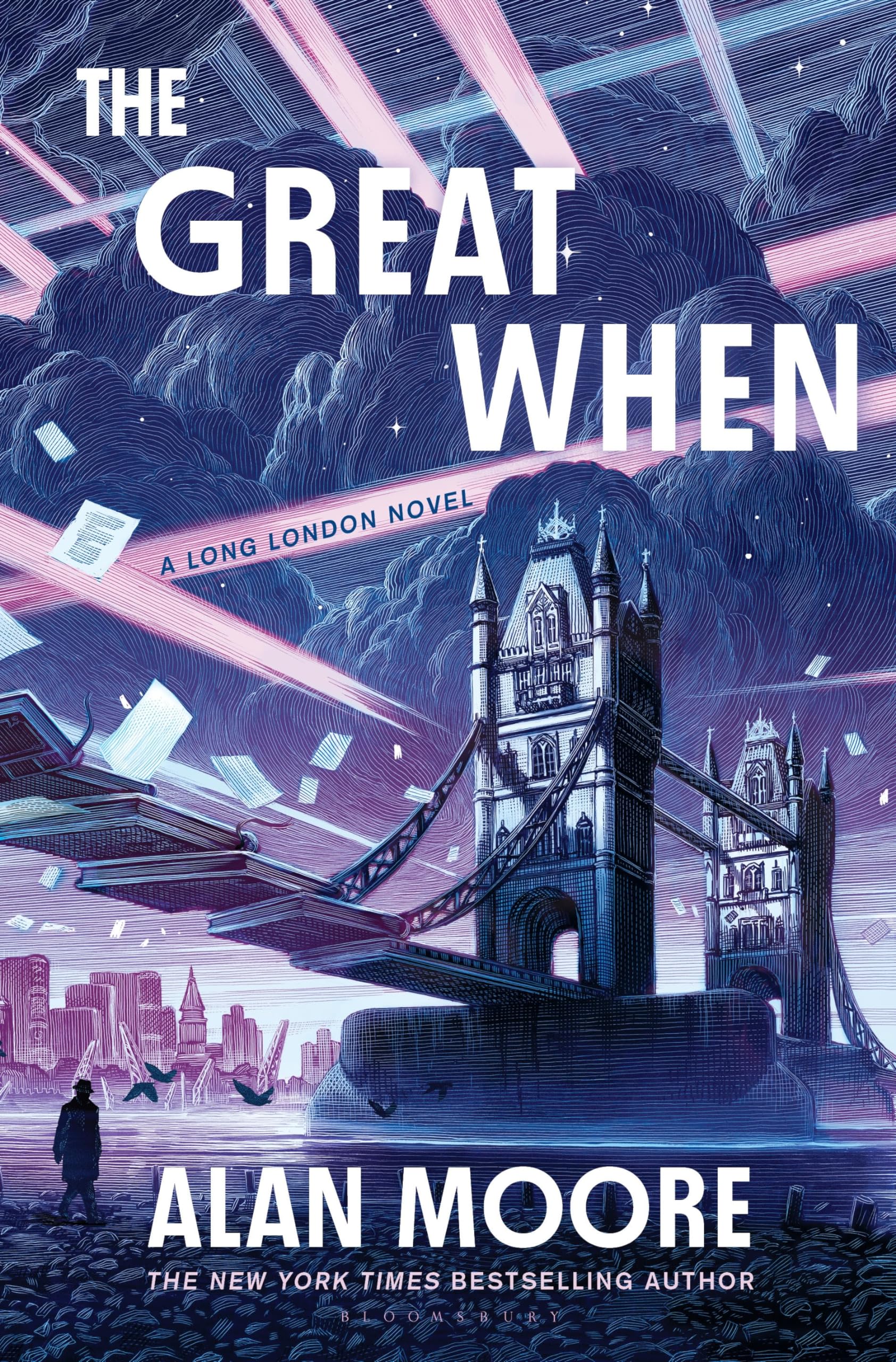
Why then, after all this time, has Moore agreed to have Colin Callendar’s company, Playground, adapt the ‘Long London’ novels (there will be five of them by Moore; the first, The Great When, already came out this year) into a huge ‘tentpole’ TV series? Not only that, Moore seems excited about the possibilities these adaptations offer. As quoted in a Deadline article, this is what Moore has said: “[With] Playground, I feel that I’ve connected with people who respect both me and the narrative and are receptive to such input as I can offer … and, given Playground’s track record, I have little doubt that this will be anything short of spectacular. It’s taken me some time, but I think at last I’m ready for my closeup.”
Given this positive reaction, one would have to assume that Moore’s direct participation in the development of this project is assured on some level — he’s not just licensing the IP. It might even be a case where Moore is showrunning or centrally directing the series to some extent in the same way Neil Gaiman was centrally involved in the more recent shows adapting his work (before the allegations levied against him). Although the quote above doesn’t suggest that, I could see Moore signing on to be very hands-on, despite being in his seventies. He’s often worked with collaborators and seems just as happy pulling something together with a motley crew of creatives as he is slaving alone for hours in front of his computer, banging away at the keys. Case in point: the Show Pieces films. When making those, Moore was essentially directing them alongside Jenkins and even stepped in front of the camera to act. I wouldn’t be surprised if Moore had been there in the editing booth too. He has the sort of intensity and sensibility that film auteurs do, being involved in every step of the process.
Though Moore and company hoped The Show would become a new TV series, it never materialized. He intended to introduce and establish a typically Moore-ish surreal world — a subjectively subconscious treatment of his beloved Northampton, dubbed ‘Nighthampton.’ It sounded in interviews as if he had vast ideas and enthusiasm for the proposed project. Work on the ‘Long London’ series (which will deal with a dimension where London exists as an ideal or Platonic dream entity throughout history) may be tapping into some of the same energies as ‘Nighthampton,’ giving him the chance to expand similar ideas and inspirations on a grander scale with a larger palette, and fulfill what was not ultimately manifested through The Show.

Furthermore, working on a TV series may be Moore trying to launch a new direction with a medium he’s not easily associated with and wanting to subvert it. It may be a way to do something new and cutting edge and, in the process, not just stay relevant but establish a vanguard. Just when I thought that Moore was closing off popular access to his work and ideas by making his prose descriptions lengthy as if weeding or intellectually carding his fans, his intentions to work the books into TV may be another experimental foray and a gamble at something new. That won’t necessarily make it popular with viewers, but with Moore, you never really know. He’s too odd and invested and interesting to simply write off. If Moore is already hatching ideas for a new TV series, it’s pretty safe to say it won’t be like most other tentpole fantasy projects. As he did when bringing together people to work on digital comics (his Electricomics which could also be seen as one of the ‘eras’ not mentioned in the above list), this series could be an attempt to reinvent the direction of tentpole franchises in the very same way Moore’s writing reinvented genre comics.
Finally, one last reason why Moore might be on board for this project: Collin Callendar is interested. He has a history of making award-winning weighty TV versions of classic theatre employing very serious and classically trained actors. Callendar is not a lightweight, nor does he seem to simply go for traditional BBC adaptations of classical works. Now, he seems to be looking for new directions and Moore’s literary and intellectual cred might be what’s attracting him to the idea of producing a fantasy franchise. In any case, it’s an interesting confluence of creative talent. Working with someone like Callendar must be more appealing to Moore than working for outfits that produce superhero films or ones that aspire to put out disposable fare we’ve seen parodied in the recent HBO series The Franchise. This may finally signal not just the decline but the end of this popular era in entertainment — what Martin Scorsese referred to as not films, but theme parks.
So, is this a new era for Alan Moore? Whatever the reasons are for venturing in this direction at this late stage in his career, I think the results will at least be unexpected and interesting. I don’t know if the results will catch on with the mainstream, though, because Moore seems to have moved further and further away from that audiences since the 1990s. In fact, like some sort of Heisenbergian quantum law, the more Moore is personally invested, the less mainstream the project tends to be. Jerusalem is the perfect example of something that’s so personal it features Moore’s family and yet is probably the work the least number of his fans has actually read all the way through. Show Pieces and The Show, though they are somewhat like David Lynch’s work (I’m straining to find a comparison here!), didn’t draw in the large audience that Lynch somehow accrued. At the time Moore was touting those films, he said he wanted to create something that actually tied together and had substance to its mystery, unlike the popular TV series Lost. I don’t think the new program will even be that much like the book because it feels very much like a literary experience with lots of interiority and gaps of decades between events. It’s also rich in historical detail, but not action. Watchmen was, for Moore, pointless to adapt into a film, so I’m guessing an adaptation of The Great When might not be so much an adaptation as an extension of the book.
In the end, those who look forward the most to whatever ensues may be that shrinking core of diehard Moore fans (let’s call them “Moories”) who no longer expect anything in line with mainstream expectations around character, plot, and satisfying formulas. We Moories are happy those earlier eras exist, and we like to pull them off our bookshelves from time to time or discuss aspects of them in Facebook groups. But just as equally, we look forward to that new “album” — waiting to discover the new sound when it “drops.” Like previous works, it will most likely have some element of the Kabbalah or the Tarot and will probably have the unexpected transcendence (maybe using CGI in new ways?) of a “live experience.” It probably won’t look or sound like other shows or be as focused on cliffhangers, crossovers, and popular appeal. I’d be very surprised if Moore, at this late stage, could even care about such things. Why should he? He doesn’t have to prove anything to anyone at this point; his career certainly doesn’t depend on it. It’s all one big experiment, regardless of the outcome. And as a Moorie myself, what I’m looking for is not a conventional crowdpleaser.

