
Talking ‘Monster Locker’ And ‘Call Me Iggy’ With Writer Jorge Aguirre
by Rachel Bellwoar
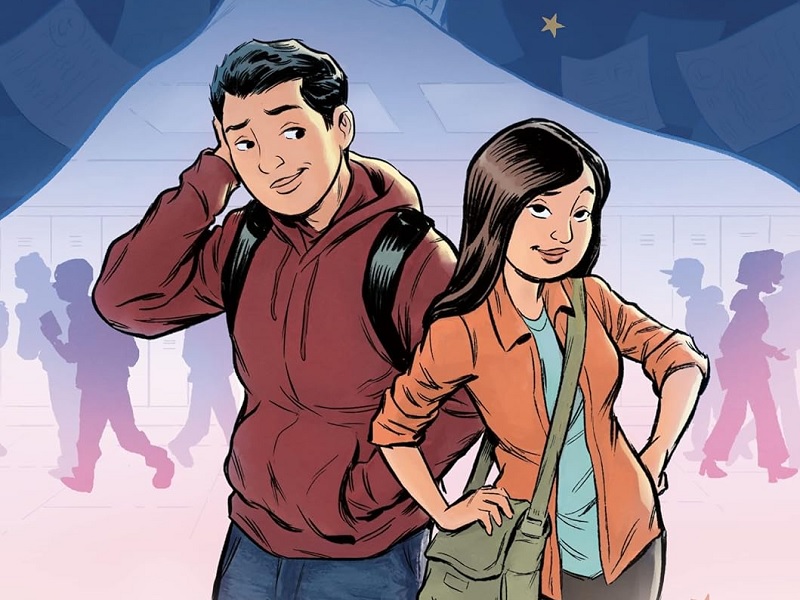
Iggy never met his grandfather in life. While looking for a Columbian flag for Spanish class, however, Iggy inadvertently releases his grandfather’s ghost in writer Jorge Aguirre and artist Rafael Rosado‘s graphic novel, Call Me Iggy. Set during the 2016 election, the book sees Iggy start to form political opinions of his own, while also dealing with regular teenage woes, like crushes and homework.
Call Me Iggy wasn’t the only book Aguirre wrote this year. He also launched a graphic novel series with artist Andrés Vera Martínez called Monster Locker about a middle schooler who discovers a monster in his locker — and not the friendly, E.T. kind but the kind that wants to get Pablo to summon other monsters that mean humans harm. For more on both books, check out this interview with Aguirre below:

Rachel Bellwoar: What was it like collaborating again with artist, Rafael Rosado, on Call Me Iggy and what made you choose this story as your next project over another Chronicles of Claudette book?
Jorge Aguirre: Raf is my brother, mi hermano, mi compay. I’ve loved him and looked up to him since college. So any time I get to collaborate with Raf is a joy and a learning experience for me.
Call Me Iggy is a version of a story that I’d been burning to tell since around 2000. Raf wanted a break from drawing Claudette for a decade. The stars lined up. Books are always about stars lining up.
Bellwoar: Both Call Me Iggy and Monster Locker take place in your hometown of Columbus, Ohio. Do you feel that familiarity helped make the setting more specific?
Aguirre: Setting my stories in my hometown of Columbus does help me make them more specific. I’m also interested in the experience of the Midwestern Latino (like me). When I lived in Los Angeles, I marveled (and loved) how Latino culture permeated through every nook of that city. (Even more so than New York, IMO). But that was the opposite of my experience growing up in Columbus. I think that’s another reason I like to go back to Ohio in my stories. To look at a different kind of Latino experience.
Bellwoar: Both graphic novels also feature main characters who are bonding with their grandparents. For Pablo in Monster Locker it’s his Abuelita, while Iggy in Call Me Iggy meets his Abuelito as a ghost. Why was that a relationship you wanted to explore?
Aguirre: Like a lot of Latino men from Gen X, I had a very complicated relationship with my dad. So I’m always curious about exploring father-son relationships, which you see in Call Me Iggy with the dad and Abuelito. In Monster Locker, the Abuelita was originally an Abuelito. But my partner, Andrés Vera Martínez encouraged me to change her to female. The Monster Locker Abuelita has a no-nonsense, little patience, dry sense of humor that I’ve seen in a lot of my Colombian relatives. And Andrés helped me infuse her with some characterisitcs from his Tejano roots.
Bellwoar: In Monster Locker, Pablo winds up summoning Coatlicue from out of a portal in his school locker. How much did you know about Coatlicue going into this?
Aguirre: I have to give it up to Andrés (my partner on ML) for Coatlicue. I wanted Pablo to fight monsters from different mythologies and genres. But Andrés pushed for Aztec mythology to be featured in the first book. He introduced me to Coatlicue. I knew very basic things about the Aztecs, but Andrés had a much deeper knowledge than me.

Bellwoar: Along with having worked in children’s television, one series I was excited to see on your resume was History Detectives. It also tracks with how you take time in Monster Locker to explain some of the mythology behind the Aztec monsters. Have you always enjoyed learning about history?
Aguirre: Hah! I loved that you brought up History Detectives. My favorite part of working on that show were my deep-dives into history. I love history and mythology. My dad would tell me historical and mythological stories when I was kid. Especially on long road trips when the family was asleep. It’s one of my favorite memories with my Papi.
Bellwoar: As someone whose passions include physical media and old movies, I love that Iggy is a Francophile and Marisol collects vinyl records. How did you choose those particular interests for them?
Aguirre: My dad was a Colombian Francophile. He thought everything French was better than American and Colombian culture. He and my mom even joined a French food Club. I like the French fine. But all of that Francophile stuff in Iggy is my dad.
As for vinyl, I wanted Marisol to have a cool interest and I think Raf suggested vinyl. There’s a vinyl shop on OSU campus Raf used to go to.
Bellwoar: Monster Locker ends with the promise of more Monster Locker books to come. Is there anything you can tease about who or what Pablo will be going up against next?
Aguirre: In book 2, Pablo, Takashi, and Maggie fight monsters from Takashi’s culture. I’ll tease that one is a Japanese Kitsune! Andrés (who is the fastest artist I know), is almost done with the thumbnails. Hopefully there will be a book 3 and 4 and we can wrap up the whole series.
Bellwoar: When you were writing Call Me Iggy you couldn’t have known what the results of the presidential election would be. Reading the book now, though, it feels as much about the present moment as it does about the 2016 election. What do you hope younger readers (and readers of all ages) will be able to take away from this graphic novel?
Aguirre: Empathy. My gosh, if anyone reading Call Me Iggy young or old takes one thing away from the book – let it be empathy. The 2016, but even more so the 2024, felt like it was based on demonizing The Other. But we’re all humans, and we’re all going through our different challenges. If we had more empathy for each other, in the words of the poet, Maggie Smith, “You Could Make This Place Beautiful.”
Bellwoar: Thanks for agreeing to this interview, Jorge!
Both Monster Locker and Call Me Iggy are available now from First Second. Call Me Iggy features colors by John Novak, letters by Aguirre, and flatting assistance by Niki Smith. Monster Locker features color assists by Lucija Freeman.

