
Characterization In The Buffyverse — ‘Angel’ Season 2, Episode 2
by Benjamin Hall
This is part of a bi-weekly series concerning the characterization of Buffyverse characters. The first installment in this series can be found here. Arguably the best place to begin reading this series is at the beginning, but that is up to each reader. As a reminder this column will cover major and some minor characters from the shows Buffy The Vampire Slayer (1997-2003) and Angel (1999-2004). Other Buffyverse media, such as the graphic novel Spike: Into The Light (2014) are not pertinent to this series. Also there will be no referencing real world events that have direct relation to either show in this bi-weekly series.

This week: Angel (David Boreanaz) tries to redeem a past mistake. Also: the Hyperion Hotel becomes the new home of Angel Investigations.
(Warning of spoilers from this point on!)
Thesulac Demon (Tony Amendola) is literally just a supernatural parasite that acts as a metaphor for the paranoia of the 1950s. There is nothing more to the character than this.
Angel, in the present, acts pretty similar to his self in 1952. However, he does smoke in past, which is something that is more in line with his other persona, Angelus (Buffy The Vampire Slayer Season 2, Episode 14, “Innocence”). His desire to be apart from humanity is the same no matter what persona he exhibits (Season 1, Episode 15, “The Prodigal”). In this case, it is the brooding loner persona in both the present and 1952 scenes. It is worth mentioning that his desire, at times, to be actively unhelpful is more on display here than in prior appearances (Buffy The Vampire Slayer Season 1, Episode 2, “The Harvest”). Finally, his guilt is most likely what drives him to finally defeat the demon in this episode.
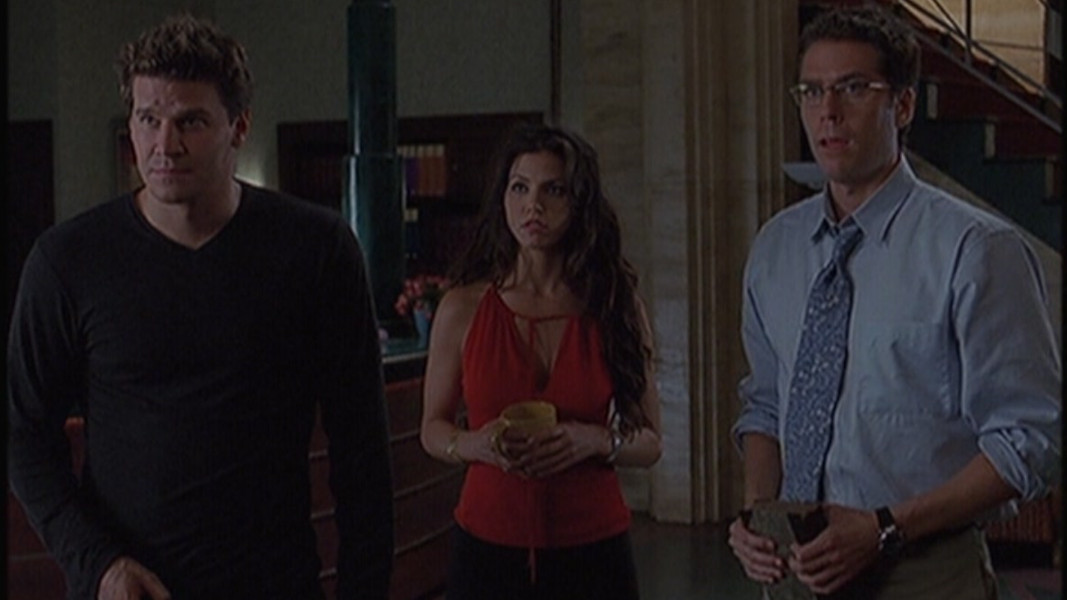
Wesley Wyndham-Pryce (Alexis Denisof), Cordelia Chase (Charisma Carpenter), and Charles Gunn (J. August Richards) are simply Angel’s support. While this fact is true in a lot of episodes, this one in particular has them acting so generically that nothing defines them as individuals.
Judy Kovacs (Melissa Marsala and Eve Sigall) somehow lives to old age despite staying in a building that no one else frequents. Either the demon has the power to keep victims alive, or it is somehow allows her nourishment. Whatever the reason for Judy making it to old age, the rationale regarding why she stays in the Hyperion Hotel is simply fear of her past actions. During her youth, she obviously gets in over her head with the money she steals. This action seems compounded by her turning on Angel and believing herself to be responsible for his end. Thus, her fear of discovery enlarges with the fear of failure. Nevertheless, Judy seems like a relatively decent person when not under the demon’s sway.
The actor (Scott Thompson Baker), the older man (Terrence Beasor), the sex worker (Julie Araskog), the writer (Tom Beyer), and the salesman (David Kagen) all have some amount of traits to them. Nevertheless, their individual personalities get little-to-no time to shine. Thus, they are more of a hive-mind-style plot device to represent the hotel’s past and the psychoses of the 1950s red scare. Beside feeding the demon with their emotions, they all also serve the story by creating a population of guests for the flashback scenes. Finally, all five lack names, and explicit details of their presumable deaths, which adds to the lack of their individual identities.
Roland Meeks (John Kapelos) acts out his racist views by denying a family (unknown actors) who is entirely Black any of the rooms to rent. What makes this worse is the fact that he earlier scolds the bellhop, Frank Gilnitz (J. P. Manoux), about rejecting guests on fears alone.
Frank Gilnitz, meanwhile, seems to be mentally unstable even without the demon’s influence. This is notable since he keeps cheering Angel’s apparent death by hanging, and his commentary on the suicide the demon causes.
C. Mulvihill (Tommy Hinkley) is simply a private detective hunting for Judy and the money. His noticeable traits are lock-picking and how his aggressive persistence borders on being bully-ish.
Denver (Brett Rickaby) provides Angel with information that he needs, and this makes Denver both a font of exposition and a researcher of the supernatural. He is very observant and appears to have some level of magical knowledge since he spots Angel’s vampiric nature and suggests possibly using magic.
The majority of this episode is like most prequel material in that it either contradicts prior canon or feels relatively pointless. Yes, viewers get to learn more of Angel’s history, but it seemingly contradicts both prior and later episodes (Buffy The Vampire Slayer Season 2, Episode 21, “Becoming, Part One”) (Season 2, Episode 7 ,“Darla”). Additionally, there is the problem of the main cast seeing no real developments because most of the episode is a flashback. If one throws in the fact that Angel is only dealing with the Thesulac Demon in the present day as a form of penance then one can see him as less of a hero. Those developments hurt Angel’s position as a hero seeking redemption rather than aid it.

