
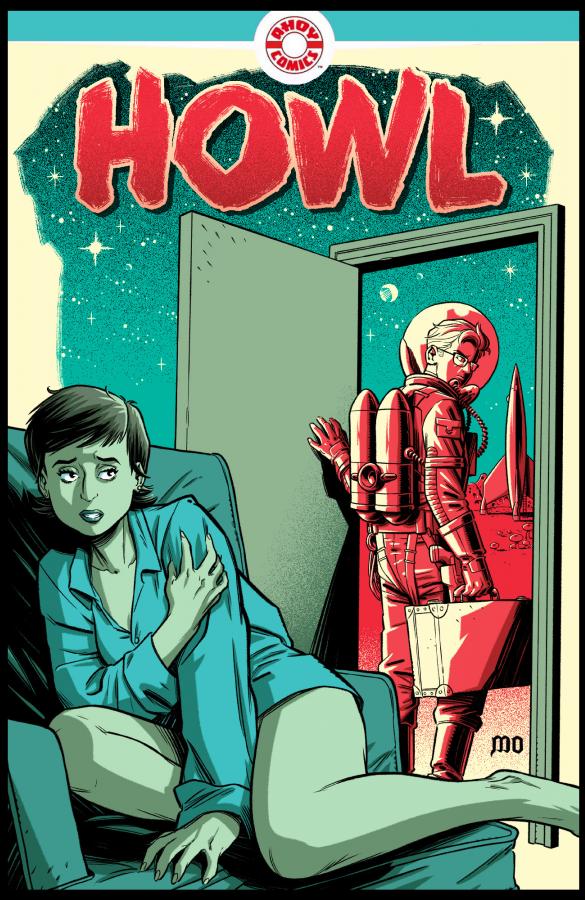
Review — ‘Howl’ #1 Succeeds By Backgrounding Its Alien Invasion
by Austin Gorton
Overview
Howl #1 works by successfully doing two things at once: arguing that you don’t need a subversive sci-fi plot to present the 1950s as a complex time with rampant nonconformity, while also setting in motion a subversive sci-fi plot involving mushroom aliens.
Overall
8/10There is a trope, to the point of becoming a cliché, if it’s not already. In stories set in the 1950s, which posit that for all the Baby Boomer suburban conformity, there’s actually a darker/more turbulent/kinkier undercurrent beneath the surface.
Howl #1 attempts to deconstruct that trope by embracing it. While this first issue leans a little more heavily to the “deconstruct” side of that line by presenting a relatively straightforward that backgrounds the darker, more outrageous sci-fi elements, it also sets the stage for further deconstruction — and alien mushroom mayhem — in the issues to come.

The elevator pitch of Howl is “Invasion of the Body Snatchers in Greenwich Village”. Within the first few panels of Howl #1, an ongoing mycelial invasion of Earth — depicted as nearly-microscopic red dust passing unknown from a hidden ship and later plants into passersby — is established as people go about their business in Greenwich Village.
This immediately establishes the series as participating in the “hidden darkness beneath the conformist surface of 1950s culture” trope, replacing pod people with mushroom people. Yet after those first few pages, the alien stuff mostly fades into the background, and only rears its (fungal) head sporadically.

Instead, writer Alisa Kwitney spends the majority of the issue deconstructing the trope by showing there is plenty of nonconformity going on independent of the invasion. It follows Ziva, a college student-turned-lover of an up and coming sci-fi writer. Ziva is seen repeatedly bucking the conventions of the time. She likes science fiction. She engages in a sexual relationship with Bert, an older writer, outside of marriage, much to her mother’s dismay. She drops out of school. She has a job as a writer in her own right, re-writing articles from male authors for a woman’s magazine. She develops a long-term relationship with Bert, but doesn’t marry him — and feels little personal desire to do so despite societal pressure.
The portrait of Ziva that comprises the majority of Howl #1 is one of a woman already bucking the stereotype of the 1950s as an era of uniformity and conformity, even before the sci-fi elements of the story enter the mix.
This “normal abnormal” aesthetic is aided by artist Mauricet. With a smooth line that creates the feel of animation, he gives the whole issue a pleasant mundanity. He also uses shadow and light beautifully, punching up scenes of “regular” happenings like pillow talk or dinner parties with remarkable depth.

All throughout Howl #1, the fungal invasion is still percolating in the background (one of the people in Bert and Ziva’s social circle is infected, and draws Bert into the mix), but it has nothing to do with the unconventional-for-the-time lifestyle of Ziva. It doesn’t take space aliens, the issue is saying, to shatter the cliche of the “normal” 1950s. Yet the invasion is looming, and by issue’s end, the conflicting approach of deconstructing a trope by embracing it is firmly in place. With Ziva’s atypical lifestyle poised to become more atypical than she can imagine, the stage is set for what looks to be a captivating & complex series.


