
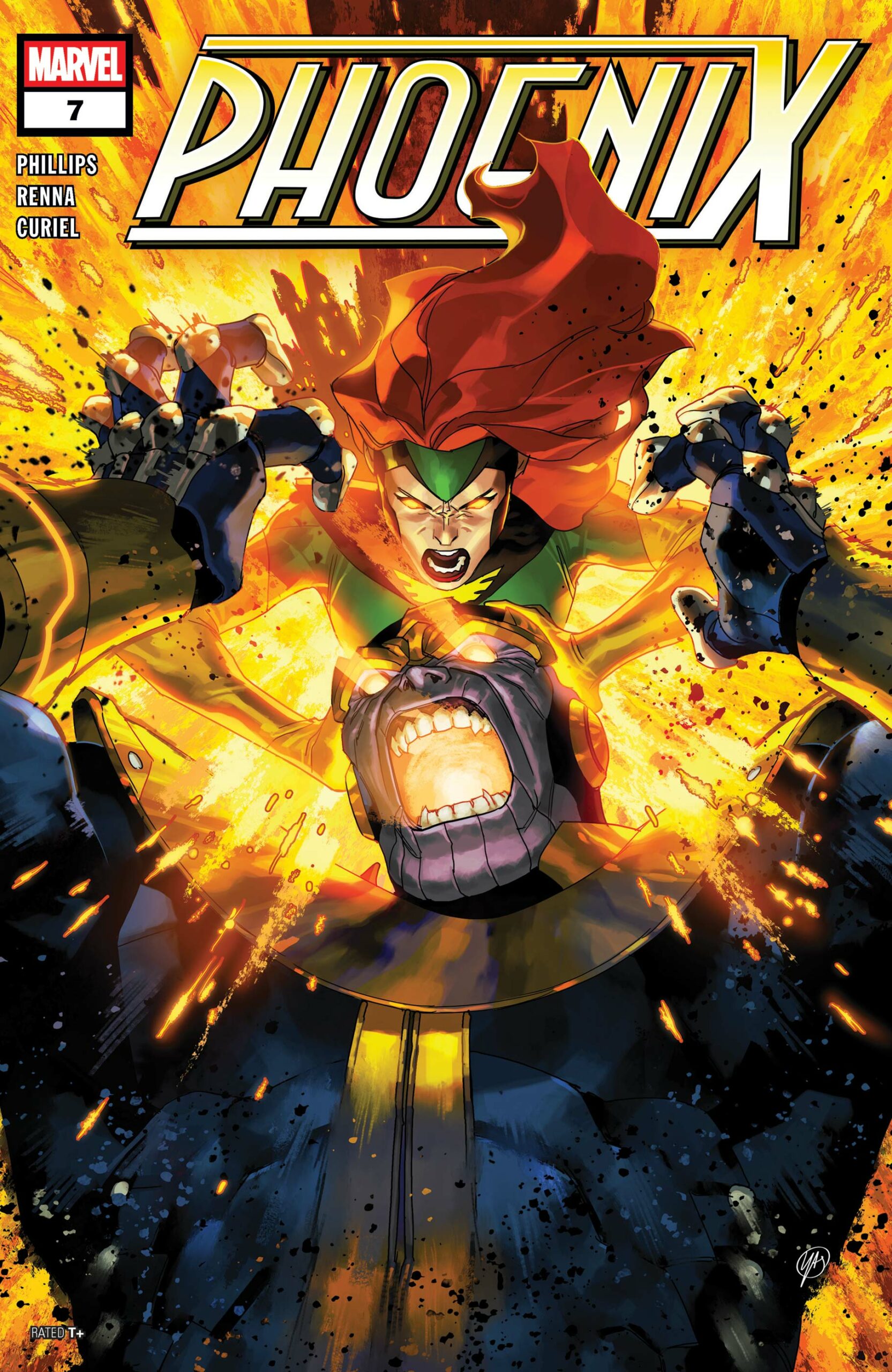
Review — ‘Phoenix #7’ Is An Improvement That Underscores An Ongoing Problem
by Austin Gorton
Summary
With Phoenix assembling a team to take down Thanos, Phoenix #7 marks an improvement for the series on a micro-level, but underscores the ongoing issues with scale affecting the book as a whole.
Overall
3/10On micro-level, Phoenix #7 marks a significant improvement over previous issues of the series. There is more direct action, more people for the title character to talk to. Also, artist Marco Renna isn’t swiping (or swiping as egregiously) as Alessandro Miracolo, so we’re not being distracted by wondering where we’ve seen a given image before.
Yet for all that, this issue doesn’t really address the larger problems with the series on a macro level. It is still struggling with scale, and this issue not only fails to improve that, it does some things that contribute to the problem directly.

Phoenix #7 opens with Jean having assembled her own Cosmic Avengers/Guardians of the Galaxy to help her in her fight with Thanos, who is now effectively ruling the galaxy. On the one hand, the Phoenix crew is a fun, eclectic mix of characters, from Nova and Captain Marvel (both returning to the series) to Sif and Rocket Racoon.
As with the earlier exchange between Captain Marvel and Phoenix, by giving Jean some people to talk to, writer Stephanie Phillips humanizes Jean. This helps keep the narrative grounded.
On the other hand, this whole conflict with Thanos is happening really fast, and it speaks to the series’ larger issues with scale. This is meant to be a book of sweeping cosmic vistas, both visually and narratively, with Jean at the center of it all.
Thanos effectively conquering the galaxy certainly fits that bill, and he is a worthy foe, power-wise and thematically, for Phoenix to tackle. Yet as depicted in Phoenix #7, it all feels very small. Not everything needs to lead to a massive linewide crossover with multiple tie-in books, but it feels like Thanos becoming, essentially, the Emperor of Space should be a bigger deal.

It should take more than five random ad hoc characters to take down a galactic regime, and said regime should take longer to build up than the space between issues. Or, conversely, if the point of this book is that Phoenix has leveled up, that Jean has bigger concerns than the parochial happenings on Earth and the power to back up those concerns, then she shouldn’t need Captain Marvel or Nova (or Adani) to help. Even if giving her some people to talk to that aren’t her long-distance husband or his uncharacteristically-skeevy father improves the issue on a micro-level.
Certainly, Big Stuff is happening commensurate with the intended scale of the book. But it’s a classic case of telling vs. showing, where the sense of scale — the impact of those happenings, on the title character, the series, the ur-narrative of Marvel Comics — is missing.
Thanos conquered the galaxy essentially overnight, yet that’s presented as almost an afterthought, and the mission to overthrow him in Phoenix #7 reads more like a storming of Bowser’s castle than the epic conflict on a cosmic scale it should be. Even as the issue represents some improvements in terms of the art and character interactions, it continues to feel like a much smaller book than it clearly intends to be.
