
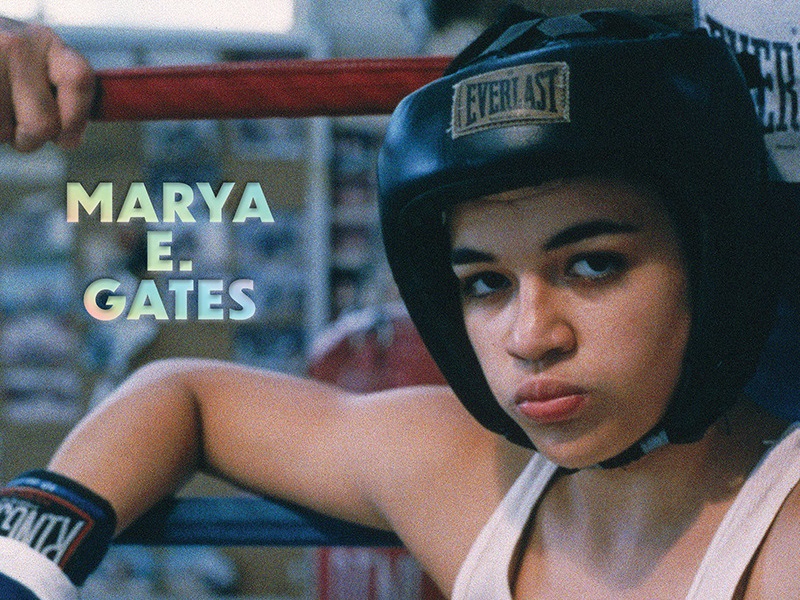
An Interview With ‘Cinema Her Way’ Author Marya E. Gates
by Rachel Bellwoar
From creating Noirvember, to regularly highlighting silent films and films about Palestine in her newsletter, Marya E. Gates has been gracing the world with insightful film criticism for years. Her new book, Cinema Her Way, features nineteen interviews with female directors and you can learn more about it in the following interview:

Bellwoar: As someone who’s been following your work for years (and knows how much you’ve deliberately made a point of covering films directed by women), I couldn’t have been more excited by the news of your first book. What made you decide to have it take the form of a book of interviews?
Marya E. Gates: The original idea for the book came out of my 2015 viewing project A Year With Women. I had wanted to take my knowledge and turn it into a book that was going to be profiles of 365 women so that if people wanted to they could watch a film by a new filmmaker each day for a year. Alas, my day job got in the way and the book proposal went on the backburner. Then my wonderful agent, Nicki Richesin, reached out and asked if I had any ideas for a book, so I dusted out the old proposal and re-worked it to feature just fifty-two profiles; meaning instead of a filmmaker a day, it would be one filmmaker a week for a year. Once Rizzoli came on board as the publisher, they were a big fan of my Female Filmmakers In Focus interviews and suggested I combine the two ideas into one beautiful illustrated book where the filmmakers shared their own stories. As a big fan of oral histories and art books myself, it felt absolutely perfect.
Bellwoar: One consequence of Cinema Her Way being a book of interviews is it feels very grounded in the present. Which isn’t to see that female and non-binary directors are a new phenomenon – you make it very clear that women have been directing films since the birth of cinema – but these are all voices of women who are currently working in the industry (or, if not, that’s due to no fault of their own). Was that a deliberate choice – to look more towards the future than the past?
Gates: I think the book very much looks into the past. Some women included in the book started making films over fifty years ago. The deliberate choice was to include women from multiple generations to not only showcase that women have been making films – and building robust bodies of work – for decades, but also to create a primary source on the thematics and process of these women for future researchers and scholars. One thing I have found in doing my Female Filmmakers in Focus interviews is that women directors in the past often were not asked about their process the same way male directors were. I have also found that the careers of many women working today are not written about as rigorously as their male peers. I wanted to address both of those issues.

Gates: It was really a dream come true. I spoke to her about a week before Christmas in 2022 and it was truly surreal. She was also incredibly generous with her time and very detailed in her answers. I am so grateful that she shared so many stories about her career and her process with me. It was an honor.
Bellwoar: In the interview, Armstrong talks about how more women are attending film school but how that isn’t being reflected in the number of women hired afterwards. For all that the industry has been making strides in the right direction, do you feel that just highlights the importance of statistics, in showing that yes, things may be better, but when you actually look at the numbers it’s still pretty terrible?
Gates: Yes. I think in particular the annual Celluloid Ceiling report, which Dr. Martha M. Lauzen, who is the founder and executive director of the Center for the Study of Women in Television and Film at San Diego State University, has been compiling for the last 27 years, has been incredibly insightful. Unfortunately, the data is often only used to compose infuriating headlines every January by all the trades that people share in anger on social media and then forget about it again for a year. While consumers can’t change hiring practices, or other factors that affect box office like how many theaters a film is released in or for how long, they can make more of an effort to specifically see films directed by women in theaters during their opening week. That box office commitment can help the box office numbers of those filmmakers whose films do make it into theaters. That call for consumer activism is why I highlight new releases directed by women every week in my Weekly Directed By Women Viewing Guide, with the hope that if more movie goers know these films are out in theaters, they will choose to support them.

Gates: One of the main reasons I wanted to write this book was to dispel the myth that most women only make one film. Along with the nineteen filmmakers I profiled in the book, I also offer an appendix at the end of the book with a further 365+ names of filmmakers, most of whom have made more than one film. There is this idea that only men are auteurs, or that only a few women have made enough films to warrant a study of their body of work and that is simply not true. I believe that the more people who know that many women have robust bodies of work, the more likely it will be that all women will get a chance to make a second, third, fourth, or even more films.
Bellwoar: What kind of prep work goes into each interview? Do you prefer to have the films fresh in your head or does that really depend on time?
Gates: Generally for these interviews I rewatched the filmmaker’s whole filmography, or in some cases tracked down the few of their films that I hadn’t already seen. I also listened to any audio commentaries that were available on home video releases. A lot of these filmmakers had films in the Criterion Collection, so I watched any interviews that they had produced. I scoured YouTube for as many video interviews, festival Q&As, or whatever else I could find. For each filmmaker I also read every previous interview they had done that I could find online or in books. Some filmmakers had also appeared on podcasts, so I did a lot of podcast listening as well.
Bellwoar: Each interview begins and ends on some variation of the same two questions – what inspired you to become a director? and are there any female directors you’d recommend readers check out? — was it helpful, having that common thread to tie the interviews together?
Gates: Yes I found having that framework helpful. Most of my monthly column interviews also end with some iteration of what other women filmmakers either inspired them or that they think others should seek out. Which for the book was particularly illuminative because sometimes a filmmaker would mention another filmmaker I had already interviewed, or some filmmakers who don’t seem all that similar would be inspired by the same previous filmmaker. It showed a real connection through the generations that wasn’t immediately apparent from their work alone. I also decided to ask the first question because in my research I had found that women filmmakers are often not asked why they wanted to direct films, and I personally always love to hear what that first spark was for someone.

Shown: Rosanna Arquette (as Roberta Glass) [Courtesy of Orion Pictures/Photofest © Orion Pictures]
Gates: Part of this had to do with the cost of licensing photos, which can sometimes be pretty hefty. But also, I love Alex’s work. She’s been making women directors zines for years. I actually own several prints of women directors she drew five or more years ago who I eventually interviewed for the book, so it felt fitting to include her in the project.
Bellwoar: If you could choose any subject for your next book, what would it be (unless there’s already a second book in the works, which would be amazing)?
Gates: I think about this a lot and have way too many ideas, but at this stage they are all too broad. Hopefully I’ll have time again soon to really sit and think about a project that will be both intellectually interesting for me, but also fun and informative for readers. I will say it will likely be another film book because film is what I know best and love the most.
Bellwoar: Thanks for agreeing to this interview, Marya!
Cinema Her Way: Visionary Female Directors In Their Own Words goes on sale February 25th from Rizzoli.

