
TTRPG Review: ‘Pathfinder: War Of Immortals’ Is A Fun Read And Reality-Changing
by Anton Kromoff
Welcome to the table,
As someone who has run TTRPG campaigns that have span decades, I am no stranger to injecting world-shattering events into the landscape of a narrative to shake things up a bit. From elemental weapons that can unlock the fundamental forces of good and evil to wandering reality architects who only want to explore their bliss and escape the weight of responsibility, I have rolled the dice and watched the players at my tables dash off into the strange corners of reality to find the answers to big questions and bigger mysteries.
The weight of coming up with these kind of world-changing moments is typically placed firmly on the shoulders of the industrious storyteller,s though, and not something included in an actual TTRPG book. Sure, there are some cool adventures out there — some truly monumental stories contained within the pages of various modules and adventure paths. Yet, for the most part, the reality changing moments are always reset so that the status quo can continue on and the narrative world can play out as if nothing truly happened.
So when my pals at Paizo announced Pathfinder: War of Immortals, I was more than intrigued. I was positively smitten with excitement to see exactly how that talented team of game designers, storytellers, and artists were going to capture a monumental moment and change the world they have spent forever building up in a fresh new way.

War of the Immortals kicks off with Gorum, a god of war, being killed by Achaekek, an assassin god. It sets off an unhinged chain of events that result in all sorts of reality-shifting events across Golarion, the world where the Pathfinder setting takes place. After Gorum’s death, various gods start to plot and scheme ways to take more power for themselves. Meanwhile, the actual blood of and essence of Gorum mixes together and rains down these absolutely epic bits of mythical metal across the planet’s surface — launching a race to collect them as they can be forged into powerful weapons or used as epic level spell components by those industrious enough to use what they have collected.
This whole ordeal creates a ton of tension and chaos in the realm of the gods and land of mortals, creating more war than a god of war could have ever conjured on their own.
From the perspective of a Storyteller, this is next level world building and tool crafting for the table. It does such a spectacular job of blending narrative and game material that I want this to be a new standard in the table top space.

Before we travel further into this review, I am just going to tell you all — full stop — this book is really fun. As someone who has close to 150 Pathfinder books on my shelves, I know that Golarion has always been a fluid reality if you bring in things from the digital Pathfinder Society Organized play and the adventure paths. A lot of those stories have been folded into War of Immortals. Yet, why this has been so impactful for me is that if you play outside of Organized Play (as I do) and you work out of core books and established mythos, a big beautiful hard back gaming book (and this book is indeed beautiful) with such world-shifting content feels like you are getting hit with a Death of Superman or Dark Knight Returns-level offering in the gaming space. It’s just cool. It’s just fun. It’s just neat!
More than a novelty or an elseworld, this is a functional shifting of the gaming world put into a standard gaming book format and published by the publisher of said world. We don’t just get things like this on the shelves. A team willing to take us to this kind of place in gaming is one who has faith in their worldbuilders and storytellers. That is for sure something I am here for.

The book introduces the Animist class, a really cool casting class that pulls on spiritual energy and apparition manifestation to channel the knowledge and magics of the divine to change the world around them in really cool ways. The Animist has some really rad practices they can focus on including Liturgist, where they draw on spirits through song and dance; Medium, where they can act as a conduit for spiritual energy; Shaman, where they can become buddies with the spirits they manifest; and (my favorite) the Seer, where they can talk into what can easily be described as “sight beyond sight,” allowing them to look into the spirit world and realms beyond.

The book also provides the Exemplar, a really fun class that allows the player to take on a character who has a spark of the divine within them. It creates an opportunity to explore what it means to be a “godling” or a larger-than-life character like Maui or Hercules. Exemplar’s have Ikons, these really cool sacred vessels that are tied to the divine spark within the Exemplar and can be used to evoke their powers.
What I love about the class is that it really leans into the mythos of “earning ones name” and that can open the door to a slew of amazing moments and memory-making adventures at the gaming table. This is such a cool idea. The design is versatile enough that you could field and entire party of Exemplar’s and, honestly, come up with a cool campaign on that premise alone.

The two new classes are not the only additions for player characters in War of the Immortals,though. There is a whole chapter based on the Servants of Power, giving really cool new options for the Avenger, Bloodrager, Seneschal, Vindicator, and Warrior of Legend class archetypes. These tools allow you to bring existing characters or build new ones into the events of War of Immortals with flair that is unique to the story as it is unfolding in a changing world.

The tools are not just for player characters. There is a whole section for Storytellers with notes and ideas for facilitating a game with your characters that hits on notes in the mythical folklore space.
My favorite aspect of this particular part of the book framed how to unlock mythic paths for your players in a way that compared reality to a dungeon crawl with doors that could be locked or unlocked. Honestly, my jaw dropped after reading it and I’ve thought about it a few times a day since first encountering it.
I really need you to lock in with me here: this section is an aside on a single page in this book and it fundamentally planted a seed in my brain that is growing new ideas rampantly — and I have been running TTRPG games for the vast majority of the time I have had the capacity to think!

The book also contains a really rad Gazetteer that provides some stellar location notes, and ways to build out epic level characters to really have your players experience what it is like to run god-like entities at the table. There is even a section on Storied Equipment and Mythical Artifacts with spells, items, weapons, and armor. These have all been tuned-up and designed to feel like something more than just additions of dice to your roll when you are using them.
Of course there are also cultists, monsters, and even mythic Kiju presented in these pages to give you some high level threats and templates to make them mythic level and ready to match your players new found levels of heightened power.
That’s where this book shines. It does not go too deep into things like a bestiary or a full blown treasure vault — though Pathfinder does have one hell of a treasure vault book — but it gives you enough to build out the ripples caused by the death of Gorum at your table.

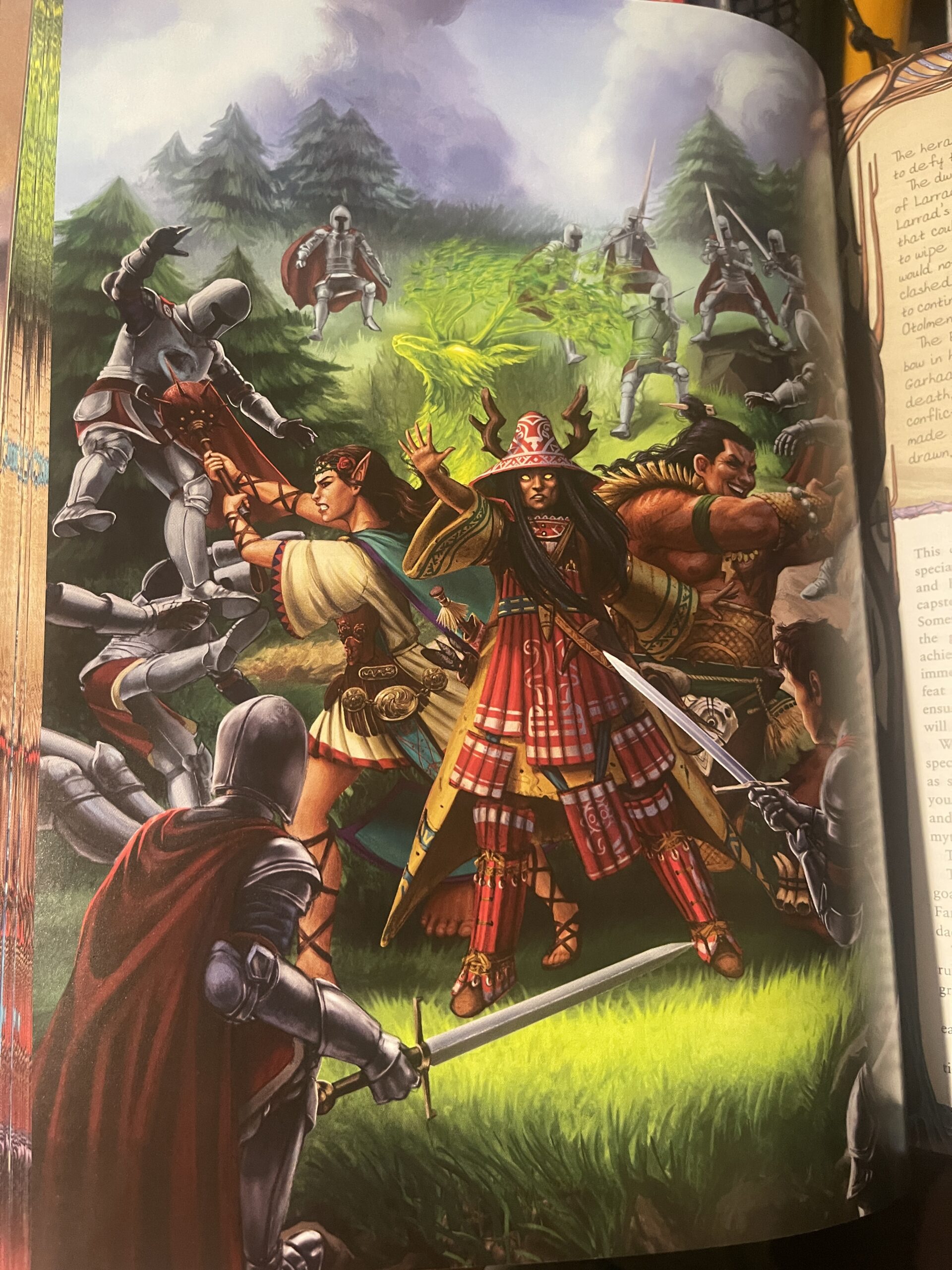
This is a must-have for Pathfinder 2nd edition players and Storytellers looking for a way to keep up with a rad, ever changing, living world. I think this book deserves to be on the shelves of those who love worldbuilding and crafting dynamic stories in the TTRPG space. It is brilliantly put together, beautifully illustrated, has a clean design, and it does what I have come to expect from Pathfinder: it blends narration and game mechanics in a meaningful way that makes the book both a useful tool at the table and fun to read.
Until next time, go check this out and let me know what you think in the comments.

