
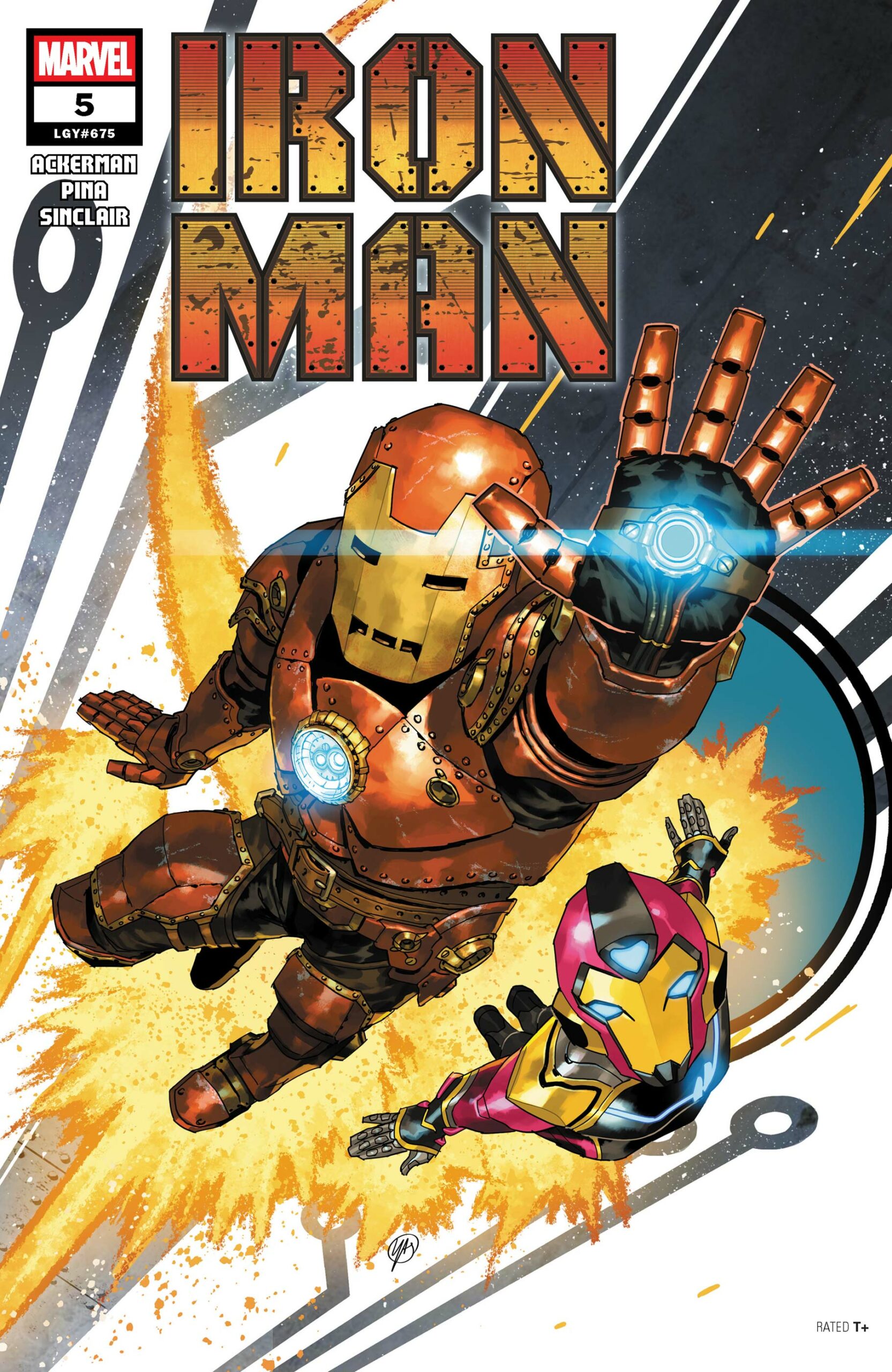
Fighting The Past With A Big Honking Sword — Reviewing ‘Iron Man’ #5
by Austin Gorton
Overview
On the surface, Iron Man #5 is more typical superhero fare, as Iron Man and Ironheart battle a robotic Lucia von Bardas and a purloined Stark Sentinel. But writer Spencer Ackerman uses the comic book action to setup a showdown between Iron Man’s past and future, while artists Javier Pina and Alex Sinclair elevate the action sequences with their work.
Overall
7/10After starting with a series of issues involving magic armor, demonic pacts, and big swords, Iron Man #5 is the most traditional Iron Man issue yet. The bulk of its pages is dedicated to Iron Man and Ironheart fighting a tech-based villain.
It doesn’t entirely abandon the book’s sci-fi/fantasy mashup vibes in favor of pure sci-fi (Iron Man is still wearing his anti-magic armor and wielding a big sword). But last issue’s guest star, Scarlet Witch, remains off-panel and the resolution is pretty firmly set in the world of traditional comic book action.
Yet writer Spencer Ackerman doesn’t abandon thematic development while backgrounding the fantasy stuff; instead, he constructs an issue in which Tony is basically fighting himself as a vehicle to chart a path forward.
Picking up where last issue left off, Iron Man #5 involves Tony and Riri going toe-to-toe with Lucia von Bardas, one-time Prime Minister of Latveria (Doctor Doom’s stomping grounds). While on the surface, much of this issue is a pretty standard superhero punch-’em-up — albeit one that is well-drawn by artist Javier Pina, with colorist Alex Sinclair doing standout work by giving assigning each of the main characters their own color palette — Ackerman builds the conflict around the idea of Tony fighting himself.
Everything in the issue-long fight reflects this: from its setting in and around an old office building of Tony’s father, to the use of Bardas — a more traditionally-political villain supported then tossed aside by S.H.I.E.L.D. — and her henchmen, former S.H.I.E.L.D. agents, to the fact that the armor she’s wearing is effectively supercharged by the repulsor blasts with which Iron Man and Ironheart hit her.
All throughout, Bardas underlines the metaphor by pointing out how often Tony has lost control of his technology and had it used against him.

This carries through all the way to the climax, when Bardas turns a Stark Sentinel against the heroes, the ultimate symbol of Stark tech being purloined and used against Tony. In the end, Tony’s new sword and some borrowed size-changing Pym Particles deployed by Riri prove the deciding factors, two pieces of technology separate from Tony’s past.
In doing so, Ackerman is smartly keeping the book tethered to the recent narrative past while laying the groundwork for new ways forward in the form of the newly-christened “Repulsword” and Tony’s mission to not only get Stark Industries out of the weapons business (again), but to reckon with it (and his own) often reckless past.

Thus, Iron Man #5 isn’t just a genre-required action-oriented issue, but one which underscores another tension driving this iteration of the series. We have fantasy and science-fiction, and now we have the tension between the past and the future of Tony’s company.
More importantly, this issue shows how these two tensions are connected, the way Tony’s new way of thinking and new tools at his disposal can undo the sins of his past while charting a course for the future.