
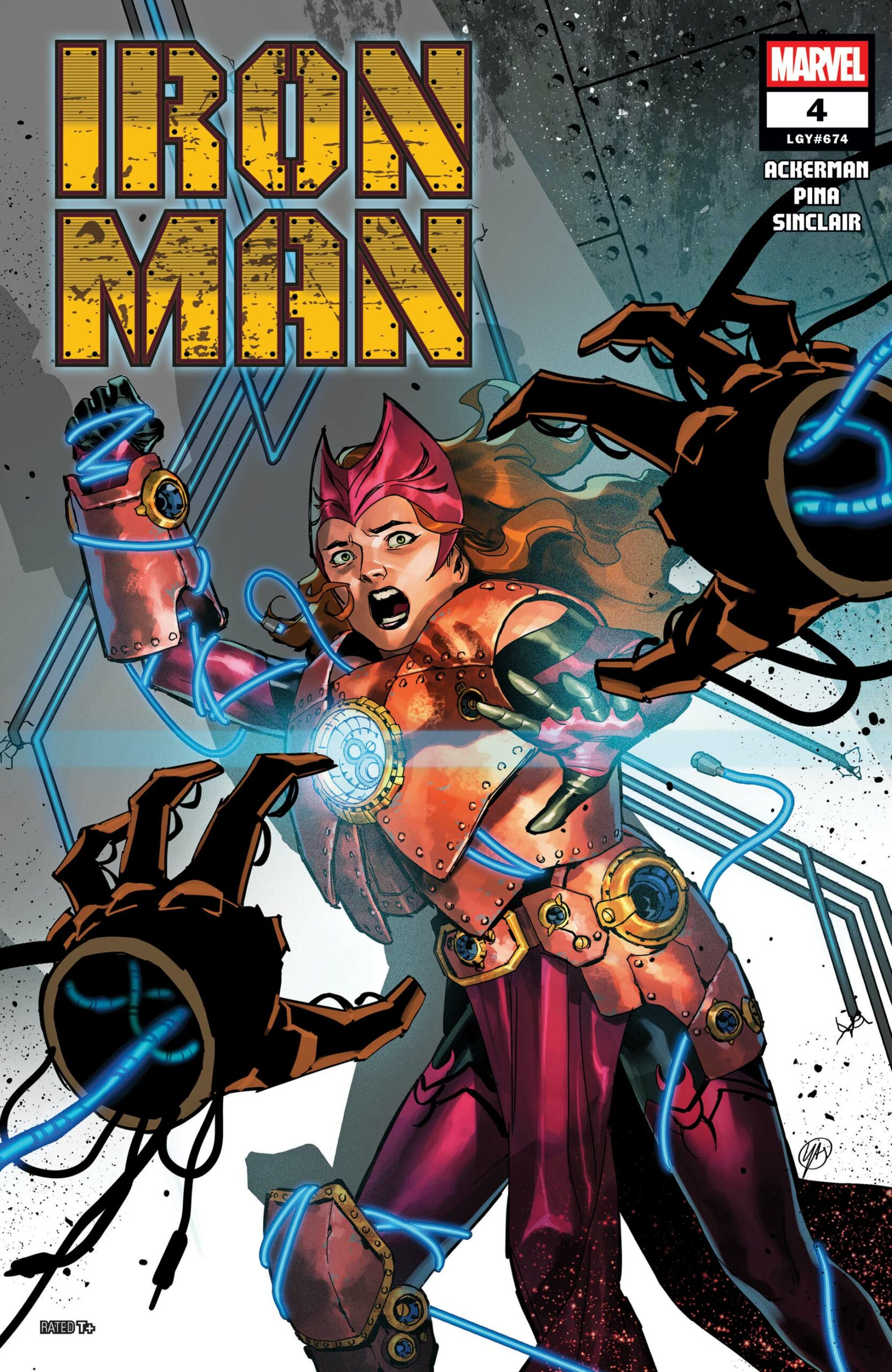
Review — ‘Iron Man’ #4 Successfully Mixes Sci-Fi And Fantasy
by Austin Gorton
Summary
Iron Man #4 succeeds by maintaining the series’ mix of fantasy and sci-fi, espoused by a pair of guest stars and double-page spreads, while the narrative pushes the character forward without severing all ties with the past.
Overall
7/10It may seem a bit obvious given that a Scarlet Witch guest appearance is touted right on the cover, but Iron Man #4 succeeds because it makes it clear that the series’ mashup of sci-fi and fantasy isn’t going anywhere. Even though the book’s first arc concluded with the Stark-Roxxon merger quashed and the execs’ deal with the devils upended, Tony Stark still has the demonic Iron Monger armor (given to him by Justine Hammer last issue) to contend with. It is the vehicle for the Scarlet Witch guest appearance, and a symbol of the book’s genre mashup, making it clear this is an area writer Spencer Ackerman intends to play in for a while, to the book’s benefit.

Yet, while Scarlet Witch gets the cover appearance, she’s not the only guest star. As a testament to the sci-fi/fantasy mashup of the Iron Monger armor, Tony has also called in Riri Williams — Ironheart — to help examine it. She and Scarlet Witch represent the two sides of the armor and the different genres it represents. When Tony’s attention is drawn into shenanigans stemming from his time as Director of S.H.I.E.L.D. and his father’s past work with his company, Ironheart accompanies him for a more traditional, sci-fi comic book action-adventure plot. Meanwhile, Scarlet Witch stays back to continue studying the Iron Monger armor following a bravura double-page spread from Rod Reis that is moody and gorgeous, triggered by Wanda’s examination of the magic tied to the armor.

Out in the real world, Tony and Riri get drawn into a plot involving Tony’s past. This provides Iron Man #4’s action quotient, as the pair are joined by Melinda May, former S.H.I.E.L.D. Agent 33 — who is effectively a supporting cast member at this point — to fight a group of former S.H.I.E.L.D. agents robbing one of Tony’s old facilities for equipment. While this sequence is a much more straightforward comic book action sequence compared to Wanda’s journey into magic, artist Javier Pina echoes Reis’ fantasy-oriented two page spread with a more action-themed one of his own, a cinematic sequence which uses panel borders to propel the action as the heroes move across a static background. Like the Iron Monger armor, the dueling two-page spreads showcase the book’s cross-genre commitments.

In the end, Tony, Melinda and Riri end up in an old facility of Tony’s father, where they come face-to-face with a Stark Sentinel. In concluding the issue this way, Ackerman underscores that this series doesn’t exist in a narrative vacuum. As much as he’s centering magic in Tony’s world more than usual, this is still a book with direct connections to the immediately-previous iteration of the series. The now-aborted Roxxon-Stark merger was born out of Feilong’s actions in that title, and here again, we have one of the Sentinels he helped create re-entering the narrative (under the control of another villain, one who is more tech-based and has a past with Ironheart). Between its guest stars and plot points, Iron Man #4 is defining the series as one in which fantasy will exist right alongside the usual sci-fi elements of Iron Man, and in which the narrative will be pushed forward without abandoning what’s come before.
