
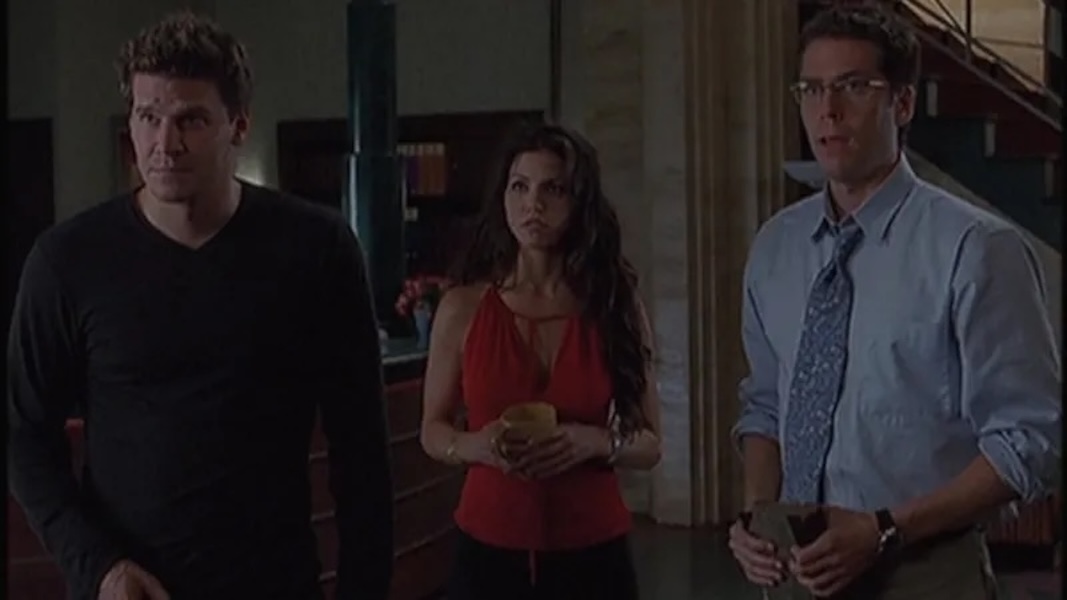
Characterization In The Buffyverse — ‘Angel’ Season 2, Episode 4
by Benjamin Hall
This is part of a bi-weekly series concerning the characterization of Buffyverse characters. The first installment in this series can be found here. Arguably the best place to begin reading this series is at the beginning, but that is up to each reader. As a reminder this column will cover major and some minor characters from the shows Buffy The Vampire Slayer (1997-2003) and Angel (1999-2004). Other Buffyverse media, such as the graphic novel Spike: Into The Light (2014) are not pertinent to this series. Also there will be no referencing real world events that have direct relation to either show in this bi-weekly series.

This week: Angel Investigations helps a woman with powers. Meanwhile, Darla (Julie Benz) continues her manipulations.
(Warning of spoilers from this point on!)
(Trigger warning for talk of non-consensual actions and abuse)
Bethany Chaulk (Daisy McCrackin and Madison Eginton) is a stereotypical Carrie White-type character (Carrie by author Stephen King [1974]) in that she gets powers from a lifetime of abuse. But unlike Carrie, she apparently does not go on a vast killing spree after dealing with her abuser.
Wesley Wyndham-Pryce (Alexis Denisof) demonstrates a lack of knowledge about non-demonic topics. This is interesting since one would assume that at least one demon species would exhibit telekinesis. Considering his own history (Season 1, Episode 14, “I’ve Got You Under My Skin”), it is rather odd that he does not immediately recognize in Bethany’s behavior any signs of past abuse. While he ultimately figures it out, it seems more because of Cordelia Chases’s (Charisma Carpenter) talk of “vibes” and his recent research than Bethany’s behavior. Although, to be fair, certain behavioral patterns in survivors of abuse do not always present the same and are not always obvious.
Cordelia is stereotypical in how she views the topic of gender and how it relates to sex. There is arguably nothing new or relevant to speak of regarding her characterization besides this particular aspect.
Charles Gunn (J. August Richards) officially becomes a part of Angel Investigations after agreeing to get a paycheck from them. Granted, this is more a reaction to something that Cordelia insists on Angel (David Boreanaz) doing than an action by Gunn.
Darla continues to magically manipulate Angel. She also acts with the same personality she has as a vampire despite giving off hints of being a regular human, such as when she hides in Angel’s room.
Man #1 (David J. Miller) and his buddy (actor unknown) are two rapists that Wolfram & Hart hire to attack Bethany. They really only exist to cause Cordelia’s vision, which introduces Angel to Bethany.
Landers (Drew Wicks) and the nameless Detective (Michael Harte) are two police officers investigating the deaths of the two guys Bethany kills. They don’t have a point to being in this episode other than filling out a part of a scene.
Lilah Morgan (Stephanie Romanov) comes off as being good at undercover manipulation. Yet, she also becomes a puppet of the plot, which demands she blow her assignment by rushing things.
Holland Manners (Sam Anderson) is both supportive and threatening during his one-on-one meetings with Lilah. Unfortunately, this type of interaction is nothing new for him (Season 1, Episode 21, “Blind Date”).
Mr. Chaulk (Gareth Williams) is Bethany’s sexually abusive father. He exists in this episode as part of Bethany’s history of abuse — and the possible end of it — along with being an aspect of the origin of her powers.
Angel (David Boreanaz) continues to prove he is a liar whether he has the soul curse on him or not. Also, he is still a manipulator no matter his persona. One can see this with how he uses Bethany’s feelings about her father in an attempt to save him. Yes, the manipulation is subtle, to the point of not seeming to exist, Nevertheless, by reminding her of her inner strength, he tries to have her act in a certain way. At the same time, this action makes him another puppet of the plot so the ending avoids a direct mimicking of Carrie. The resulting death is debatably justified. Meanwhile, the coffee drinking continues despite Angel previously telling Joyce Summers (Kristine Sutherland) about not indulging in caffeine (Buffy The Vampire Slayer Season 3, Episode 20, “The Prom”).
This episode is much like the last one (Season 2, Episode 3, “First Impressions”), in that there is no progression with the characters, and the plot — along with the characterization — is stock. That said, there is some thematic progression in making this season darker than the last one.
