
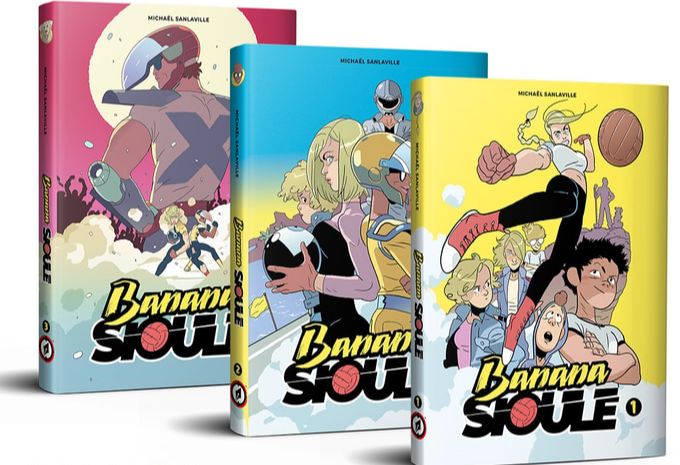
Lucky Luke, Airwolf, And Medieval French Rugby — Michaël Sanlaville Talks ‘Banana Sioule’
by Brendan M. Allen
Magnetic Press has launched a Kickstarter campaign for the adrenaline-fueled sports manga Banana Sioule. Created by Michaël Sanlaville, this high-stakes, high-impact saga blends the intensity of rugby and dodgeball into an action-packed story of ambition and survival.
Michaël was kind enough to answer a few questions for us regarding the series. Here’s a transcript of that interaction.
Brendan Allen: I have to ask about that title. Bananas don’t seem to play a huge role in the story. Why mention them in the title?
Michaël Sanlaville: In French, “avoir la banane” (to “have a banana”) means to display a beautiful smile — it is a little (bit of an) outdated expression today, but very fashionable in the 80s-90s. We found “banana” a little everywhere: the names of heroes (Banana Joe), Clubs/bars (Banana club, Banana café) etc etc… The first idea was to offer a sunny and positive story, hence this title.
Allen: And what about the “Sioule” part? How did you land on the name of this sport?
Sanlaville: “Sioule,” or “Soule,” or “Choule” is a medieval French sport, an ancestor of football and rugby, practiced between villages to relax the atmosphere and resolve conflicts through play. This discipline is found in different forms in the Basque country in Italy.

Allen: Your bio says you’ve been drawing dinosaurs and skulls from an early age. What were some of your early influences, and how do those affect your current work?
Sanlaville: I have been drawing since I was little. Like many children, I copied my parents’ comics. Mainly classic Franco-Belgian comics like Lucky Luke, Asterix, or satirical press cartoons, later Hara Kiri, and when the anime/manga wave arrived on our screens, first in the 80s-90s and in our bookstores (later), I frantically drew all these new heroes overflowing with power, energy and violence.
Very few American comics, without wanting to offend my future American readers, because there were very few around me. I only knew them through the first films that featured them, Batman in particular. Today, these references are part of me, and there is not one that I claim more than the other.
Allen: While animation and comics are vastly different mediums, your animation experience bleeds into your illustrations. There is a sense of movement in these static images. How do you find that balance?
Sanlaville: I first trained at the Emile Cohl school in Lyon to learn drawing and still images in general, but I also discovered 2D animation there. That’s why I continued my studies at the Gobelins school, to deepen and enrich my knowledge in this booming field in the 2000s.
Unfortunately, I didn’t finish my studies at this school, which also taught 3D animation, and I felt they gave 3D too much importance for my taste. I couldn’t bring myself to give up drawing to learn 3D on a computer for a whole year. I think that 2D animation is a very good school to enrich and nourish your drawing.
I worked for a few years at the Xilam studio in Paris before slowly returning to my first love: comics. At first, I worked on my books between animated productions, and then in 2012, I left the world of animation for good to devote myself to it fully.
What is certain is that I like movement, and when working with still images, they must be as dynamic as possible. I have no difficulty making them move, which is certainly the legacy of all those years spent animating. Concerning the placement of the camera, I obviously owe it to American cinema and the period of the “new Hollywood” in particular.

Allen: Banana Sioule is described as a “love letter for shônen-style manga.” There are also references to Airwolf, with Mr. Springfellow being named as a nod to Jan-Michael Vincent’s iconic 80s role Stringfellow Hawke. Do you want to share any other Easter eggs and references, or do you prefer for readers to find them on their own?
Sanlaville: Of course! Manga has influenced my drawing and my way of telling stories so much that it seemed logical to pay tribute to it without distorting myself either. That is to say, by not trying to reproduce the Japanese codes identically because I am not Japanese.
The same goes for the easter eggs, which are also a way of paying tribute to the TV series of the 80s. Airwolf, K-2000 (from Knight Rider), Fall Guy… There is Springfellow but also the director of the Sioule school is named “Arkenciel,” like “Archangel” played by Alex Cord in the Airwolf series. And the stranger’s helmet which is like the pilots’ helmets in Airwolf. And the helicopter that appears at the end of volume 3 (but without its cannons). Haha!
Soni is named after an old series from the 60s, Daktari, which rocked my childhood and nourished my reflection on the character. I wanted him to be as strong and as good as Helena to show that I didn’t stay locked in all these somewhat “old school” references where black characters didn’t have a good role. Soni is not the “big bad” of the story, contrary to what one might suspect along the way, and anything but a “sidekick” destined to die…
Allen: You worked with artist Bastien Vivès on Hollywood Jan and Lastman. You’ve also written and illustrated projects like Green Plague and two adaptations of San-Antonio novels into comics. Which process do you prefer, writing or drawing?
Sanlaville: When I wrote Green Plague, I realized that writing was as important as drawing. Unfortunately, it took me a while to realize it, and I had to read a lot to catch up. I read all the great French authors (the classics) in a few years, and I discovered treasures like San-Antonio, written by Frédéric Dard, who rocked my adolescence. A genius author, now forgotten and very little regarded by his peers. Indeed, Dard wrote dime-store novels: easy to read, violent, and sexy but doubled with a humanist and modern subtext. A real genius!
Writing fascinates me as much as drawing because one doesn’t work without the other! Like sound and pictures in cinema.
As for Bastien, I met him at the Gobelins School while studying. He’s a long-time friend who inspired and guided my work. I have a lot of respect for him, and I always work with him. I know who he is and who he isn’t!

Allen: Your collaboration with Bastien on Lastman saw twelve volumes in print, and was adapted into an animated series. Did that reception change your approach to new projects?
Sanlaville: Of course. I usually say that Lastman is my 3rd drawing school! Balak and Bastien taught me a lot, and I hope I taught them things, too. A perfect symbiosis between 3 friends, without any clashes for 7 years. Who could dream of a better collaboration?
In addition to the small financial comfort, the success of Lastman allowed me to work on much more personal projects like Banana Sioule, for example, which I approached in the same way but with the goal of saying something different and addressing a younger audience. Lastman didn’t change my way of working, I simply have a bigger toolbox!
I also found a precise balance between writing and drawing. Lastman allowed us to tell a lot of things with very few tools. As for the animated series, I can never thank Jérémie Perrin, Laurent Sarfati and all the people who worked on the animated series enough. They gave the Lastman universe a new dimension by stretching the story in such a beautiful way. A simple adaptation would have been much less interesting. We made our “Star Wars” on our very small scale.
Allen: What is your typical process when creating new illustrations for a project? Is there a noticeable difference when illustrating your own stories compared to working off someone else’s script?
Sanlaville: My method is always the same. Pragmatic and organized. I have seen so many friends, colleagues, and authors get lost in the writing and research phases when creating a book that I quickly understood that you have to know how to decide, choose, and move on so as not to waste time.
There will always be mistakes, bad choices and failures in the construction of a project, but when all this is assumed and understood, the next book will be richer, and the lessons will be carried by others. I am also someone with endurance. I work every day for 7 hours, no more, no less, like a cyclist who trains, never slower, never faster, and little by little I reach new heights.

Allen: I know some artists prefer physical media over digital, and vice versa. Do you prefer paper, pencils, and inks, or digital tools?
Sanlaville: I like both equally. I obviously work more on a digital tablet than on paper for economic reasons, but I recently drew an entire book in Indian ink and watercolor so as to never forget the basics.
And what a pleasure! Finding paper again after so many years on a digital tablet was not easy! Just like forgetting digital tools like the famous “ctrl z”! But I succeeded, and I experienced it as a real rebirth. Now that I have taken this step, I’m no longer afraid, and I’m even eager to draw a new book “by hand”.
Allen: To wrap things up, what happens after this volume? Are there more chapters in the world of Banana Sioule?
Sanlaville: Of course! The rest of Helena’s adventures are already written. This project is very personal, and the characters I staged are my childhood friends. Inevitably, there is a bit of me in Helena. That’s why I wrote much more than these 3 volumes, for fun.
Believe it or not, when I was younger, I played Sioule in the boy scouts. Maybe that’s why I like the “no rules” aspect so much and no limits universes that I often found in the cinema (with films like) Mad Max, Running Man, and Battle Royale, in manga (with stories like) Cobra and Gunmm, and even in video games (like) Destruction Derby.
If tomorrow I have the opportunity to develop the universe and continue to tell my characters’ stories, I’ll go for it head down!

The Kickstarter campaign for Banana Sioule ends March 28. Backer rewards kick in at the $12 level for a digital copy of book one. Physical copies clock in at the $20 level. Digital copies of all three books are available at the $30 tier, and physical copies of all three books are at the $60 tier. Various bundles, collector’s editions, boxed sets, and hardcovers are available at higher tiers. Check out the campaign at this link.
