
Talking ‘Past Time’ With Joe Harris And Russell Mark Olson
by Rachel Bellwoar
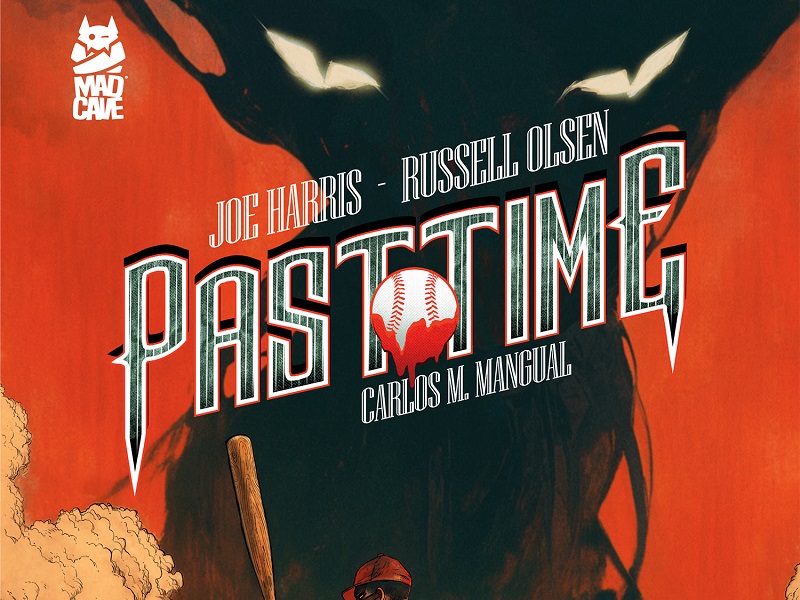
Vampires like to play sports, too. At least that’s the argument writer Joe Harris and artist Russell Mark Olson are making with their new series, Past Time. With letters by Carlos M. Mangual, here’s what the two creators had to say about vampires dipping their fangs into baseball:

Rachel Bellwoar: Baseball is known as “America’s favorite past time,” but are there any other meanings behind the title, Past Time?
Joe Harris: Well, sure. It’s a play on words. Aside from sounding like the affectionate moniker we’ve referred to baseball as for years, it conveys the idea that time is running out. And time, for Henry Hayes, is both interminable and in short supply all at once.
Russell Mark Olson: To piggyback on Joe, time is as much a character in this series as Henry or any of the bush league players who come into his orbit.
Bellwoar: Your enthusiasm for the sport really shines through in the press release, but where did the idea to mash-up baseball and vampires come from (the only parallel I can think of is Space Jam, which had basketball and aliens)?
Harris: I was reading some about the birth of baseball under the lights and the idea of playing without the sunshine struck me as the perfect inroads for vampires to make their presence known.
Bellwoar: Did you always want to tell this story across two timelines, 1920s Nebraska and ’80s Chicago?
Harris: Well, the 1920s are when lights first started popping up in the game. Specifically, they were a novelty exploited by semi-pro and mini-market teams to boost ticket sales, and those games tended to happen out in the sticks, away from the big cities and stadiums. As far as ‘80s Chicago, I chose that period to highlight the advent of lights at Wrigley Field. It was the last major league stadium to add lights, in 1988. But we’ll get to a few other timelines soon, vampires being mainly immortal of course.
Bellwoar: What are the challenges of bringing a baseball game to life on the page?
Harris: I wanted the baseball scenes to feel authentic while simultaneously driving character development, and the overall story, so there was a little bit of a balancing act. I would offer that you don’t need to like baseball to follow this story. But if you do like baseball, I’d like to think you haven’t seen a more authentic depiction of the game in comics before.
Olson: The biggest challenge art-wise has been the scale of the diamond and outfield. There are a lot of moving parts to any individual point in a game, so depicting it with limited page real estate has meant thinking hard about where to place the virtual camera to capture the action. We’ve done our best to make the ballgames authentic.

Bellwoar: Every vampire story plays by different rules. Sunlight and memory, or compulsion, seem to factor heavily into this one. Why did you want to explore those aspects of the mythology?
Harris: The trappings of vampires in fiction dovetailed nicely with the characters’ wants to succeed and climb the ladder toward the big leagues. They’re just wrapped up in themes of immortality, the loneliness involved, and having more of a window than an otherwise “mortal” player might have to try and reach the pinnacle and achieve their dreams.
Bellwoar: As a loophole around the sensitivity to sunshine, night games are becoming a thing in issue one but is it still weird to go against the vampire aesthetic of darkness and have them play under the bright stadium lights?
Harris: Nobody says vampires can’t come out when the electric lights are on.
Olson: I think the vampires in this book are always shrouded in a kind of shadow, even in the brightest light.
Bellwoar: While Henry’s backstory hasn’t been revealed yet, I’d love to learn more about the decision to have him wear a mask and whether that means he served during WWI?
Harris: He is a veteran of the Great War. In the aftermath of that brutal conflict, disabled veterans who suffered terrible disfigurements would often be fitted for face masks to conceal their injuries. But we’ll get into that soon enough!
Bellwoar: Thanks for agreeing to this interview, Joe and Russell!
Past Time #1 goes on sale April 2nd from Mad Cave Studios.
