
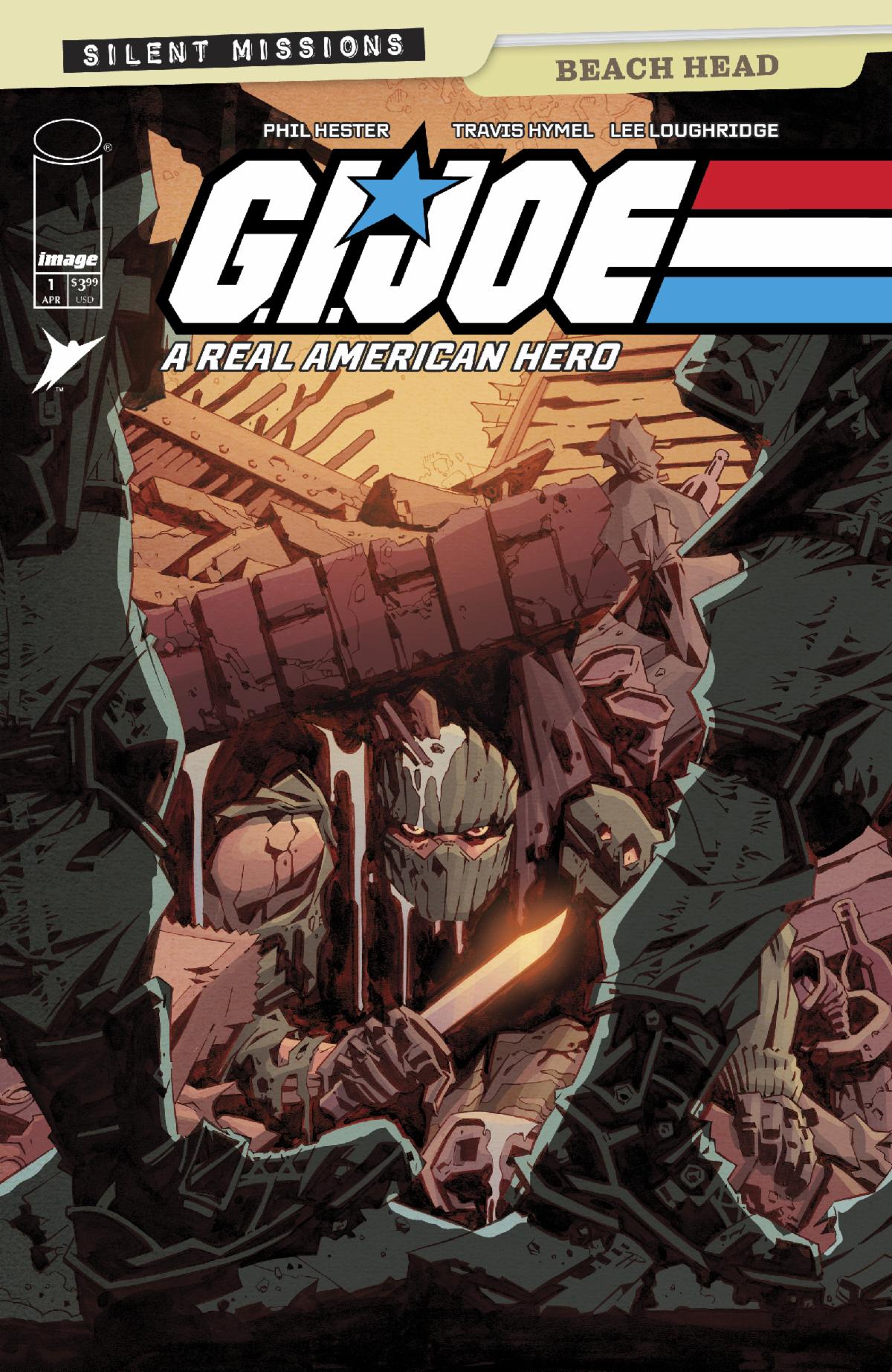
Going Silent — Talking ‘G.I. Joe: A Real American Hero – Silent Missions: Beach Head’ With Phil Hester
by Tony Thornley
In December of 1983, one of the most notable single issues of comics was published.

In G.I. Joe #21, writer/penciller Larry Hama and inker Steve Leialoha told a completely silent story. It featured commando/ninja Snake-Eyes rescuing his comrade and love interest Scarlett from Cobra, specifically the new ninja Storm Shadow. It was a game changer for the series, and for comics as a whole.
As an homage to that issue, Skybound Publishing is taking the month of April to feature a series of silent G.I. Joe issues featuring big name creators in G.I. Joe: A Real American Hero — Silent Missions. Each week, a different Joe takes center stage, facing off against overwhelming odds.
The special event kicks off with G.I. Joe: A Real American Hero — Silent Missions: Beach Head from comics superstar Phil Hester. The issue finds the Joes’ training instructor injured on his latest mission and captured by Cobra. After staging a daring escape, he finds himself in over his head.
We got to sit down with Hester and talk about everything that went into the story, from process down to character.

Tony Thornley: Hi Phil, thanks for sitting down with us to chat! So I’ll start with the obvious, what’s your history with G.I. Joe?
Phil Hester: Thanks for having me. Full disclosure: I am just a tad too old for ARAH era Joe. My G.I. Joe has a beard and Kung Fu Grip. I would say that demographically, I am an Eagle-Eye Joe/Atomic Man/Intruder G.I. Joe kid. All that said, I was becoming a pro at about the time the Marvel book really blew up, so I was aware of the property primarily as a comics fan and burgeoning professional.
Tony: How did this project come to you?
Phil: Via editor Alex Antone. He’s put together a pretty stellar line-up of non-traditional G.I. Joe artists for these Silent Mission specials and I was lucky to be included. I worked with Alex a good deal when he was at DC, and contributed to his Creepshow anthology when he slid over to Skybound, so this was a bit of a reunion gig.

Tony: Can you tell us a little bit about your story and how it kicks off this little event?
Phil: It takes place in a kind of DMZ/no man’s land in some vaguely Eastern European city at the epicenter of a conflict between G.I. Joe and Cobra. We start with Beach Head in the custody of Cobra, but executing an escape that leaves him wounded and helpless. He is taken in by a pair of war orphans who nurse him back to health, but not before a squad of Cobra Alley Vipers descend on their bombed out apartment building. What follows is a tense, brutal cat and mouse game between a weaponless Beach Head and the elite assault squad, all while Beach Head tries to shield the kids from harm.
Tony: As a lifelong G.I. Joe fan, I’m a little ashamed to say that Beach Head is a character I don’t know at all (so much so that I thought it was “Beachhead” until I did a google). What makes him the perfect character for a spotlight story like this?
Phil: Like many Joes, a lot of what makes Beach Head click is visual. To be frank, he looks cool. I also wanted to pay homage to the one man vs an army vibe of the original Hama/Leialoha silent issue. Beach Head’s role as an instructor of G.I. Joe recruits makes him perfectly suited to adapt to the most dire situations and still find a way to bring the fight to the enemy.

Tony: What makes a character like Beach Head — charging in first and taking charge of a situation- the right character for a story like this?
Phil: Well, it’s essentially a survival story. Beach Head is trapped and alone. Even the kids who help him become a complicating factor. He can’t just go berserk on the incoming Cobra troops; he has ro protect the kids, too. Also, since it’s a silent story, a lot of the characterization is either strictly visual and/or implied. His trademark mask becomes a strong visual motif for his shift in and out of teacher mode and lethal combatant mode.
Tony: Now obviously G.I. Joe #21 is a huge inspiration for this story. What else did you draw inspiration from in creating this story?
Phil: As I said earlier, I was on my way to becoming a comic book artist myself when #21 came out, so my admiration for that book isn’t necessarily as a G.I. Joe fan as much as as a comic book fan, specifically a fan of Larry’s and Steve’s, both giants. I was also heavily into artists that emphasize storytelling over showy visuals. Eisner, Miller, Krigstein, etc. Larry definitely falls into that category, as I hope I do. In fact, DC hired both Larry and I at around the same time a few years ago to coach up some of their current talent who didn’t have the time or inclination to think “story-first” the way Larry and I do. The challenge of telling a story without captions or dialogue was something I relished, not something that gave me pause. All my art heroes were creators who could tell a complex story with visuals alone. This issue is just me trying to join their ranks.

Tony: Besides Beach Head, you get to draw several Joes and Cobras. I really love that the Alley Vipers were such a big part of the story myself. What was your favorite to draw?
Phil: I have to say it was Beach Head. I love drawing battle-damaged heroes and poor old Beach Head gets pretty chewed up in this issue. The Alley Vipers were sort of a last minute addition. I was intending to use regular Cobra Troopers, but Alex knew this was an ideal place to trot out the Vipers. I’m glad he did. While they are more difficult to draw, their visual presence is undeniably arresting.
Tony: This is an action heavy issue (as it should be). Did you have a favorite sequence to draw, and what made it that?
Phil: I found it all a lot of fun, but I’m the most proud of the opening and closing sequences. The physicality of the hand-to-hand combat in the opening scene is very Milleresque to me (or as close as a scrub like me can get), and the final scene has some satisfying symbolism that I feel was earned in the course of the story.
Tony: Some of these action sequences have a very distinct modern action movie vibe (a la John Wick). Do you feel there’s a soundtrack or playlist that would enhance the reading experience here?
Phil: Haha! Well, I’m in danger of dating myself badly with this answer, but Reznor & Finch are always welcome.

Tony: Besides not having a lettering pass, what was your process like in creating this story?
Phil: I think the bulk of the work was done in the thumbnail stage. Since it’s without dialogue, I had to make sure the storytelling was cogent, clear, dense, but still stylish and satisfying. You want readers to linger in some places and be propelled in others, so I spent a lot of time working out just how the reader’s eye would flow across the images. One of the benefits of a dialogue-free comic story is that your compositions are not competing with balloon placements. As I said earlier, I spend a lot of time manipulating the eye flow of the reader whether it’s a silent story or not. Sometimes I can craft a striking composition that drives the reader’s eye exactly where I want it to go, only to find a big old white balloon floating right in the middle, demanding the reader’s attention and disrupting the flow. No such compromise here!
Tony: The creative team is rounded out with Travis Hymel and Lee Loughridge. What did you feel they each brought to the story?
Phil: I haven’t worked with either very much, but they both “got” the feel of the story right off the bat. Travis’s own drawing style is very minimalist and high contrast, so we’re on the same page aesthetically. He did a great job of not only being faithful to the pencils, but making sure the ruined cityscape had the requisite layer of grit and grime. Lee is a master, capable of the brightest super-hero smash up in the morning, then the grimmest noirish war story in the afternoon. No need to ever give Lee notes. He bats 1.000.

Tony: Changing subjects to wrap up — what are you listening to, watching or reading right now?
Phil: I’ll play it safe and say all my friends’ comics! On the “real book” side, I just finished Annie Jacobsen’s Nuclear War: A Scenario and Emily St. John Mandel’s Sea of Tranquility, both very engaging for very different reasons. I’m really enjoying Wet Leg’s debut and the new Kim Deal record. I’m in my late 50s, but still find myself lingering on college radio for the most part.
Tony: Is there anything else you’d like to add, plug or just throw into the universe?
Phil: I can be found on most social media as @philhester. Massive, ox-killing omnibuses of my runs on Swamp Thing and Green Arrow were just released if you’ve paid off your student loans and suddenly find yourself awash in cash. Keep your eyes peeled in ’25-’26 for some gigs that I both write and draw, or some combination thereof, from Dark Horse, IDW, and Ignition Press.
