
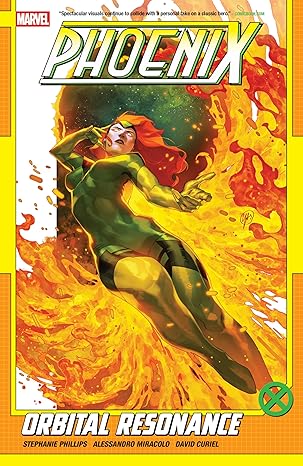
Intriguing New Status Quo, Mixed Execution — Reviewing ‘Phoenix: Orbital Resonance’
by Austin Gorton
Overview
Collecting the first five issues of the Jean Grey solo series, Phoenix: Orbital Resonance is a mixed bag. It is a showcase for both some curious decisions that find its title character overly-reactive while borrowing another hero’s Rogues Gallery as well as the promise and potential in a premise that finds Jean operating on a whole new level, with art to compliment the grandeur of its ambitions.
Overall
5/10Wolverine, and occasionally Cable, aside, the X-Men don’t have a great history of supporting solo series for their members. Many have been attempted throughout the years, from Cyclops to Jean Grey to Nightcrawler, Rogue, Gambit, and more. None had significant staying power or cultivated strong followings.
The post-Krakoa “From the Ashes” publishing initiative is seemingly steering into this skid with the release of a bunch of solo series, starting with Phoenix, starring an “in sync with the Phoenix Force” Jean Grey. More than just a solo series starring one of the original X-Men, however, Phoenix is also a cosmic title, a spiritual successor of sorts to Al Ewing’s SWORD and X-Men Red series during the Krakoa Era.
As a result, it takes place far away from Earth, as the title character attempts to use her massive cosmic power to make the galaxy a better place for all life. It’s an intriguing and expansive new direction for the character, albeit one let down somewhere in these first five issues by some mixed execution.

Running parallel to the actions of Jean Grey throughout Phoenix: Orbital Resonance is the adventures of Adani, a new character, whose father is killed by the Dark God Perrikus (who escapes from his prison in the first issue collected in this volume). Perrikus proceeds to make Adani a pupil of sorts, and she serves as a parallel protagonist to Jean throughout the book, often narrating entire issues from her perspective. It’s a curious decision by writer Stephanie Phillips to so quickly put the title character into a timeshare in her own series.
More concerning is the fact that Jean remains remarkably reactive throughout much of the book. Depicting characters taking consistent aggressive action is always tricky, as it’s simply easier to start off a story with “someone calls for help, the hero responds” and much more difficult to come up with ways to work dramatic conflict into a story if the hero is constantly ending threats before they start.

But if the purpose of this series is to put Jean on a larger stage where she can use her cosmic abilities to take big actions, she’s spends entirely too much time simply sitting back and waiting for someone to inform her of a situation that needs her attention.
Obviously, even as Phoenix, she’s not omniscient, but it’s a troubling pattern for the future of a series with the goal of pushing Phoenix to the forefront when she’s constantly relying on other people to present her with situations where she can help. For all the sweeping cosmic vistas of her using her power throughout the book, she often feels like the most passive character in it.
Similarly, the art from artist Alessandro Miracolo is a bit of a mixed bag. At times, he turns in some wonderful pages, rendering Phoenix in full cosmic glory, filled with the glorious oranges and yellows of the Phoenix fire effect, that captures the intended epic scope. A two page spread in issue #1, in which Jean fights to prevent the collapse of the black hole, is an effective synthesis of words and art as she literally and metaphorically dances across the page.
At the same time, Miracolo quickly came under fire after the release of issue #1, when people on social media started pointing out just how flagrantly the artist was seemingly tracing art from other creators. While swiping is not an entirely uncommon practice in comic book art (and was, once upon a time, celebrated by editors and publishers as a way to maintain a certain house style or mimic a popular artists style), the volume of it present in the first issue of such a high profile series was concerning, and it’s clear he continued the practice in subsequent issues.

There’s also some concern that most of the antagonists in Phoenix: Orbital Resonance are culled from Thor’s Rogues Gallery: Gorr the God Butcher, Thanos’ Black Order, even Perrikus himself, the arch-foe of the book, is from a series of late 1990s Thor stories. It creates the impression that Jean is simply borrowing the trappings of another character to vault herself onto a larger stage.
Yet the book ends on a promising note in that regard, with the ruling Galactic Council, led by Gladiator, starts to take note of Phoenix’ actions and moves to curb her power, in a move that threatens to upend the galactic order of the Marvel Universe in some significant ways. It’s the kind of development that meets the promise of the series, one which presents Jean with a significant antagonist commensurate with her power, put into play due to factors tied to her personal history. The launch of the first new solo series of “From the Ashes” in Phoenix: Orbital Resonance is occasionally rocky, but the potential for it to blossom into something great is there.

