
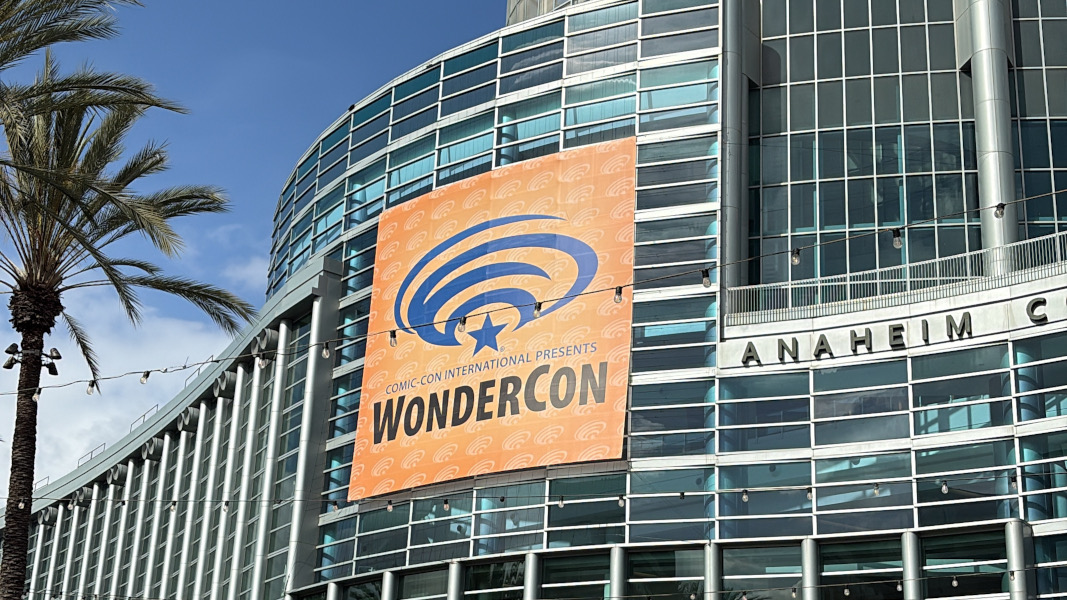
WonderCon 2025: Todd McFarlane Talks Diamond, Toys, And More
by Erik Amaya

WonderCon, although a Southern Californian hotspot for cosplay, is still a show about comics, toys, games, and more. And perhaps no one exemplifies that sense of variety more than Todd McFarlane. A frequent presence at the convention in years past, he enjoyed special guest status at the 2025 show over the weekend and Comicon.com had the chance to sit down with him for a chat. And with last week’s Diamond Comics Distributors bankruptcy auction still fresh in our minds, we had to ask him his thoughts on the matter.
Per the Internet scuttle, McFarlane was said to be interested in buying at least part of Diamond. He confirmed for us that he and his business partners “did have our nose in there looking at it.” But he stressed they were looking at a very specific part of the operation.
“There were, I believe, close to 20 different businesses — assets, if you will — that were available for varying prices depending on what you wanted to bid. So you could buy stuff a la carte.” Ultimately, things shook out very different when Alliance swooped in to buy nearly all of Diamond. But even before that company emerged as the ultimate suitor, another issue arose that gave McFarlane pause. “It can get a little complicated [when] you’re trying to get information and you’re trying to go, ‘well, how do we make a bid if we don’t have the proper information?'”
That desired info was the volume of comics Diamond was shipping as its financial situation started to look dire. “The thing about Diamond is that you need volume to make that work,” he explained. “And part of the issue, I think, looking at it, is that they built a really great machine and then Marvel left, and then DC left, and then, ultimately, Image left. [It] might’ve been the nail in the coffin. And so you have a system built that is big and expansive and maybe even expensive, and you don’t have the volume to justify the scope of your setup.” Image Comics’ departure from Diamond would’ve also created difficulties had McFarlane been able to buy the comics distribution component. The publisher’s current distribution deals would prevent it from offering books via Diamond for at least two years. “You can’t just sit on a business with a burn rate for two or three years, and then you’d have to then convince maybe DC to come back to make it really sort of work,” he said.
The auction saw Alliance taking the lion’s share of Diamond — although certain specific aspects like Free Comic Book Day still seem up in the air — and McFarlane hopes the new owner, once it takes possession of Diamond, will help nurture the network of retailers in Diamond’s system as they will ultimately prove to be unique storefronts for Alliance’s other businesses to utilize. Although, he was quick to add, “I don’t know. It’s their businesses now.”
Nevertheless, Diamond’s troubles since the pandemic lockdowns opened the way for distributors like Lunar and Penguin Random House to get a foothold into the business, recreating some of the early 1990s market conditions when Diamond jockeyed against Capital City and a few other distributors for dominance in comic shops. “There were between three, maybe five, if you count the smaller ones that were distributing comic books. The problem was that it eventually all collapsed and then being just Diamond,” McFarlane recalled. Then, as now, the issue then was volume. “The pie was getting cut up way too many times, and so it wasn’t going to work,” he said. “And so there had to be some consolidation, otherwise the industry and the distribution machine was going to fall apart.” Last time it was Diamond who emerged as the specialty market distributor.

“And so could you argue you have a pendulum that swings to the left until you hit some kind of critical mass, and then it usually starts to come back and it swings to the right until you get hit critical mass and it just keeps swinging back and forth,” McFarlane continued. “I would argue now that I’ve been in business for close to 40 years, that neither extreme is where the pendulum should be. It should be in the middle, but the pendulum never stops in the sweet spot [for long]. I don’t care what business it is, it always just keeps going until it finds out that it basically engorged itself one direction or the other, and then they correct, and then they overcorrect.”
Despite the current upheaval and its resemblance to the ’90s, one thing is different this time around: access to comic books as stories and as premium collectables has reached a sort of parity. Back then, speculation meant you might have a hard time finding a copy of Spawn #10 at cover price. Now, options are available for those who just want to read the story and those who want a limited edition collectible product. McFarlane said this was never a grand plan of his or the companies at large, but a necessary evolution as both the artform and the business matured.
“When I suggested we should do two covers for Amazing Spider-Man #300, it was sort of roundly dismissed and laughed at. ‘Nobody would ever buy two covers for the same book!'” he laughed. McFarlane remembered that discussion with Marvel taking place in the late ’80s. Just a few years later, the company was doing gangbuster sales with variant covers — a term that came into existence at the time — of X-Men #1 and subsequent covers with gimmick like holographic images, foil stamping, and more. “It went from one extreme to the other in terms of the speculative marketplace in the early ’90s.” he recalled.
He also noted that while Spawn was also caught up in that boom, it did so publishing only one cover a month. “In hindsight — I just thought of it — I go, ‘yeah, what would’ve happened if I’d done two covers?'” he joked.
Now, though, access to comics is easier for the reader and the collector alike. “Whatever gives you personal interest and joy, do it, right?” McFarlane said. That joy could include “buying something for 10 bucks and flipping it on eBay for 20”, building “my collection that’s in my closet,” or simply reading the comics (or playing with the toy) and leaving the collectiblility factor to those who get their kicks from it.
Of course, McFarlane comes to that understanding via a unique perspective. He became a toy manufacturer in 1994 and has weathered shake-ups in both industries. In the mid-to-late ’90s, according to him, “the number one age category of people who bought action figures were between ages of six and eight — kids basically. And the mom’s buying it for the kids and for birthdays and whatever else.” The number two slot was branded merchandise for preschool-aged children with the group in the third slot being collectors over the age of 14. Nowadays, the collector dominates the retail charts even if retailers are still in the process of learning how to position toys to that segment when it spent generations understanding that toys were for kids. “They’re kind of catching up to the reality that’s out there,” McFarlane said.
Whether it is a toy or a comic book, the core of things is still putting out as high quality a product as possible at an agreeable price point. Curiously, he said he avoids Internet feedback until a particular toy or comic underperforms. “But that’s when you’re doing an autopsy,” he said.

One of the other guiding principles: finding the right thing for the right audience. When doing licensed toys, like the Teenage Mutant Ninja Turtles, it is also about finding the right niche within what the licensor has available. “We initially came at that with the Turtles going, ‘Hey, how do we do some Turtles and do it a little bit different?’ And the answer was, ‘well, we’ll do ’em based on the comic book imagery as our inspiration, not necessarily any of the cartoons or the movie stuff.’ The line takes its inspiration from the IDW series, with the four main character even more individualized than in other interpretations. “Depending on who the rights holders are, it varies on what you can and can’t do. So you find your crack wherever you can get it,” McFarlane said.
That also informs the choices for figures in the Todd’s MODs range. “Yes, you’re going to have to eventually get the core characters that everybody likes and that are a little bit easier to sell. So Superman, Batman, whatever, and your iterations of those costumes — there’s been different ones — but again, you’re going to have to get to your Flash and your Green Lanterns and Wonder Womans and all that other stuff.”
“One of the early ones we did was with Killer Croc. So why? Because he’s got a big body that seems like you can sort of do Tasmanian Devil with him,” he continued. That ability to distort the design also becomes a factor in choosing which characters get the Todd’s MODs treatment.
Then, of course, there is always the cool factor. It exists for Spawn, licensed figures from DC or TMNT, gaming designs from Warhammer or Dungeons & Dragons, and the search for the next big thing. But the longevity of story also counts for something. “If you can then also put a backstory or a character that people care about — whether it’s because of the story and or the visual or a combination thereof on top of it — and it’s cool? Shoot, that’s a big combo! It’s hard to fail with a winning combo like that.”
Winning combos continue to fuel McFarlane in his various business and, as seen at WonderCon last weekend, it continues to make him a staple of the comics and collectibles industries.
