
Previously On X-Men: ‘Wolverine’ hits #400, Cable Makes Paradoxes And Sinister Rocks Out
by Austin Gorton
In this week’s X-books, the Adamantine story wraps in Wolverine #8, Cable does his time-travel thing in Cable: Love and Chrome #4, Mister Sinister monologues in Exceptional X-Men #8, and X-Factor #9 is…actually a decent issue of the series!
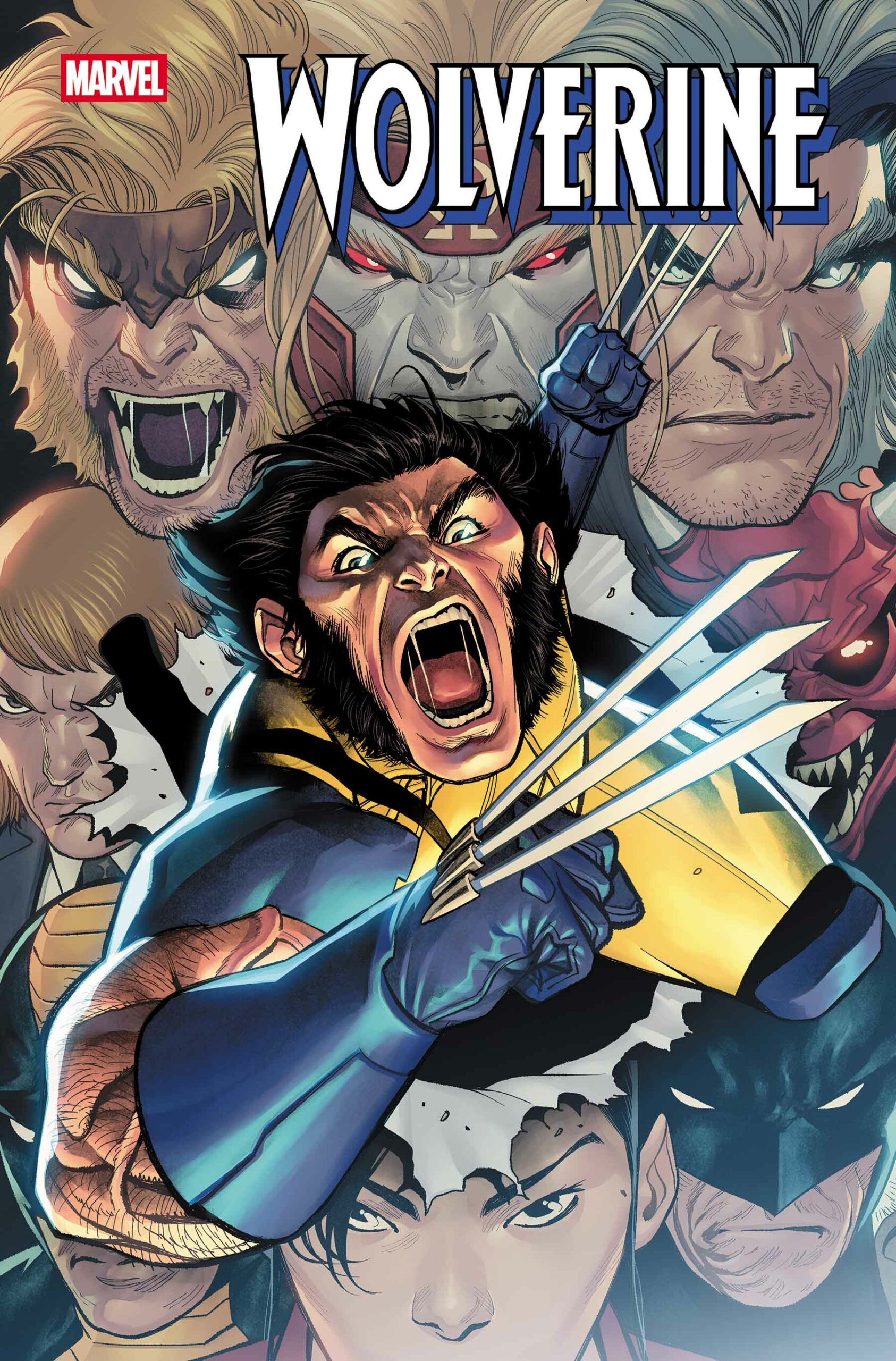
Wolverine #8 by Saladin Ahmed & Martín Cóccolo

The first act of the Adamantine story concludes, and the next story arc begins, as Wolverine celebrates reaching 400 (ongoing) issues. Also featuring a standalone story by Daniel Warren Johnson.
- The math on the four hundred issues excludes the original Chris Claremont/Frank Miller miniseries (since we’re getting issues of the ongoing series that launched after that one). It also ignores all the various spinoff books, like Savage Wolverine or Wolverine: Origins (something to which an editorial comment admits).
- To celebrate, this is an extra-large issue, though the only true “bonus” is the Daniel Warren Johnson story, and a three page collection of thumbnail images of all four hundred covers (similar to what appeared in X-Factor‘s recent 300th issue). The other two stories in the issue conclude the Adamantine arc (for now) and turn Kid Wendigo back to normal before setting up the next arc of the book. Both are part of the regular creative team, so they just read like regular issues of the series.
- The threat of Romulus is ended rather perfunctorily, with Wolverine ramming his claws down his throat (the art makes a point of highlighting how his mouth/innards are exposed even while the rest of him is covered in the Adamantine’s gold armor, but it still feels like an easy win over a character who has proven difficult to best in the past; it’s not like “stab him in the mouth” requires a huge intellectual leap or sense of strategy unique to this fight.
- The Adamantine itself though lives to fight another day, impressed by Wolverine’s whole schtick (being a weapon/animal that uses his rage/killer instincts for heroic goals) and deciding to explore the modern world more before making its next move. This is a much more satisfying conclusion, the kind of “you win…for now!” ending that is superhero comics bread-and-butter.
- The art seems to imply that the Adamantine leaves the injured/dead Romulus behind, but Wolverine later says it took Romulus along to wherever it’s going.
- The second story — which is really just an extension of the first — involves Arcade attacking Wolverine and trying to turn Kid Wendigo feral again. In the end, Kid Wendigo resists his darker urges, saves Wolverine, and gets killed by acid in the process, only to return as Leonard, freed of the Wendigo curse. Wolverine attributes this to the actions of the Northern Gods which, sure, why not?
- It’s unclear why Arcade, a contract killer, is targeting Wolverine and Wendigo, and where he got all the information on Wolverine’s past (including details of the Weapon X project that gave him his adamantium skeleton, the death of Silver Fox, and his feelings for Jean Grey and Cyclops) that he uses to torment him.
- Wolverine does note that Arcade’s data is out of date, as he considers Jean just a friend and settled his beef with Cyclops long ago. While the latter is certainly true, the former sure seems like throuple erasure.
- Leonard is reunited with his mom (and, seemingly, written out of the book), which in the end seems like little more than a ham-fisted attempt to get Wolverine thinking about his mother, just in time for her to mysteriously return, in letter form, at the end of the story.
- Wolverine says his mother Elizabeth rejected him shortly after his mutation manifested. This is broadly true, as seen in Origin #2-3, though there was a lot happening in the moment and her reaction to those events probably wasn’t driven entirely by Wolverine (though it’s understandable that 12-year-old James Howlett would read it that way).
- In the mysterious letter the mysteriously alive Elizabeth mysteriously leaves at Wolverine’s mysterious motel, she refers to him as “James” vs. Logan, and comments on his usage of the name Logan (which was the family name of the groundskeeper who killed Elizabeth’s husband and was strongly implied to be Wolverine’s biological father in Origin.
- The closing ten page story by Daniel Warren Johnson is a great little art piece, the kind of thing we used to get as the second or third feature in an annual but with much stronger art, featuring a feudal Japan-era Wolverine gaining vengeance for a slain village, but can never find peace because he’s unable to lay down his weapons (his claws) after the deed is done.

- At this point, it still seems like every issue of this series is occurring before the first From the Ashes issues of X-Men and Uncanny X-Men.
Despite taking an issue (or two) too long to get there, the conclusion to the Adamantine story somehow still feels rushed, and the decision to revert Kid Wendigo — often one of the best things about this iteration of series thus far — back to normal just to awkwardly setup the return of Elizabeth Howlett is disappointing. But in the grand scheme of “characters from Wolverine’s past return to wreak havoc in the present”, bringing back his mother is at least a relatively deep cut with some intriguing potential.
Cable: Love and Chrome #4 by David Pepose and Mike Henderson

Cable uses time-travel to try to prevent the death of Avery Ryder.
- Artist Mike Henderson continues to deploy the nine panel layout judiciously but effectively, using it slow down the action or create repetition, before resorting to broader, larger panels for bigger action.

- David Pepose, meanwhile, believeably renders Cable’s growing desperation throughout the issue, as he jumps through time with increasing frequency and in increasing intervals, with decreasing concern for the consequences, until the consequences slap him right in the face.
- The final twist, that Cicada, the villain that led Cable to Salvation Bay and his encounter with Avery in the first place, is actually Avery, created by Cable’s efforts to save her in “the future” is exactly the kind of plot point that time travel stories thrive on.
Timey-wimey shenanigans in which Cable keeps jumping through time trying to change the future only to inadvertently create the villain of the series is the kind of thing I wish this book had gotten to faster, but I’m glad it’s here now.
Exceptional X-Men #8 by Eve L. Ewing and Carmen Carnero

To cover for the captive Axo, Mister Sinister sends an Axo clone out into the world, whom Bronze, to her credit, almost immediately clocks as an imposter.
- Dazzler’s music make repeated appearances throughout Exceptional X-Men #8: Clone Axo compliments one he overhears (a major clue for Bronze, who knows Axo hates Dazzler’s music), Kate is singing a Dazzler song in the shower, and even Sinister sings a couple lines. The lyrics shown are all from “In the Darkest Light”, the lyrics of which appeared in Dazzler #3.
- Ewing continues to underscore Kate’s obsessions with “normalcy”, with her sort-of girlfriend Nina pointing out how often Kate uses that adjective as a compliment in reference to her.
- Bronze and Melee trying to contact Emma by thinking about her really hard is a great moment.
- Mister Sinister references the adult onset mutants from the 3K story over in X-Men.
- The Axo Clone is a terrible bit of work from Sinister — it isn’t very good at impersonating Axo, doesn’t have his powers (which subconsciously affect his appearance, making their absence quite noticeable to Bronze) and seems to fall apart into goo after roughly a day. Unclear if Sinister is off his game, or didn’t think he needed to put much effort into the clone for whatever reason (though he seems surprised when he’s alerted to the clone’s demise).
- Sinister has also identified each Krakoan resurrection left minute remnants of genetic material (presumably this means that there’s genetic material from the previous body in the new one, or something like that). Why he thinks this is important gets interrupted by the Axo Clone alert and the end of the issue.
- I don’t care if you ask if it’s okay: talking on the phone while using a hair dryer to dry your hair is rude and would render all conversation unintelligible.

Even for this book, which is hardly briskly-paced, this is a majorly decompressed issue in which very little actually happens (the first seven pages are just Sinister monologuing to the captive Axo). But the art is still top-notch, and Drama Queen Sinister remains a delight.
X-Factor #9 by Mark Russell and Bob Quinn

Havok and Frenzy are recruited by a black-ops mission, with the rest of the actual X-Factor team running a decoy mission.
- It’s unclear why this issue doesn’t get a “One World Under Doom” tie-in banner; it’s just as much, if not more, connected to the events of that crossover as issue #7, and picks up on the Doom-related plots from that issue directly.
- Havok’s off-the-book mission involves him stealing back the mind-control AI program from the Chechnyan mutants Black Wolf who stole it from X-Factor in issue #7.
- Ironically, this is probably Havok’s best mission, success-wise, in the book; he succeeds in the objective, captures Black Wolf (which wasn’t required but isn’t really a bad thing), and the only complicating factors (the presence of Xyber, Cecilia Reyes, and Granny Smite) that prevent the mission from being a clear win are outside his control.
- In the end though, it turns out Havok’s mission was just cover for the real X-Factor to attack Polaris while Havok is distracted.
- It’s not clear WHY Angel would be so gung-ho about hunting down Polaris (he says it’s his job, but that doesn’t really cut it), though there’s some implication that his Archangel persona is influencing thinks.
- He points out that his metallic Archangel wings are non-ferrous, which is funny just because in the Marvel Universe, all metal usually seems to be magnetic/able to affected by Magneto/Polaris’ powers.
- Ordo, the Black Wolf member with missiles for hands, just wanting normal hands, and Havok wondering where Frenzy found three-handed handcuffs for the three-armed Trident, are legitimately funny beats.

With the end of the series looming, this might be the best issue of the book yet. Havok’s mission isn’t a clear victory but it’s not because he and his team are doofuses, both Xyber and Granny Smite feel like actual characters for the first time, and both the humor and satire are present, but appropriately-moderated.
For more X-related criticism, check out Scott Redmond’s review of Ultimate Wolverine #4, also out this week!
