
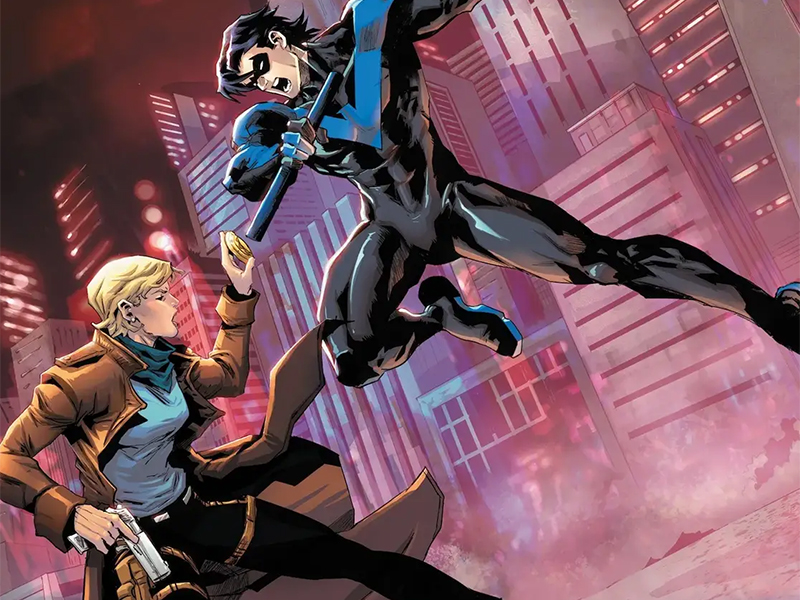
Bad Apples In A Rotten Orchard — Reviewing ‘Nightwing’ #125
by Scott Redmond
Overview
This dual issue interlude arc offers a powerful and far too poignant message. Francavilla’s artwork is always next level, finding all the right ways to flirt with the correct line which this issue stands upon.
Overall
9.5/10Police-centered stories are tough things in fiction. Real world feelings often color how we feel about them fictionally too. There’s a fine line, where too much is ‘copaganda,’ and too little feels inaccurately hollow.

Unsurprisingly, Nightwing #125 finds a way to thread that needle with seeming ease, presenting a story which showcases the stark realities around the police, the complications, and the danger of secrets and codes.
Nothing less was expected from regular series creators Dan Watters and Wes Abbott, who are joined by Francesco Francavilla for this two-part arc.
**SPOILERS FOLLOW**
**Trigger Warning: Discussions of Abuse**

Since the start of this run, the issue with police has been at the forefront. Spheric Solutions has been piling up high-tech weaponry at the police’s feet, while stirring up crime and violence. This leads up to a gang war where the gangs are mostly being decimated by war-ready police.
Maggie Sawyer, now the commissioner in Blüdhaven, has been a voice in the middle, much like Mayor Melinda Grayson-Lin, the sister of Dick Grayson, aka Nightwing.
Watters has navigated the complexity this whole way, taking it up a few notches for this particular arc. Murder mystery meets street noir meets microscope investigation of the systems of power.
The arc is called “By the Book” with the first issue titled “Good Cop/Bad Cop.”This speaks directly about how thin the line really is between the concept of good and bad with the police. The officer murdered in this issue is described as ‘by the book’ every time someone speaks about him. Even his wife says this, but with a whole different context.

This cop, who follows the rules, follows them even for horrible things. Using knowledge of the laws to work through abuse of his family. He never leaves any physical marks but causes damage all the same. All of it is just enough to wiggle around the rules those he and his ilk are charged with enforcing. He seeks cruelty for the sake of cruelty because it’s permissible cruelty.
He’s seen as a “good one” by his fellow cops but as the true terrible person that he is by his family. This situation is far too common in the real world where spousal and family abuse by cops runs far too high.
Dialogue needs to hit in a certain way for this story to have the gravity that it does. Abbott always knows how to bring the most out of any of the lettering within an issue. Here, the majority of the dialogue is presented very evenly, with a baseline approach, employing similar bubbles, fonts, and other elements for most of the characters.

It’s the mysterious Captain Hallow who has something different; darker, heavier, and altered for great effect. This evokes the feeling of something unnatural or beyond our scope of knowing, helping the story keep its feet in the two worlds that it’s inhabiting. Even with that overall approach, the emotional power to every word on the page is never lost.
Instead, they ring truer than ever the deeper we travel through the narrative.
Having a supernatural element in play doesn’t take anything away from the crux of this issue. This puts the police on the proverbial hot seat in a way, poking at the idea of the façade and the reality that society has built over the years.
Tapping Francavilla for this arc was inspired. Things that are spooky and heavy fall right into his artistic wheelhouse. This builds up the suspense with each panel, giving the spaces really deep and dense aesthetics, contributing an inherent roughness which befits the very core of this particular story. While playfully sprinkling in bits of whimsical fantasy stylings to remind us that these stories are realistic but also beyond our world.

Walking the fine line between reality and fantasy is anchored by the emotional breadth. Visceral moments really hit home as the characters’ expressions and body language sell it all. The overall situation plays itself out before our eyes in a fluid and powerful way. There is no way to look at Francavilla’s artwork and not feel something. It strikes and sticks with the viewer long after they finish reading.
Colors are some of the most stand-out things about what Francavilla does as an artist. He always chooses a color palette with bold saturated colors which become dense filters at times, with striking blues and oranges as the most common colors within the chosen palette style, really giving the overall art, the heavier and spookier feelings. They are both complimentary and contrasting with the use of blacks and shadows throughout the story.
Nightwing #125 is now available from DC Comics.
