
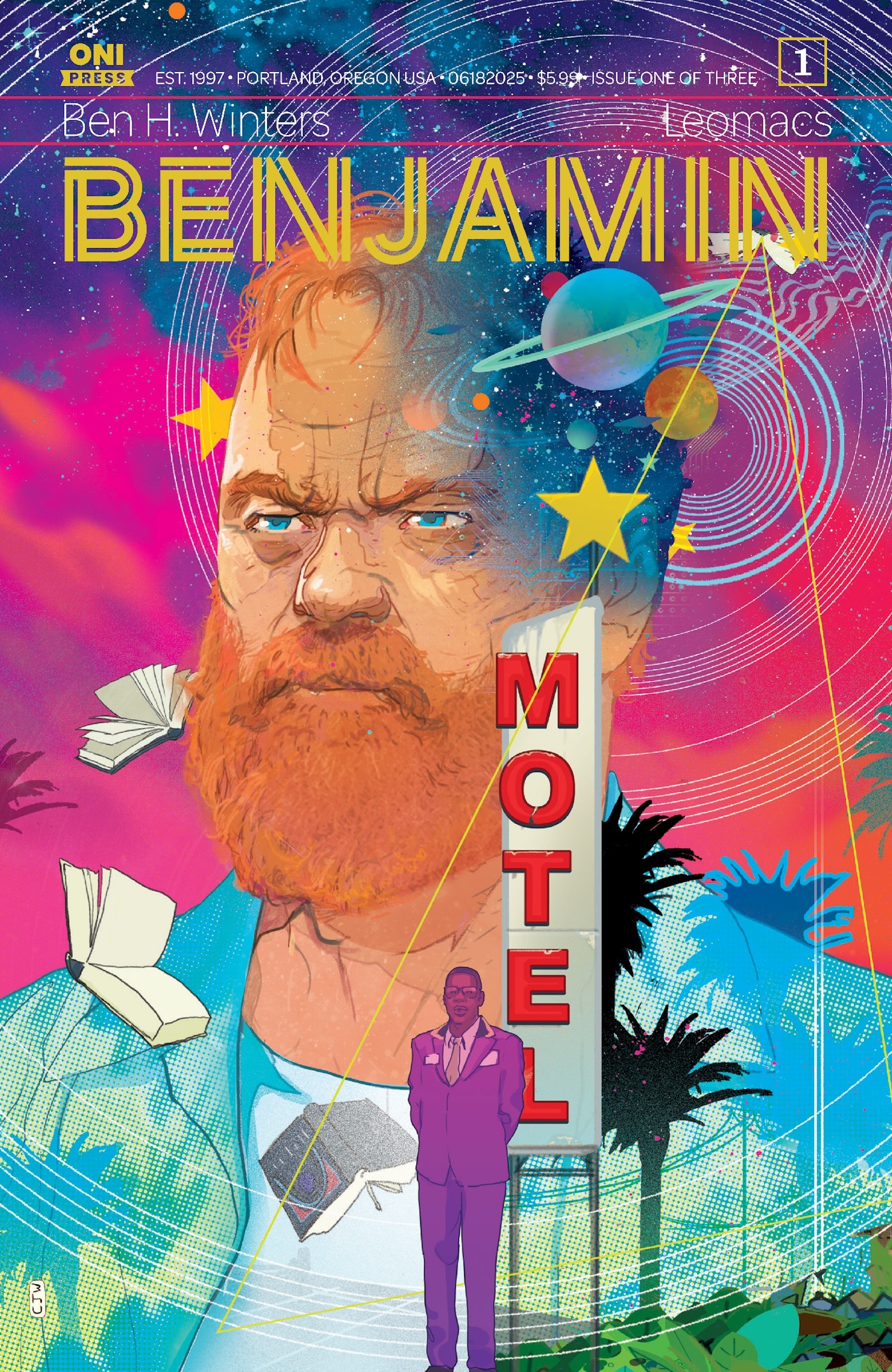
A Hell Of A Protagonist: Discussing ‘Benjamin’ With Writer Ben H. Winters
by Tom Smithyman
Ben H. Winters is no stranger to writing. Winters has penned the novels The Last Policeman trilogy and Underground Airlines and worked on FX’s Legion TV show as well as Tracker on CBS. He’s even found time to stories for Oni Press’ EC Comics anthology reboot.
Now, he’s writing Benjamin, a creator-owned three-part series about fictional science fiction author Benjamin Carp, who comes back from the dead after decades. In a Comicon exclusive, Winters discusses the differences between writing for television and comics as well as his obsession with visionary author Philip K. Dick.

Tom Smithyman: This is your first creator-owned comic. That carries a financial risk to you personally. Why do you feel so strongly about this story?
Ben H. Winters: Would it be cheesy to say that nothing worth doing doesn’t come with a little bit of risk? If so, I won’t say it, but I’m thinking it. This story is one of those that sort of emerged in my head, demanding to be told. I’m not sure I knew it was going to be a comic book until I had lunch with Hunter Gorinson, at that time newly anointed headman of Oni Press, and he was like, “Well, whatdy’a got?” Once I started imagining Benjamin Carp’s adventures in comic form it seemed impossible not to do it that way. And here we are!

Smithyman: This is not a straightforward sci-fi tale, rather blends questions about existence, oblivion, the past and future, in addition to Hollywood. Do all of those concepts make it more difficult to write than say an episode of Tracker, or is that just how your mind gravitates?
Winters: Television and comics are such different beasts, and yes this story is miles from the episodic stories I’ve done for TV, where there is a defined problem — a missing person, or a murder to solve — and a clear investigative path. Here, for Benjamin, the problem is deeper and weirder and more tangled: the dude died in 1982, and now he wakes up, and he doesn’t know why.
He doesn’t know what he’s here for, which by the way is not unusual: none of us really know what we’re doing here, how we got here or where we’re going. So it’s a goofy, tongue-in-cheek, science-fiction adventure story, but it’s also the story of man’s search for meaning in the universe. And there are no commercial breaks to sell trucks!

Smithyman: You’ve said that Benjamin is based on a number of luminary science fiction authors, including Philip K. Dick, Ray Bradbury, and Robert Heinlein, but Benjamin Carp seems to share many of the same details as Dick specifically. They both wrote 44 novels, both died in 1982, and both struggled with amphetamine use. That seems like more than a coincidence.
Winters: Well as I’m sure you know, and probably many of your readers, Dick didn’t really hold with the idea of coincidence. He believed in synchronicity, in the deep-down unspoken and unseen connections between all things. Now he also did a lot of drugs, and didn’t sleep much, so we must take his point of view with a grain of salt at all times. But I have always thought he, himself, would make a hell of a protagonist: brilliant and driven and curious as he was, but also so deeply flawed. If Carp shares some of those qualities, I can only hope he’s as interesting as PKD was himself.
Smithyman: I’ve had a chance to read nearly all of Dick’s novels, as I’m sure you have as well. Do you have a favorite?
Winters: I’m super-partial to The Man in the High Castle. As a sci-fi writer, as a student of American history, as a Jewish person — High Castle sings to me on all its weird-ass levels. Anyone reading my own speculative-fiction American history novel Underground Airlines won’t have to work hard to detect the influence.
Smithyman: That is a good one. Dick’s concepts were wildly inventive, but his main characters all seemed to taste like chicken. How do you avoid that trap when you are creating new characters?
Winters: I wish I had a great answer to that, although I do appreciate the implied compliment. I think I often find characters through their voice; I start to hear patterns of speech, which kind of guide me to the kind of person they are. That sounds sort of like an answer, when the real answer is: I have no idea. The story and the character suggest each other, and they both come to life together.
Smithyman: Artist Leomacs is drawing the book’s interiors. What is the back and forth like between the two of you, and how does that contribute to your writing?
Winters: Because of the way the schedule worked out on this one, I was essentially done with my piece before Leomacs came on board, so it’s mostly been a process of him taking the scripts, drawing something face-meltingly good, and me going, “Uh, yeah, dude, that’s incredible. Keep doing that!”
I lucked out. I think Leomacs has an intuitive grasp of what I was trying to do here, this story that keeps sliding into other stories, into memories or dreams or chapters of books. Subtly, cleverly, he guides us in and out of these other realms.
Smithyman: From Total Recall to Do Androids Dream of Electric Sheep (Blade Runner), a number of Dick’s novels have been turned into feature films. If you could convert any one of them, starring you as the main character, which would it be?
Winters: Through a Scanner Darkly is one of my favorites, just a lot of hanging around in darkened rooms having agitated conversations. I can highly recommend the audiobook as narrated by Paul Giamatti — if anyone is destined to play PKD, it’s that guy.
Smithyman: Giamatti is a fantastic choice for just about any role! Best of luck with Benjamin!