
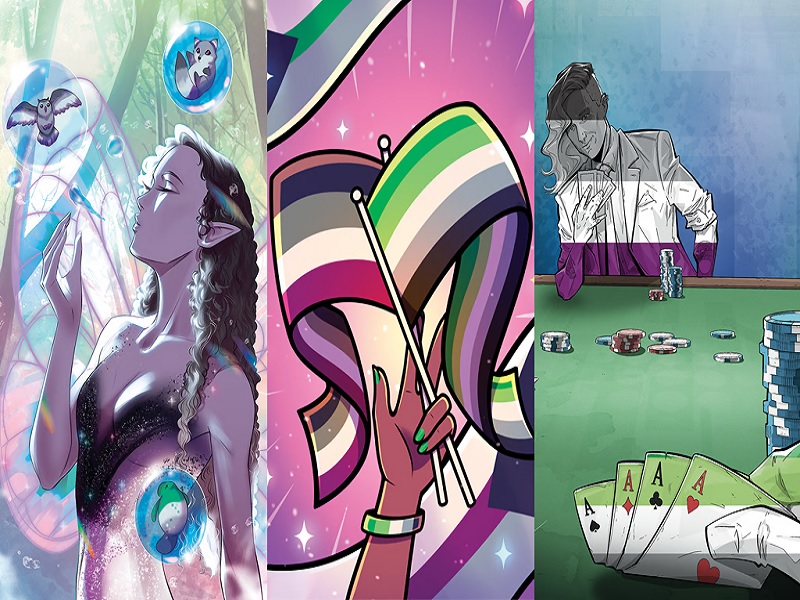
Crowdfunding Comics: Talking The ‘Aces And Aros’ Anthology With Co-Editor Jeremy Whitley
by Rachel Bellwoar
Jughead and Gwenpool are good company to be among, but there are so many more stories comics could be telling about asexual and aromantic relationships and people. Twenty-one of them are about to be collected in Aces and Aros: An Ace and Aromantic Comic Book Anthology being funded on Kickstarter by Lifeline Comics. Edited by Kat Calamia, Phil Falco, and Jeremy Whitley, here’s what Whitley had to share about the experience and the upcoming crowdfunding campaign:

Rachel Bellwoar: When did the idea for this anthology first start being tossed around and were you involved from the start?
Jeremy Whitley: I think with the success of other Lifeline books like Transphoria and Bi-Visibility it was sort of an organic idea that Kat and Phil decided they wanted to give a shot. They are experts at the process of making an anthology like this, but not necessarily at the world of Ace and Aro stories. I’ve been friends with Kat for years now and she had seen me come out as demisexual and then work with an all Ace team to write the story of Gwenpool coming out as Ace at Marvel, so I seemed like a natural choice for an editor to bring on regarding the subject matter.
Bellwoar: For those who might not be familiar with the terms, what does it broadly mean to identify as asexual and/or aromantic?
Whitley: Strictly speaking, asexual means a person who does not experience sexual attraction or desire and aromantic is a person who does not experience the desire for romantic connection. They are often, but far from always linked.

Bellwoar: What was the process like for choosing contributors and connecting with other creators who are asexual and aromantic?
Whitley: Well, it’s been a long and interesting process for me. When I came out and then again with the Marvel story, a lot of them found me. It’s pretty exciting to find out that other people out there doing the sorts of things you do have brains that work the same as yours. I’ve found there are a lot of moments where people have shared experiences that they had never really connected to their sexuality and putting that puzzle together can be a revealing exercise.
When it came to this book, we put a priority on finding and inviting creators on the ace spectrum. It was not a requirement that all creators be ace, but our largest area of interest was in providing deep and meaningful representation that aspec people are often denied. Not every single creator is, but those who aren’t have shown themselves to be very patient and understanding when it comes to getting it right.
Bellwoar: Between yourself and your co-editors, Kat Calamia and Phil Falco, how was the work divided?
Whitley: Well, all three of us read each and every submission and gave our own scores based on how strong we thought the stories were. Our scores lined up pretty similarly, so it wasn’t too difficult to make some decisions about which stories weren’t a good fit and which we felt needed to see the sun.
We did a quick round of eliminating some stories that dealt pretty closely with the same plot elements. Surprisingly, we didn’t get an overwhelming number of coming out stories. What we got a lot more of were stories about particular genres of fantasy creatures, like sirens and succubi. Apparently we ace folks are pretty proud of our ability to overcome seductive monsters.

Bellwoar: Is there anything you can share about the story you’re writing for this anthology and what it was like reuniting with the art team from your Love Unlimited issue where Gwenpool came out as ace?
Whitley: It was amazing! Bailie [Rosenlund] and Kelly [Fitzpatrick] are both incredible artists and getting to have fresh pages from the two of them pop up in my inbox is always incredible.
Bellwoar: What’s been your favorite part of the editing process?
Whitley: Ooh! That’s a tough one. It was fun to see the excitement when people learned they’d been accepted. I’ve really loved watching the artwork come in and seeing how incredible everything is turning out.

Bellwoar: I love the fact (as teased by the press release) that this anthology will be covering multiple genres. Are there any you’re especially excited about or wish you had thought of?
Whitley: I think one of my favorite twists on the idea of asexuality in genre fiction is actually a spy story that’s being edited by one of my co-editors. It really plays with the tropes of seduction and sexuality as part of spy fiction that I think is really clever and original. We also have some wonderful fantasy and sci-fi stories, as well as some clever magical realism.
Bellwoar: There’s sometimes confusion around what the “A” in LGBTQIA+ means. I’ve heard “ally” come up before. Why is it important that asexuality get more recognition and representation?
Whitley: If you had asked me a few months ago, I think I would have had a completely different answer, but thanks to JK Rowling, I think it’s become pretty clear that people don’t understand asexual people. Often, it seems the first response of people who don’t understand us is violence, whether it’s physical or verbal. I think a lot of people who have had difficult romantic or sexual experiences take solace in the cliche that there is somebody for everyone and it’s just about meeting the right person. A lot of people feel like they can for someone who’s not attracted to them to be attracted to them. I think men in particular are taught that relationships with people of other genders are a sort of points based system, where if you continue to “be nice” and push long enough, a relationship will or should escalate to being sexual. I think the existence of asexual people who are proud to declare themselves as part of that spectrum makes those people uncomfortable. Discrimination against asexual people may not be as visible or physically violent as discrimination against other members of the LGBTQIA+ community, it is baked into a lot of assumptions that people make every day.

Bellwoar: Thanks for agreeing to this interview, Jeremy!
Click here to contribute to the Kickstarter campaign for Aces and Aros.
