
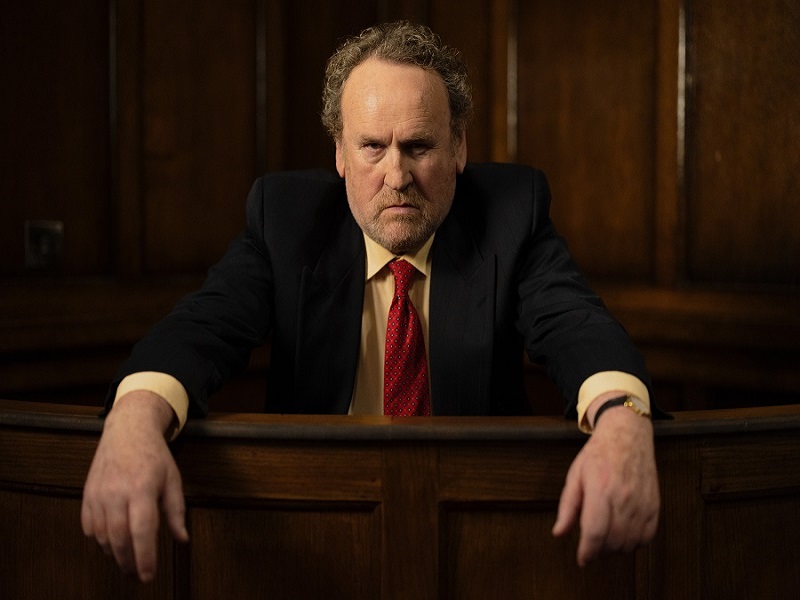
An Interview With ‘Re-Creation’ Directors Jim Sheridan And David Merriman
by Rachel Bellwoar
In 2019, journalist Ian Bailey was found guilty of killing French TV producer Sophie Toscan du Plantier. This was more than 20 years after her murder in Ireland, and, because Ireland refused to allow Bailey to be extradited, the trial took place in France in his absence. Jim Sheridan (My Left Foot) and David Merriman‘s new film, Re-Creation, uses the facts of the case but imagines an alternate reality where the trial was conducted in Ireland instead. Having just made its world debut at Tribeca Festival, here’s what Sheridan and Merriman had to share about the film [Note: this interview was transcribed from video]:

Rachel Bellwoar: What initially drew you to this case and made you want to look into the murder of Sophie Toscan du Plantier?
David Merriman: Probably about five years ago. Jim had just finished his documentary for Sky, Murder at the Cottage, and he and I met up on another project and started working together, and he was incredibly passionate about the project and I think to one extent or another, felt like maybe there was unfinished business, and the two of us spent a great deal of time talking about it. And I think we have this in common. That injustice is something that kind of really bothers us, and I became convinced very early on that Ian Bailey had been falsely accused and so we spent an enormous amount of time trying to examine what had been discovered, and find new ways of looking at the case. And experts, blood spatter analysts. FBI agents. All this kind of stuff. And we discovered new evidence, and that again reaffirmed that we didn’t think that Ian Bailey was the murderer. And so the two of us spent years travelling around and talking to people and working on it, and that kind of brought us to a place where we felt like, you know, it would be possible to to create something artistically that would express what we felt about the case and put it in a way that might move the needle even just a tiny little bit. So that was kind of it for me.
Jim Sheridan: Yeah, I mean for me it was, you know, initially, I was doing a little film festival — the opening of a thing called this Fastnet Film Festival which was in Schull and the people starting it didn’t realize it was on at the same time as Cannes, and I had to travel from Cannes to Schull, and it took me ten hours, and it made me start thinking about the Sophie murder, and why she’d travel that distance, over and back, longer than going to LA, because you had to go Cannes-Dublin, Dublin-Cork, Cork to Schull, and that’s — And then I found out her name. My name is in her diary, and those two things connected up, and I got interested.
Bellwoar: Having previously directed a docuseries on this case (Murder at the Cottage: The Search for Justice for Sophie), how quickly did you know you weren’t done telling this story, Jim?
Sheridan: Well, when they announced a cold case review based on one of the facts we presented in the doc, which was a new suspect, that kept me interested, and it was almost like I wanted to find out what the police were going to find out, and I stayed interested. And I didn’t want to let it go, because that concept of a new suspect was fundamental to shifting the target off Bailey’s back, you know? And once you have that, you have something positive to look at rather than the negative of, “did he do it or not?” And the more you talk about, did he do it or not, the more likely you are to find that he had to have something to do with it, because we’ve been talking about it for twenty years. So it’s kind of a reinforcing negative when there’s no solution, when it’s just immediate campaign against them. You know, it’s just a PR trial, a PR accusation, you know? And it was all about the press and their reaction to what happened.
Bellwoar: In the opening text, you mention having commissioned new forensic reports and analysts. Was this information you had while making the docuseries or is this new evidence that’s come to light since?
Merriman: Yeah. So we we engaged blood spatter analysts. An FBI agent who is from the behavioral science unit to analyze the case and the evidence for us, and went back and rei-nterviewed a pathologist who had done some work on the previous Murder at the Cottage, just to explore some things that didn’t end up making it into the documentary at that point in time. There was quite a bit that we did, and then we uncovered audio recordings of the police that had never been heard before. To my knowledge, we’re the only people who have a copy of them, and one of them is in the film. There’s many of them. And so yeah, there was a lot of new things that we discovered along the way, which further made us believe that, you know, Ian had been wrongly accused of this murder.

Bellwoar: Any film about a hold out juror (in this case Vicki Krieps) is going to draw parallels to 12 Angry Men. What interested in using that same framework to go over this case and did you ever consider focusing on the trial instead or were you always more interested in imagining what the jury deliberation would’ve been like?
Merriman: Well, I think we were making a slightly different film initially. And the production ran into some issues, budgetary wise. And instead of having nine sets — we were going to kind of make a docudrama — we discovered we could have one. So Jim had had this idea for a long time about presenting the evidence in this way. We essentially took ourselves to a hotel and worked on it for several weeks to get a framework together of what it could be. I think 12 Angry Men obviously is, you know, an amazing film without bias, and obviously not based on a real case, but an amazing character study as well, and something both myself and Jim love, and have seen several times. So it just seemed like [it] was a natural, when we were funneled into one room, the jury was the place to be.
Bellwoar: How much thought went into which number to give each juror and where, in turn, they would be sitting in the room in relation to each other?
Sheridan: Well, we kind of had a template of 12 Angry Men, so the foreman is easy. He sits at the head of the table, and Juror 8 is where Henry Fonda is, and Juror Three is where our John Connors is. So those three positions were fundamental, and then around them we position people, and probably that right-hand side of the table with Juror Three was a stronger position. Because, you know, it’s easier to be negative and aggressive and angry. So it kind of fell into place fairly simply after that, wouldn’t you say, Dave?
Merriman: Yeah, I think so. And I think, meeting the actors that we cast. And you knew quite a few of them, were able to say, I want this person and this person. Naturally kind of, we thought, well, this would suit this actor, the essence of that person in ways, I think.
Bellwoar: Was it always the plan to cast yourself as the foreman, Jim?
Sheridan: Yeah, I mean, I think I just took the foreman roll because I knew more about the case than anybody. So I had to had to allow, you know — Dave was directing when I was sitting down, and I needed that badly, an outside view, but internally I could control the action from inside the jury room, which I think was very important, you know?
Merriman: 100%. Yeah, because it was a lot of improvisation. So Jim was able to fire off. As he said, because he’s so knowledgeable and a natural actor as well.
Bellwoar: What was it like, deciding how much to reveal about each juror’s personal life?
Sheridan: Well, we had to depend on improvisation and getting to know the jury themselves, and a lot of the personal lives wre their own actual personal life, so that made it stronger. We were trying to get people to come out and tell us about their own life and their own assumptions and their own beliefs and their own prejudices. So that’s how it came out.
Merriman: Yeah, I mean, I think we started with a very broad view of who people would be. And, as Jim said, then people brought their own thing to it, which I think made it really work. From a character point of view. It felt real.
Bellwoar: The movie ends with a cover of Bob Dylan’s “The Man in the Long Black Coat” by Camille O’Sullivan. How did that song come about?
Sheridan: Well, because the black coat of Bailey was a big item that he was supposed to have bleached and then burned and then washed, and then it reappeared and the actual truth was that the coat? He stayed, the police took it, but the man who was seen following Sophie in the town, and close to the scene of the murder, also had a black coat — long black coat. So that’s really what it was about.
Bellwoar: Thanks for agreeing to this interview, Jim and David!
Re-Creation made its world premiere at the 2025 Tribeca Festival on June 8th.

