
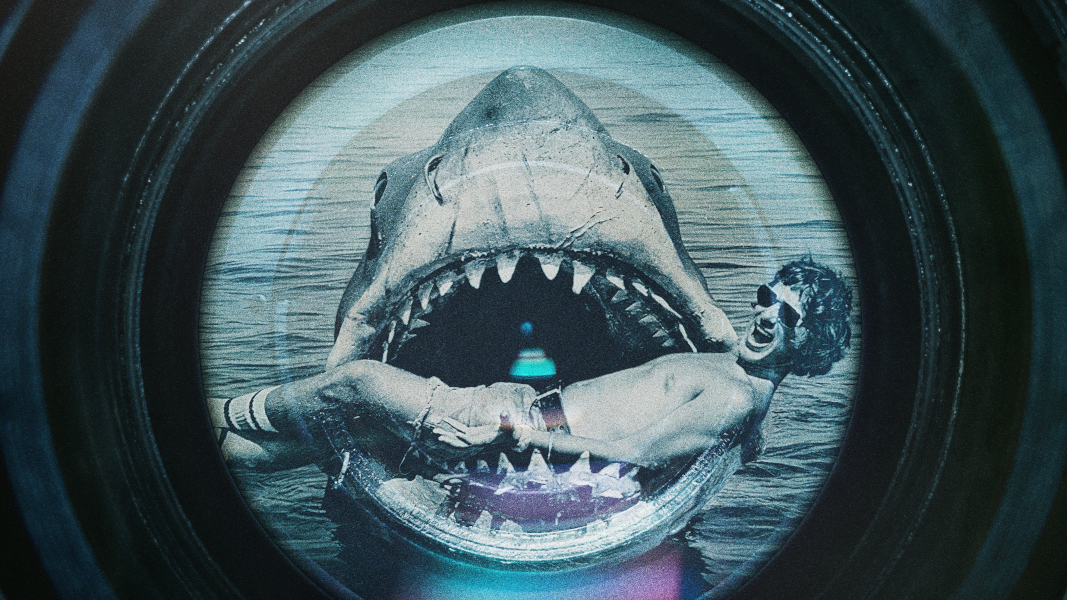
Interview: ‘Jaws@50’ Director Laurent Bouzereau Talks New Perspectives On The Making Of ‘Jaws’
by Erik Amaya

Last Friday, Jaws celebrated a special milestone: 50 years of audiences discovering its terror. The film put director Steven Spielberg on the map and made anyone who watched it a little more wary about getting in the water. It also changed the way the public viewed sharks while also upending the way movie studios released and marketed films. Indeed, the notion of the blockbuster came into existence because of the audiences lining up around the block to see the movie. It stands as a testament to just how a difficult production can still result in a near-perfect film.
As it happens, filmmaker and film historian Laurent Bouzereau knows a lot about how Jaws was made. He is the director of the upcoming NatGeo documentary Jaws@50: The Definitive Inside Story and The Making of the Jaws, the feature-length making-of retrospective included on most releases of the original Jaws since the Universal Signature Edition Laserdisc release in 1995. So, as he told Comicon.com’s Erik Amaya, returning to the story for Jaws@50 meant finding new perspectives on the how of Jaws. The pair also discussed the anniversary of The Making of Jaws, how the film passes from one generation to the next, and more.
Erik Amaya: So while it is the 50th anniversary of Jaws, it’s also the 30th anniversary of The Making of Jaws. What continues to excite you about telling stories of how this movie was made?
Laurent Bouzereau: I remember David Brown, who was one of the producers on the film, said to me, “I have to warn you about something. You’re going to be asking all of us specific questions about the same thing, and we’re all going to give you a different version. This is Rashmon, and if you’re not willing to accept that this is Rashmon, you should not be making this movie.” That was something I never forgot because I always feel like it’s everybody’s point of view that you bring into the table when you’re interviewing people about the exact same thing and everybody’s experiencing it from their own craft, from their own point of view.
And so that was the first entry into Jaws and Jaws has never left me for 50 years, I saw it when it came out in France. It evolved into my curiosity being much more about the human experience of it rather than the mechanical aspect of making it. The heart and soul of making [Jaws] was extremely trying and difficult and challenging. And I really wanted to tell a story of persistence and the triumph of the human spirit and human creations over the worst of circumstances. It was a very challenging thing to make. And I think that no one knew, not even Steven, that it was going to ever have any impact. And so I find that extremely inspirational, much more than my first doc, which is about logistical issues. So I really wanted to tell a relatable story of a challenge and facing adversity and, ultimately, coming out of it a winner; something we can all aspire to in life, really.
Considering that so many people involved in it have sadly passed on — star Roy Schneider, novel writer Peter Benchley, and producers Richard Zanuck and David Brown to name a few — do you feel their parts of the story are told in The Making of Jaws, or do you wish you had the chance to sit down with them again and maybe get more of that emotional angle for Jaws@50?
LB: Of course! Part of doing these documentaries is extremely painful because I knew all those people. I did a film on Richard Zanuck, he passed away as I was on my way to see him for lunch. He was a very close friend of mine and I told his story. He sent me an email on the Monday and he said, “Laurent, I just watched my life and let’s have lunch.’ The story of his life is the last movie he saw.
None of this is lost on me. And Roy Schneider’s interview with me about Jaws is iconic and Richard’s — and Richard Dreyfus is still around obviously — but pretty much David Brown. Those people were never given a chance to talk about Jaws. When I did [The Making of Jaws], it was the first time they ever talked about it since they made it! And a lot of those people were forgotten and slowly were being forgotten. Susan Backlinie [the swimmer at the start of the film] died last year, right before I started making Jaws@50. So part of these films is really painful because you realize that we’ve lost so many of those incredibly talented people. It’s difficult. But again, the goal was to try and listen.
Making it accessible for younger generations is also a concern, I imagine.
I think that young generations are being fed so much content that the way into the story is not to bring up the past, the way in is to have someone like Jordan Peele — who they just saw his new movie — talk about something that inspired him. And Steven is timeless, so Steven was going to be part of it. Aside from Steven himself, who was the heart and the soul of this film, I wanted to bring in voices to confirm that Jaws is a generational thing that is passed on not only amongst the locals of Martha’s Vineyard, but audiences and filmmakers, and also ocean scientists — which is an incredibly vast array of inspiration. And very few films or works of art have that kind of power.
Is it easier or harder to find previously unseen photos or film at this point? I don’t think I’ve ever seen the 8mm footage from the on-set teacher before. That felt new to me.
LB: One of my anxieties was like, “Oh my God, all the Jaws fans are going to be counting [what’s new].” But to me, it’s the point of view that matters. I had to let go of “never-before-seen.” How about “never-before-told?” Or “never-before-felt?” That’s what I was interested in. And then yes, I did find stuff that had never-before-seen. I would call Steven’s archivist and say, ‘Do you have any footage of [Universal executive] Sid Sheinberg in Steven’s office? Do you have footage of Steven watching the Oscars? Do you have any footage of [script consultant] Hal Barwood? And so suddenly I have all those!
Again, Steven’s perspective and how he was documenting every aspect of his life and generously sharing it with me, I was blown away. And then the people on Martha’s Vineyard … I think some of that footage has been available before to a core group of Jaws aficionados, but the thing that was interesting was to use that footage to have Carol Fligor tell that story about being a teacher.
Suddenly, you realize the footage feels new because she’s bringing a perspective to it, which would never happen today on a film set. They’d be banned from the set if you were filming anything. And again, the commentary to the images is what makes it feel new. Even to include a scene from the film to point out to the fact that the film was all about home and going home. There’s no place like home. That commentary from Steven has not been out there at all! And so to bring that commentary to the footage or the film itself makes it all the more powerful in a sense because, suddenly, you come into it from a different angle.
You can look at a painting and just appreciate it, but you can find a piece of information about it and suddenly it takes on a whole new dimension. So hopefully that’s what Jaws@50 does.
Jaws@50: The Definitive Inside Story airs July 10th on National Geographic and streams on Hulu and Disney+ the next day.