
Hear Me Out: ‘To Wong Foo, Thanks For Everything! Julie Newmar’ Heals America This Pride Month
by Mal White
Welcome back to “Hear Me Out,” a weekly series where I propose your next rewatch. You’re already hunting for something to watch while you wait for your Uber Eats delivery, so allow me to sway you.
Hi Gay! It’s (still) Pride Month, and Trixie and Katya’s iconic line still has plenty of mileage. Corporate Pride Month campaigns, or as TikToker NikHagan aptly called it, “Authentic Time Month,” are still begging us to sashay into lackluster deals. At the same time, regressive executive orders attack long-fought-for rights.
For streaming services, Authentic Time advertising means putting a rainbow banner on a wall of shows and movies even incidentally featuring a queer storyline. For precisely thirty days, queer films are waved around before being buried under the LGTBQIA+ category. Amid repetitive corporate “Be You For Your Pride” slogans, the absolute gem of a movie, To Wong Foo, Thanks For Everything! Julie Newmar (1995), is there to heal us.

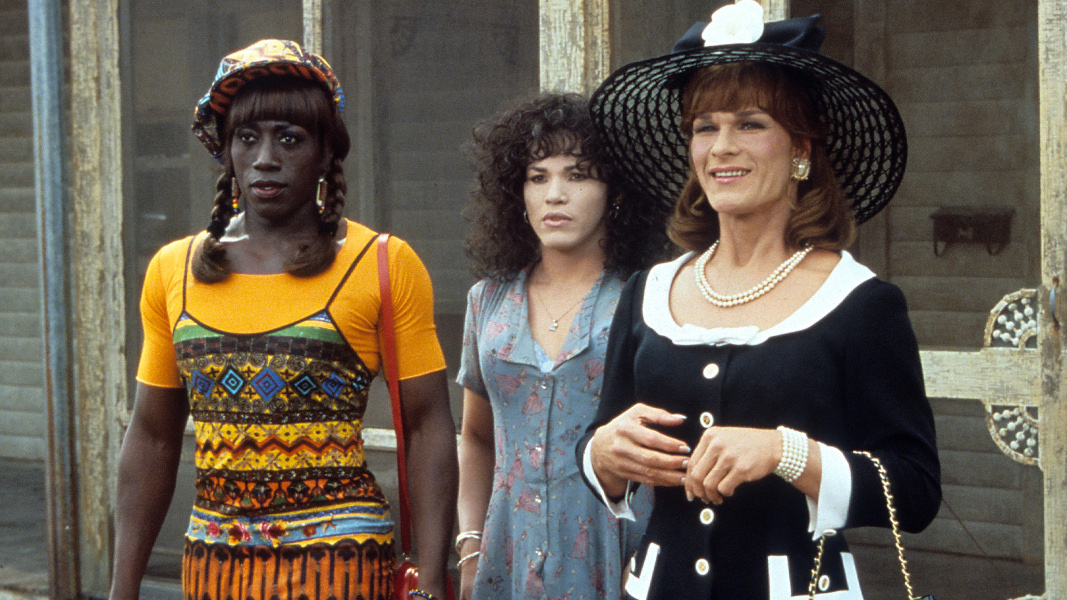
The audaciously upbeat comedy follows drag queens Vida Boheme (Patrick Swayze) and Noxeema Jackson (Wesley Snipes), who’ve just won New York’s Drag Queen of the Year in a tie. The Queens encounter sobbing loser Chi Chi (John Leguizamo), and in a fit of philanthropy, agree to take Chi Chi under their wing to teach her how to become a drag queen on their way to the Drag Queen of America competition in Hollywood.

The endeavor, blessed by Julie Newmar’s headshot, starts off strong, then hits a snag when they encounter a racist, homophobic sheriff (Chris Penn). The snag continues when their car breaks down in conservative Snyderville. Stuck awaiting a part, the trio brings a taste of big city glam to Snyderville in time for the Strawberry Festival. The town opens its minds and doors to the Queens, defending them against the embittered sheriff sworn to vengeance.
The film features amazing performances from Blythe Danner, Stockard Channing, and even a baby Michael Vartan. Plus cameos from the infamous RuPaul as “Rachel Tensions,” and Robin Williams, who a year later stars in the perfect companion movie — The Birdcage (1996) alongside Nathan Lane.

Praise for the performances was probably the most positive aspect of the film’s reception. Critics were less impressed with the plot, with Roger Ebert referring to the screenplay as “amateurish” in his review that year. Interviews with Bryant Gumbel on NBC’s Today that year reflect the time’s preoccupation with the controversy regarding three macho action stars donning drag. Controversy that also brought attention to New York ballroom culture, drag, and anxieties around queer culture in the ’90s. Apparently, audiences didn’t quite understand the meaning of “camp” yet.
The controversy continues. Modern viewers are presented with problematic race-focused zingers thrown casually around by all three Queens, but focused specifically on Chi Chi’s Latina heritage. This culminates in a race-based row between Chi Chi and Vida. Noxeema’s contribution as reluctant best friend to savior-complex Vida is a mess of race-based zingers referencing Rosa Parks and Driving Miss Daisy (1989). The joke is rooted, of course, in RuPaul’s appearance as “Rachel Tensions” while wearing a sequined Confederate flag dress.

There was and remains plenty to say about the film’s sanitization of drag culture for largely straight audiences. The film dances around the idea of sex while blurring the art with gender presentation. Unrealistically, the Queens remain in drag the entire time. Arguably, this could be for impact. As pointed out in one reality-touching scene, the Queens anxiously debate the risks of staying at a budget hotel, only to be mistaken for members of a women’s basketball players group. The movie is less about gay men and sexuality than it is about acceptance and allyship of drag queens. The idea that To Wong Foo walked so Drag Race could run wouldn’t be so far off in that reading.
Still, drag culture is rooted in queer resistance. Ballrooms are a safe space for creative expression, drag defiance, and performance. A sanitized presentation assumes safety that doesn’t exist for many queer counter cultures. Even today, Drag Story Times are forcibly banned from public libraries and shut down at bookstores across America in the midst of popular shows like Drag Race. Making drag palatable doesn’t necessarily make it accepted.

Yet, To Wong Foo remains doggedly focused on presenting a clueless, but tolerant America in need of the Queens’ glamour, elegance, and fringe. In one scene, the Queens vogue beside a train of suits that joyously vogue with them. Here, the suits release their repressed fun-loving selves by sheer proximity to the Queens’ innate fabulousness. In Snyderville, acceptance of the Queens leads to the reformation of their sins. These sins include domestic violence, a forbidden interracial relationship, a lack of a cute cafe, a criminal lack of color, and local riff-raff who threaten to assault Chi Chi at one point.

While controversy surrounding the film hasn’t changed in the thirty years since its release, the immense rewatch appeal of To Wong Foo lies in its audacity. While touching, albeit lightly, on real dangers faced by the queer community, it never fails to have fun. The Queens face threats, but find acceptance everywhere they go. Racial tensions are healed. Masculinity is reaffirmed in sensitivity. Femininity is reclaimed as a powerful unifier. Snyderville is forever changed by three drag queens in a butter yellow 1967 Cadillac DeVille.
To Wong Foo, Thanks For Everything! Julie Newmar reminds us that there is hope for America yet.

