
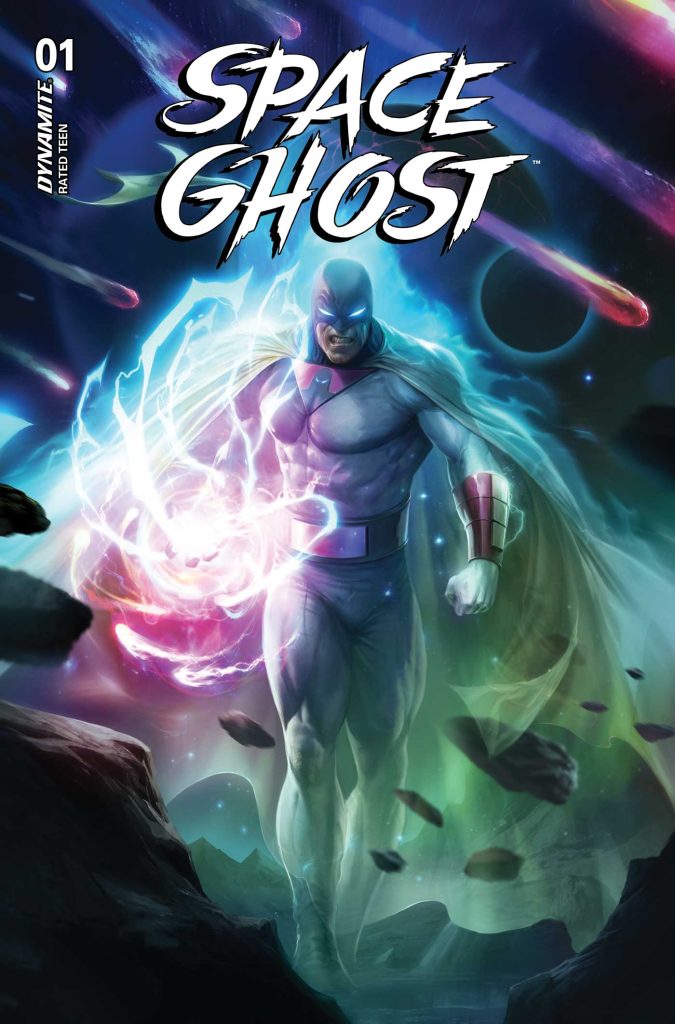
Interview: David Pepose On ‘Space Ghost’, ‘Captain Planet’, And Becoming “The Cartoon Guy”
by Austin Gorton

Over the last year, writer David Pepose has become known for translating beloved cartoons into comic book series, from Space Ghost to Captain Planet to the upcoming Speed Racer. Zeroing in on the core elements that make the properties tick, Pepose’s series successfully walk the fine line between being faithful to the source material and updating the characters for a new era and storytelling medium.
With Captain Planet out now, Speed Racer starting up in July after a Free Comic Book Day zero issue, and Space Ghost relaunching in a new volume this summer, David talked with Comicon.com’s Austin Gorton about his favorite Space Ghost villain, the deep cut video game property he’d love to adapt, and more!
Austin Gorton: I have to admit, when the Space Ghost series first launched, I questioned whether we really needed a grimdark version of an old Hanna Barbera character mostly known these days for a deeply satirical/parodic animated series from the late 90s. But you quickly won me over, in part because your take on the character isn’t a gritty reimagining. How do you maintain the balance between taking the character seriously but not presenting him and his world as jarringly serious?
David Pepose: Honestly, I think it’s very much baked into the core concept — to me, Space Ghost isn’t just about punching out sci-fi bad guys, his story has always been about his relationship with Jan and Jace.
So even if Space Ghost himself is a character rooted in unresolved tragedy, it’s hard for him to feel too grimdark to me, because so much of his life is interacting with these bright and bubbly kids, you know? It’s all about the contrast for me — you need a little bit of darkness, but there’s always going to be plenty of light to balance it out. Jan and Jace are ultimately what sets Space Ghost apart as a concept, beyond the sci-fi setting or weaponry — when you strip everything away, this is a found family series, first and foremost. They help make each other better, which I think can only result in an optimistic story. And you can see that in every page, thanks to our amazing artist Jonathan Lau, who recognized from the beginning that this was an ensemble series, and really gave Jan and Jace so much personality visually.
Beyond that, what I’ve tried to do with Space Ghost is just treat the character with the utmost respect, and to really pay attention to the source material to help inform my characterization. I wanted this to feel like a modern take, in the same way that Daniel Warren Johnson has done on Transformers, or Joshua Williamson and Tom Reilly on G.I. Joe, or Jason Aaron and Juan Ferreyra on TMNT — but Alex Toth and company really left us a treasure trove of story avenues to explore with Space Ghost and his assorted rogues gallery.
Each villain has their own unique characteristics, and their own elements that stood out to me specifically — it’s just a matter of listening to the source material, and then finding your own way of playing up those qualities. I’d like to think that the key to our success is that there’s ultimately nothing broken about Space Ghost, nothing that needs “fixing” — if anything, we’re doing what we can to lean into it.

Gorton: In this first volume of the series, we’ve gotten stories featuring most of the heavy hitters in Space Ghost’s Rogues Gallery. Which proved to be your favorite to write? And was there anyone you really wanted to work in, but couldn’t find a spot for?
Pepose: Boy, that’s like asking to choose between my kids! (Laughs) I love Space Ghost’s rogues gallery because they each have such distinct voices and personalities and concepts from one another — it’s opened up our series to such a variety of influences and tones, where no two stories feel the same. Metallus was certainly one of my favorites during our two-parter with him — I liked having a character with that kind of grandiose presence to him, who could go toe-to-toe with Space Ghost himself. Creature King was another one who really surprised me, as sort of Colonel Kurtz meets Caesar from Planet of the Apes.
And of course, Zorak, who I think was my favorite concept to reimagine, as this “Charles Manson of space” figure. I will say that once we got the Council of Doom together, Zorak definitely cemented himself as a favorite there, as well.

Gorton: Following the upcoming annual, the series is relaunching with a new #1; did you always envision a multi-volume series, or was that something that came from Dynamite? What can we expect, broadly, in volume 2 compared to the first one?
Pepose: When I was first approached about writing Space Ghost, Dynamite had offered me 12 issues and an annual to start, and I’d initially tailored my story to fit within that runway. But as the series progressed and people really seemed to respond to it, I knew there were other villains beyond the Council of Doom that I’d been itching to tackle, and so I started seeding in little details and plot points that would allow us to introduce those characters later. It was somewhere around my Space Spectre issue that Dynamite officially asked me if I had any more story ideas for the series, so I was able to take those ideas and weave them into what I’ve thought of as our Season Two.
As far as what to expect with Season Two, my goal was to take what I saw as the core formula of our series — namely, Space Ghost’s ongoing battles with a variety of sci-fi villains, as well as his evolving dynamic as a surrogate father to Jan and Jace — and find new ways to challenge our heroes. You’ll actually get a pretty good idea of where we’re headed by the time that our Space Ghost Annual comes out in July — the biggest challenge I faced was finding a villain with enough power and enough stakes to stand alongside Robo Corp and the Council of Doom, and I think we’ve definitely found it. But moreover, Space Ghost’s relationship with Jan and Jace is going to be tested in some major ways, which will provide the emotional spine of the series.
The other thing I’ll add is that the villains we have coming up are wild. We’ve got everything from toy-wielding homicidal maniacs from the future to femme fatale energy thieves to cryogenically frozen barbarian warriors to intergalactic civil wars! If you thought our first year of Space Ghost stories felt bombastic and larger-than-life, you ain’t seen nothing yet.

Gorton: My first encounter with Space Ghost was the “Space Stars” programming block in the early ’80s, when Space Ghost crossed over with the Herculoids all the time; given both properties have comic book series at Dynamite right now, any chance we might get a Space Ghost/Herculoids crossover?
Pepose: Write your Congressman! (Laughs) I’ve mentioned it to Dynamite many times, but I would love to do a Space Stars revival with Space Ghost, the Herculoids, and the Teen Force. There’s some interesting common threads between those three groups, as well as some sharp contrasts that I think could make for some very fun conflict. I’d love to write a couple of arcs with that assembled cast — so if you want to see that, tell Dynamite, and be sure to keep ordering Space Ghost!

Gorton: While Space Ghost and Captain Planet are animated series of different eras, and Captain Planet has the very ’90s (but sadly still relevant) environmental PSA angle to it that Space Ghost never had, the characters and their storytelling engines are broadly similar in terms of being powerful, titular protagonists with young wards who fight over-the-top recurring villains with distinctive “schticks,” How does your approach to each character and their world differ?
Pepose: You know, that’s a great question. I think one of the big differences for me are the contexts that each of these characters exists in. Captain Planet was always meant to reflect the world outside our window, and I think that means you have to be very deliberate with the setting and the character choices — the tone feels a bit more grounded to me than Space Ghost, who’s rooted in this very heightened sci-fi universe, where you can lean into the wilder, crazier stuff because it’s not meant to serve as a modern-day allegory.
There’s also structural differences that have certainly influenced how I approach each of these books — Space Ghost has a very tight, self-contained cast that pairs up in a very intuitive way. You can have Space Ghost in one area and Jan, Jace, and Blip in another, or you can pair off Space Ghost with any of the sidekicks. It makes the done-in-one approach much more natural, because the cast fits together in such an organic way that you can build and pace the story around that. And I think the core concept of Space Ghost and his cast is very simple and self-explanatory, so you don’t need to burn a ton of real estate on the exposition — you can just dive right in, and start introducing your villain of the month.
Captain Planet, meanwhile, is much more of a balancing act, that I think lends itself better to the more traditional multi-part storytelling — for starters, you have larger cast of Planeteers, so it feels like a superhero team book in that you need to make time for everybody to show off their individual powers each and every issue. And beyond that, you have to pace out Captain Planet himself, so that he’s fighting threats worthy of his power level, but isn’t taking up so much real estate that he takes over the entire story and sidelines the rest of the cast. It definitely makes the plotting feel a bit more like a Rubik’s Cube — but at the same time, there’s a lot of cool mythology and backstory that you can mine, so it offers different storytelling possibilities. It’s less done-in-one, more grand and sweeping — it’s definitely a different set of muscle groups.

Gorton: Between Space Ghost, Captain Planet, and the upcoming Speed Racer from Mad Cave, you’ve kind of become “the cartoon guy.” Is that a niche you’re comfortable hanging out in, and are there any other old cartoons out there you’d like to bring into the world of comics?
Pepose: The last year has been very much a confluence of different things all materializing more or less at the same time — I think I got my official offers on Captain Planet and Speed Racer on literally the same week! For me, I was drawn to these stories less because of any particular affinity for being the nostalgia cartoon guy, and honestly more because I felt like there were some really compelling stories to be told with these specific characters — when you know you’d be mad if somebody else were writing these stories, that’s my litmus test to write it. [Laughs]
As far as other nostalgia properties, there’s a handful that I could consider throwing my hat in the ring for. Anything in the Teenage Mutant Ninja Turtles universe would be a bucket-list item, for sure — Mortal Kombat would be another fun universe to explore. And if anybody ever got the rights to the Streets of Rage video game series, that would be a really exciting one to tackle.

Gorton: As a big fan of both Cable and time travel shenanigans, I had a great time with Cable: Love and Chrome, particularly the last couple issues, and the way you showed a softer side of Cable throughout. Do you have more Cable stories you’d like to tell, or any more work inside the X-office coming up that you can talk about?
Pepose: Never say never! I continue to be very grateful for the incredible response we got for Cable: Love & Chrome — it was a very different type of story than I’ve ever written, both with the sprawling time-travel elements, but also the very heavy emotional subject matter we were playing with, so I’m really proud of the work that Mike Henderson and I delivered. If I were to tackle the character again, I’d love to work Nathan into a team setting, especially given how he’s the heart of the X-Force concept. Honestly, there’s a lot of fun concepts in the X-Men office in general, and I’m game for just about anything!
Speed Racer #1 is set for release July 30th. Captain Planet #2 will be available July 16. Space Ghost Annual drops July 16th.

