
Medieval Czech Double Feature: ‘The Devil’s Trap’ And ‘The Valley Of The Bees’ Reviewed
by Rachel Bellwoar
Usually trilogies have names, like The Orphic Trilogy or The Lord of the Rings Trilogy. František Vláčil‘s does not and yet The Devil’s Trap (1962), Marketa Lazarová (1962), and The Valley of the Bees (1967) are referred to as a trilogy. Whether that was Vláčil’s intention, there are no carryover characters between the three films (some of the locations were reused), and they work as standalones. Marketa Lazarová is the longest (at almost three hours), and the only one that’s been released by Criterion. It’s also the most challenging, but in a Tarkovsky way, where the effort is more than worth the reward.

Sometimes you have to be in the right state of mind to tackle these kinds of movies, but The Devil’s Trap and Valley of the Bees are both easier than Marketa while maintaining the same level of quality. It truly feels like they were made in medieval times and not the ’60s. The attention to detail by Vláčil and his collaborators is second to none. Take Theodor Pištěk’s costumes in The Valley of the Bees. There’s something almost crude about the helmets and chain mail shirts worn by the male leads yet this feels appropriate for clothes that would’ve been handmade and not mass-produced. They feel achievable instead of streamlined
The Devil’s Trap (1962) deals with superstition, faith, and political corruption. Instead of being grateful when the miller (Vítězslav Vejražka) tries to warn him that his choice of spots for the new granary would be a mistake, the local regent (Čestmír Řanda) is determined to discredit him with the help of a priest (Miroslav Macháček). It’s very much the witch trials, with it being suggested that the miller has made some kind of deal with the devil instead of that he’s built up a knowledge of his surroundings from years of working the land and observation.
Usually mob mentality is portrayed as a negative thing, with people being easily swayed and manipulated into turning against each other, but The Devil’s Trap feels slightly more hopeful. What makes this film magical is its willingness to incorporate elements of the unexplainable, like when Martina (Karla Chadimová) throws her wreath of flowers over a wall as part of a game that’s supposed to direct her towards the person she should marry. There’s no way the wreath should fall into the hands of her love interest, the miller’s son, Jan (Vít Olmer), but it’s one of those romantic gestures that only happens in the movies – or does it?
Second Run’s Blu-ray includes a short documentary on Vláčil called “In the Web of Time” which is basically an interview of Vláčil intercut with clips from his films, as well as a Czech docushort about movie theater marquees that features a poster for The Devil’s Trap. There’s also a booklet essay by author Peter Hames, who considers how historical films were a way Czech directors could avoid making Soviet propaganda by setting the story in the past.

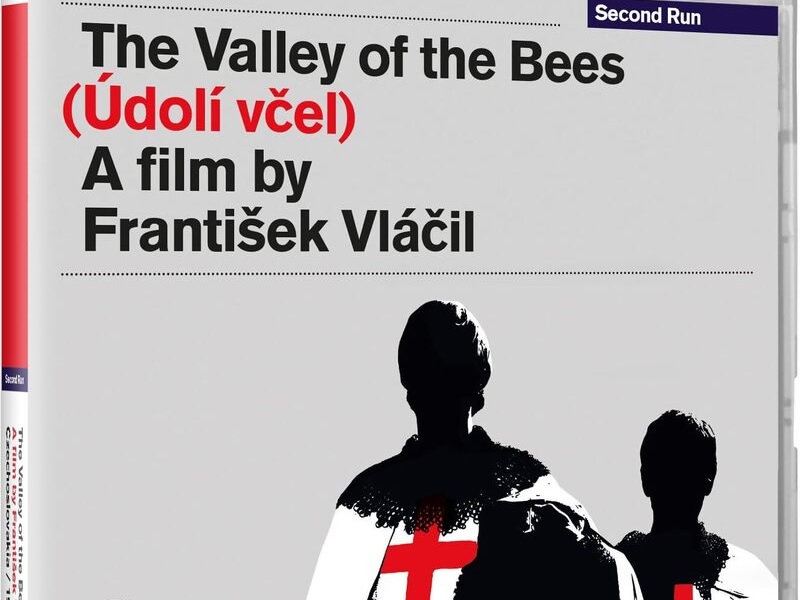
The Valley of the Bees (1967) is about how friendship and religious fanaticism don’t mix. Ondřej (Zdeněk Sedláček as a little boy, Petr Čepek as an adult) didn’t choose to join a religious order. He was promised to one by his father (Zdeněk Kryzánek) after an incident at his father’s second wedding in which his father threw him against a wall. It’s Ondřej who has to pay for that loss of self-control and, inspired by another member of his order (Josef Somr) who attempts to run away, Ondřej decides to try and escape.
What’s interesting about the timing is it’s right after the first runaway has been caught, so Ondřej is very aware of how the order responds to traitors (and it’s not with forgiveness). It just points to his desperation. Ondřej’s plan is no more well-thought out. If anything, he has a strike against him in Armin (Jan Kačer), a fellow order member who considers himself like a brother to Ondřej and makes it his personal mission to bring Ondřej back into the fold.
This movie is grim and unforgiving in all the best ways. Second Run’s Blu-ray includes a commentary by Projection Booth podcast host Mike White and his guest, Robert Bellissimo. I wish they could’ve done a commentary for The Devil’s Trap as well and some of the topics covered include religious symbolism and motifs in The Valley of the Bees like thirst. There’s also another booklet essay by Hames (who provides an overview of Vláčil’s filmography) and two documentary shorts from 1972 by Vláčil (“The City in White” and “Karlovy Vary Promenades”) that feature music by Zdeněk Liška (who scored The Devil’s Trap and The Valley of the Bees). The booklets include spoilers so don’t read those first.
The Devil’s Trap and The Valley of the Bees are available on all-region Blu-ray from Second Run.


