
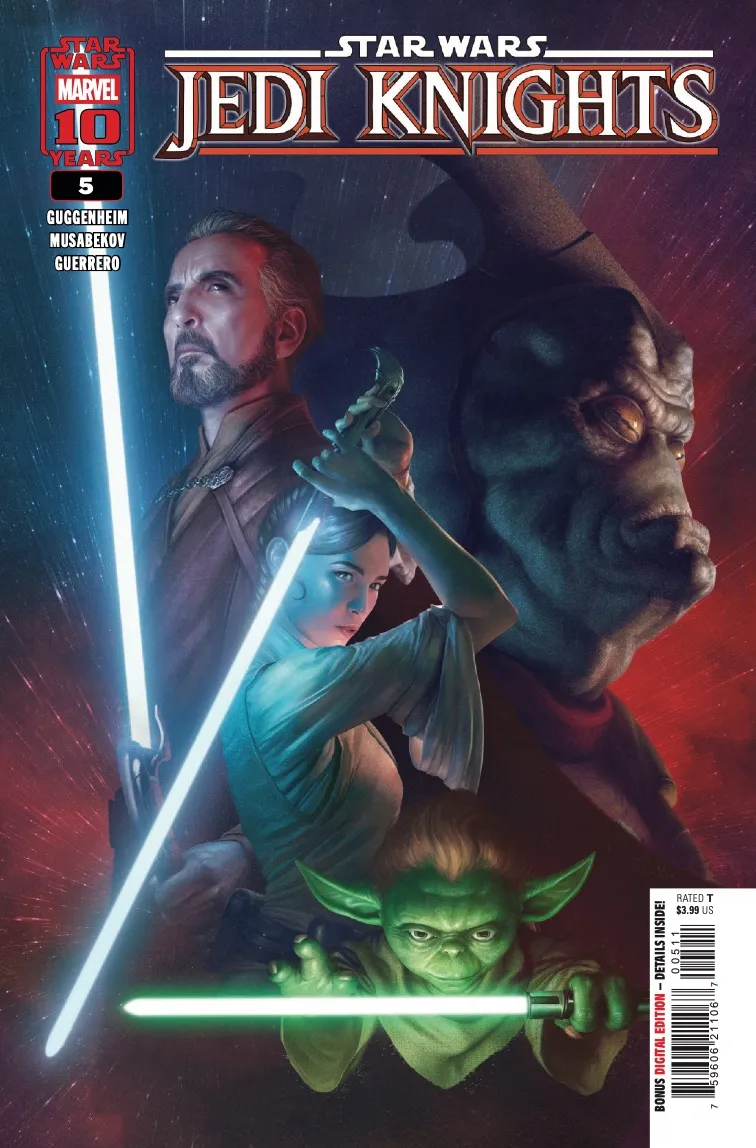
‘Star Wars: Jedi Knights’ #5 Shows How To Do A Prequel Right – Review
by Austin Gorton
Overview
‘Star Wars: Jedi Knights #5’ succeeds by manipulating the tension between what readers know and what the characters know. In the process, it shows how to do a prequel story well.
Overall
8/10Despite taking place shortly before the events of Star Wars: The Phantom Menace, this generally hasn’t been a series terribly concerned with ducking and weaving its way through the asteroid field of established continuity (in order to tell a good a story/hide from the Empire in a space slug’s belly, I guess, to carry this metaphor all the way to its end). That changes with this issue, as Star Wars: Jedi Knights #5 marks the series’ debut of Count Dooku via a story set in a largely unexplored time of the character’s history: after he left the Jedi Order but before he emerged as a leader of a galactic separatist movement (slash secret Sith Lord). The result is, if not the best issue of the young series, certainly it’s most affecting.

Continuing the series’ approach of pairing an “established” Jedi with one original to the book, Jedi Knights #5 sees Yaddle, aka Lady Yoda, and Seera Longa (who debuted in issue #1 working with Adi Gallia) get involved in a trade dispute with both direct narrative and more indirect structural parallels to the Trade Federation/Naboo dispute that opens The Phantom Menace. The Jedi are serving as negotiators, as in the film, and one side of the dispute involves the Trade Federation and their viceroy, Nute Gunray.
But writer Marc Guggenheim smartly upends expectations: on the surface — if one were to view these events without any knowledge of later films — the Trade Federation turns out to be the functional “good guys” in this despite: there’s is the stronger claim in the dispute, and it turns out — again, solely in the context of this story — that the Gillantir Corportation with which they’re feuding is a criminal front. Furthermore, Count Dooku emerges as, basically, an insurance agent working on their behalf — during which he is welcomed and eventually rescued by his former friend and colleague Yaddle, despite having already left the Jedi Order at this point.

The tension between what the characters know and what readers know makes the issue pop. The “friend” on whose behalf Dooku is looking after Trade Federation business is clearly Darth Sidious, but of course, Yaddle doesn’t know that. Guggenheim pushes these tension even further, casting the goons working for the (secretly criminal) Gillanter Corporation who capture and torture Dooku as Wookiees, traditionally-positioned as heroic and honorable characters (Black Krrsantan notwithstanding).
Guggenheim also opens the issue with a flashforward to Yaddle’s last encounter with Dooku, moments before he strikes her down and becomes a Sith Lord (as chronicled in a Tales of the Jedi animated short). Thus every interaction between Yaddle and Dooku is dripping with tension and irony, as readers know what Yaddle doesn’t: that saving Dooku means her doom.

All in all, it’s a smart way to use the series’ position in the Star Wars timeline to create tension using established history and not just in spite of it. It’s also a clever bit of prequel writing that does more than just tell the “secret history” of some benign object or character trait. This series has proven it can succeed just by telling engaging stories set in this era without having to do “prequel stuff”, but this issue proves that when it does, it can succeed just as well.
