
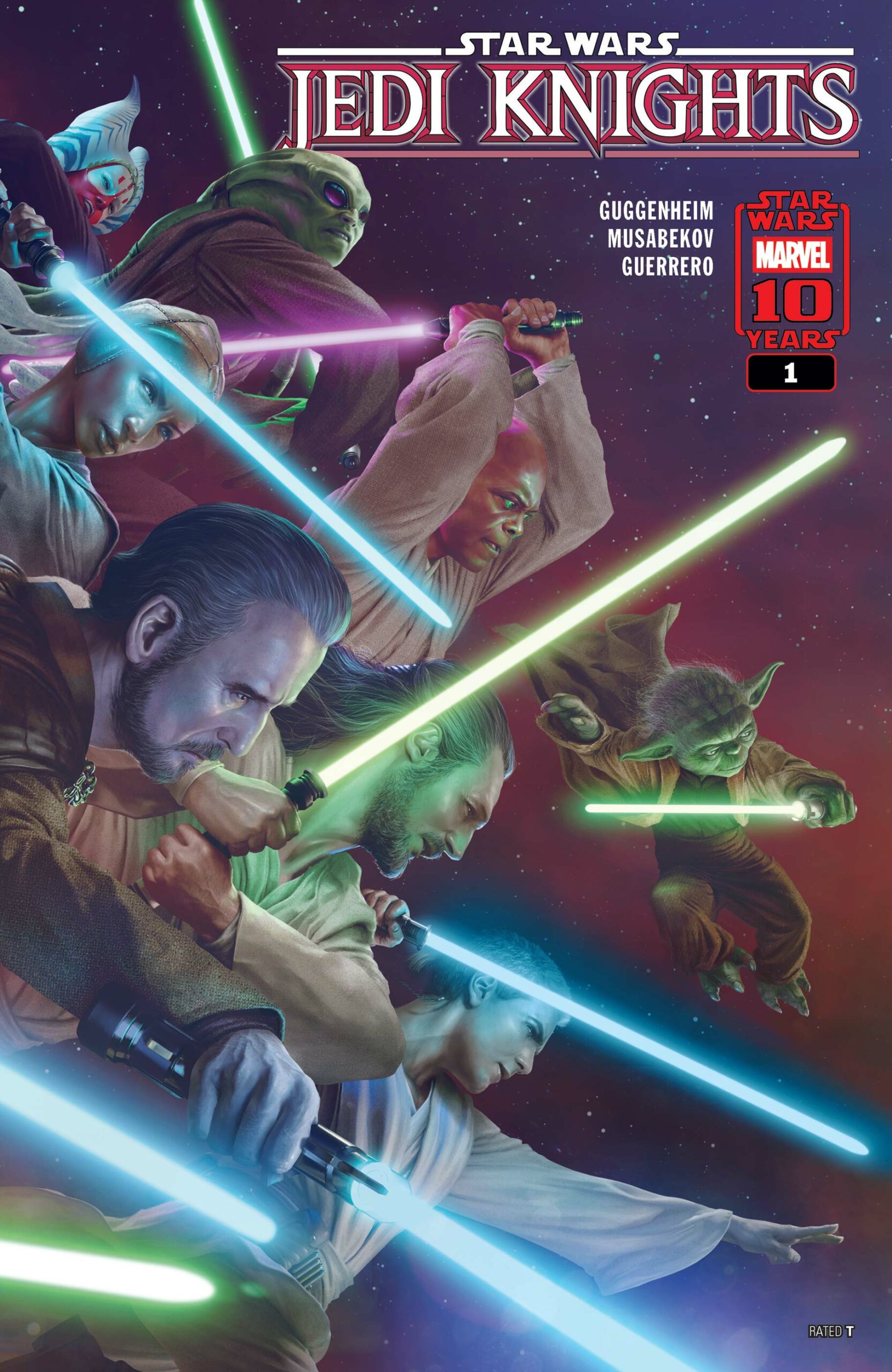
Review: ‘Star Wars: Jedi Knights’ #1 Is Another Win For ‘Star Wars’ Comics
by Austin Gorton
Overview
The first ongoing Star Wars comic set in the Prequel Era, Star Wars: Jedi Knights #1 is another hit for the new wave of books, thanks to standout art, an assortment of original and “Greatest Hits” characters, and a plot which is both satisfyingly self-contained but also teases future stories.
Overall
8/10The Prequel Era of Star Wars storytelling in an interesting place. Once the butt of jokes amongst fans, the aging up of the generation who were kids when it debuted, a re-evaluation prompted by the success of the Star Wars: The Clone Wars animated series, and the release a new Star Wars trilogy to divide and draw the ire of fans has put the Prequel Trilogy on more equal footing with the Original Trilogy. Or, at least, in a better position than when Disney bought Lucasfilm. Into that environment comes Star Wars: Jedi Knights #1, the first issue of the first ongoing series from Marvel set entirely in the time of the Prequels. While not offering the kind of “everything you knew is wrong!” reveal of the first episode of The Clone Wars, it is another strong debut for the newest era of Star Wars comic storytelling.
Set a few years before the events of Star Wars: Episode I — The Phantom Menace, the debut issue tells a sprawling but self-contained story involving Jedi intervening in a war between planets. The scale of the conflict allows writer Marc Guggenheim to kick off the series by featuring a Murderers’ Row of Prequel-era Jedi, including heavy hitters Yoda and Mace Windu, to deeper cuts like Yarael Poof and Yaddle, to Qui-Gon Jinn and his apprentice: one Obi-Wan Kenobi. But Guggenheim is smart to also introduce a handful of brand new Jedi, including the green-hued Vetna Mooncrest, the cocky Berem Khana, and the recently-knighted Seera Longa. While the large cast in this issue limits the page time each character gets, by intermingling original characters with movie characters, Guggenheim is setting up opportunities to explore characters deeper than he can with movie characters whose fates are more established.

The lack of a single point-of-view character here ultimately works to its advantage; the Jedi, as a collective, are the focus and the plot is set up in such a way to showcase their effectiveness as a unit, versus setting up one or two particular Jedi as the heroes who save the day. Such an approach is unlikely to work for every issue. But as a kickoff to the series, it’s a smart way to underscore just what this book is about. Guggenheim is aided here by artist Madibek Musabekov. One of the stronger regular artists to work on the back end of the recently-completed, Star Wars series, he seems to have leveled up in his time away. His backgrounds are more detailed while his facial expressions and body language — a highlight of his earlier work — are even more complex.
Colorist Luis Guerrero deserves a shout-out as well: each setting gets its own distinctive hue, and Guerrero is careful to make subtle distinctions in the relative uniformity of the Jedi color palette to keep the group scenes from looking too bland. A six panel, two page sequence is the highlight of their collaboration, with the different teams of Jedi spread across two planets enacting their plan to end the war. Each panel tells its own little story that is still part of the larger narrative, with varied perspectives and distinctive color palettes.

While the main plot of Jedi Knights #1 is resolved by the end of the issue, it serves as a vehicle to establish its temporal setting, introduce some new characters, and lay some seeds for future plotlines. This is done most directly in a closing montage of images seen by Obi-Wan while meditating. It is one of those “here’s some stories we’re going to do in the future” kind of things that is a staple of superhero comic books, revealing snapshots of events which may or may not come to pass. But there’s also a lingering mystery involving an assassin targeting Qui-Gon, whom Obi-Wan sees killing him during his visions. Thus, Guggenheim is able to tell an introductory, self-contained arc suitable for a first issue while also laying the groundwork for the kind of serial narrative that makes comic book storytelling so fun and unique. All in all, it makes for both a satisfying read and an intriguing start to a new series, and another win for the newest era of Star Wars comics.

