
Hear Me Out: Save Us, Godzilla. You’re Our Only Hope
by Mal White
Welcome back to ‘Hear Me Out,’ a weekly column dedicated to monsters, asteroids, aliens, and the people who want them to destroy us. Yes, this was written by a millennial without a 401(k).
The end is nigh. Well, most of us want it to be. Every week, social media trends reveal a new impending extinction-level threat. From the planet-killer asteroid of 2032 to aliens approaching Earth, embracing the end of the world has become the millennial retirement plan. Why worry about 401(k) matching when an alien invasion means no more 9-to-5?
I blame Roland Emmerich.

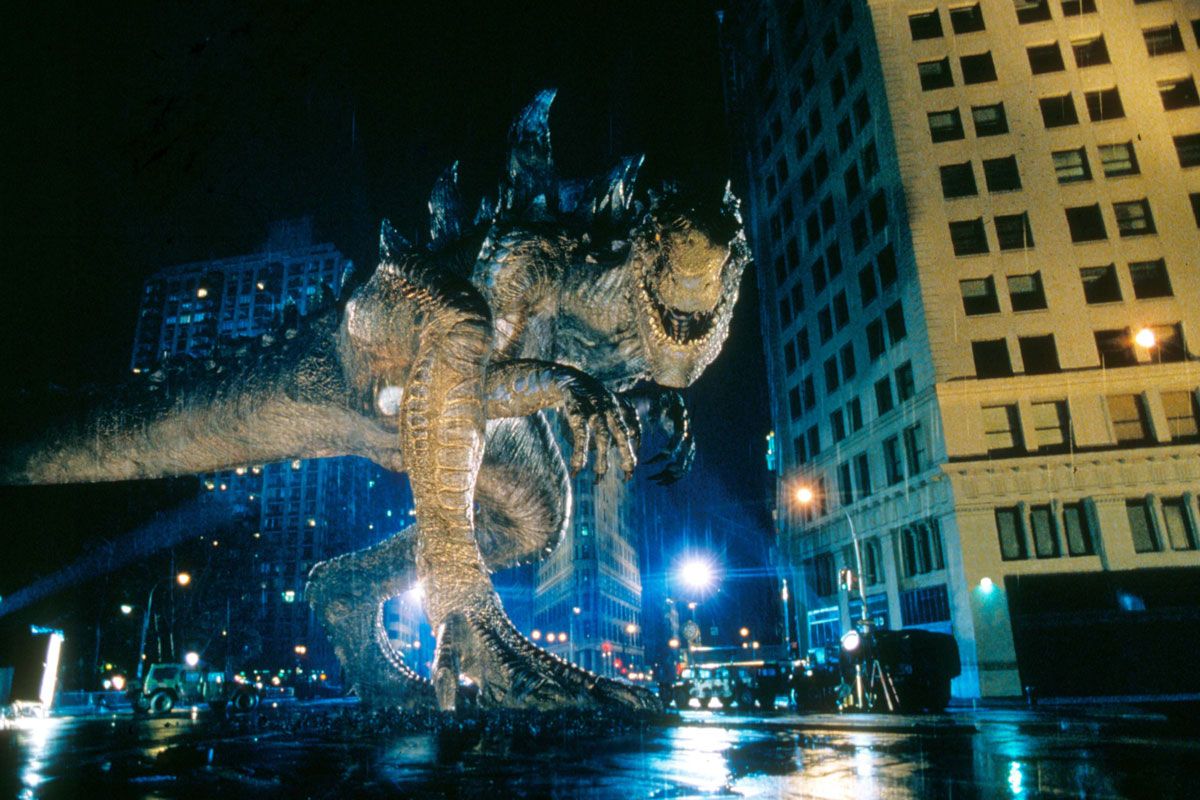
This week, the League of Extraordinary Nerds sat down to watch Emmerich’s markedly less successful disaster flick Godzilla (1999). I’d completely forgotten this movie existed until a friend proposed it. When they did, the only thing I remembered to shocking clarity was a petrified man in a hospital bed staring transfixed into a flame, whispering a haunting “Gojira.” What followed was 2 hours and 19 minutes of shameless rooting for my favorite radioactive kaiju to lay waste (and eggs) to New York.
‘Master of Disaster’ Emmerich made his mark in the nineties, most notably with the iconic Independence Day (1996). By the aughts, the disaster genre reigned, inundating millennials with glimpses of post-apocalyptic futures of social collapse. It’s no wonder why. The nineties were marked by significant televised social movements, such as the end of South African Apartheid and French nuclear testing protests.

Globalization, the 24-hour news cycle, and increased social tensions combined with Y2K technological worries fed a growing collective anxiety about the state of society. With the collapse of the housing market, rents soaring and jobs drying up, the ensuing 2008 recession ushered in an era of financial insecurity that hasn’t taken its foot off our necks since.
Like Millennials, Godzilla is no stranger to disaster. He first rose from the Pacific Ocean to attack an unsuspecting Tokyo in Ishiro Honda’s 1954 eponymous classic Godzilla. At the time, Honda’s kaiju served as a clear allegory for man’s sins against nature in the form of war, the devastating effects of nuclear bombing, and the natural world’s violent revenge. The film was released just months after the US’s Castle Bravo thermonuclear device test at Bikini Atoll resulted in the radioactive contamination of the tuna fishing boat Daigo Fukuryū Maru on March 1st, 1954.

Since then, the films saw steady release up until 1975. This period, known as the Shōwa Era, followed the consistent theme of the first release until 1964, when Godzilla took on a friendlier persona. The franchise rebooted with Godzilla Returns in 1984, nearly a decade after the last film in 1975. The Heisei Era returned to Honda’s original themes of Godzilla’s metaphoric destructive nature. The franchise saw steady releases until Takashi Yamazaki’s 2023 masterpiece Godzilla Minus One.
Like its predecessors, Emmerich’s Godzilla nods to Honda’s 1954 original. Though this time, with an almost “ripped from the headlines” timeliness. The plot follows Dr. Niko Tatopoulos (Matthew Broderick), a scientist studying the effect of Chernobyl’s radiation on giant worms. His research is interrupted by the US military, who brings him in to chase down a radioactive “dinosaur” leaving a trail of destruction from French Polynesia through Panama, Jamaica, and up the Eastern Seaboard.
Godzilla surfaces in New York, prompting Mayor Ebert (Michael Lerner) to risk his re-election campaign on an unpopular evacuation order. The military engages in several attacks, flying helicopters like swarms of bees through the skies. Godzilla deftly evades blitzes, resulting in more damage to the city than the kaiju caused. When blood testing reveals Godzilla is pregnant, Tatopoulos teams up with mysterious French agents led by Phillipe Roché (Jean Reno), to find Godzilla’s nest before they hatch.
Turns out, Roché and his team of Jeans are French Secret Service. They followed the US military and Tatopoulos because France is the reason Godzilla was created in the first place. The giant radioactive lizard rampaging through New York was the result of their nuclear testing in French Polynesia’s atolls. As Roché notes, it’s his job to protect his beloved country, even from itself. Too bad that didn’t include protecting the French colony, too.

This actually happened. Just as Honda’s Godzilla followed American thermonuclear testing in Bikini Atoll that led to the radioactive contamination of innocent people, Emmerich’s Godzilla came just two years after France’s nuclear testing in French Polynesia. The archipelago was the site of France’s nuclear testing from 1966 to 1997. Over the course of thirty years, France conducted 193 nuclear tests just 1,000 kilometers, or 620 miles, off the coast of Tahiti.
A study of declassified French documents revealed the impact of nuclear testing, which was between 2 and 10 times higher than originally reported. It’s estimated that 110,000 people, including the entire population of Tahiti, were contaminated by radioactive fallout for thirty years.
After worldwide protests against France’s nuclear testing from 1995 to 1996, President Jacques Chirac officially signed the Nuclear Non-Proliferation Treaty on May 1st, 1996. This was believed to be in response to protests and boycotts of French products, in case you wondered if boycotts work. To this day, it’s unclear whether reparations in the form of payouts were issued to those affected.

French Polynesia remains a French colony to this day despite having elected the pro-independence Tāvini Huira’atira Party. In a truly bigoted and condescending manner, France allegedly denied even entertaining talks of independence until French Polynesia proved its self-sufficiency first, as if the country is a petulant teen asking their parents to borrow the car. God forbid a nation with a highly profitable tourism industry attempt to gain independence after France literally poisoned them for decades.
Unfortunately, Emmerich’s Godzilla doesn’t dive too deeply into those parallels. The French Secret Service is the villain, but played as the wholly deniable anti-hero in the end. Godzilla takes the symbolic form of nature’s wrath — not French Polynesia’s, who still hasn’t received justice for the crimes committed against its people or even their independence.

That sordid history is left to inference and metaphor, given absolutely zero nuance or even a call to action. Still, Godzilla destroying New York could be argued as symbolic of America’s complicity in nuclear proliferation and testing. Not only does it serve as nature’s vengeance, but the wrath of every country under the heels of imperialism and the mass destruction it caused.
Maybe a little of our vengeance, too. Emmerich’s military is criminally ineffective in its efforts to stop Godzilla. They destroy building after building before they realize Godzilla is a lizard and heat-seeking missiles are useless.
The film also features a criminally negligent government. An enraged Mayor Ebert suggests he end the evacuation order because of the extreme cost of destruction. Never mind the millions that would die with the military destroying buildings. The protection of property is more important than people’s lives.

I won’t go into all the very valid reasons that Godzilla (1998) has a 20% Rotten Tomatoes score. I think the words “pregnant Godzilla” sum up those arguments better than I could. I will say that, pregnant or not, Godzilla has come to represent more than nature’s vengeance, but our desperate need to escape from an increasingly depressing reality. Hell, in some states, it’d be hard for even Godzilla to get an abortion, let alone afford rent for him and all those eggs.
On TikTok, Godzilla’s charging up sound still trends. As our favorite kaiju’s ridges light up in preparation for his atomic breath blast, TikTokers hold out their hands in blissful surrender. Darkly funny captions embrace their fates. If they aren’t killed, at least rent will be affordable in their area.
“Save us, Godzilla,” these trends demand. The radioactive kaiju just might be our only hope.

