
Previously On X-Men: One Of The Better X-Books Says Goodbye in ‘Psylocke’ #10
by Austin Gorton
It’s time to say goodbye to another “From the Ashes” title, and this one stings a little. Plus, the perils of the sliding timeline, a sad trombone of a conclusion, and more in the week’s X-books!
Astonishing X-Men #33 by Tim Seeley & Edoardo Audino

Banshee tries to help Morph deal with his split personality.
- So the idea — which was entirely lost on me last issue — is that Changeling has developed a split personality which manifests as Morph and, because he’s a shapeshifter, he changes forms when the other personality is dominant. It also seems that Morph isn’t aware of this, making his quest to capture Changeling…difficult.
- Superhero comics don’t have the best history when it comes to dealing with MPD in an accurate or sensitive way, but generally speaking, I like this idea; it’s way to both raise Changeling’s profile and bring the far more popular Morph version of the character into the mix without having to deal with alternate reality mumbo-jumbo.
- That said, it’s a curious decision to lay all this out via dialogue between Banshee and Skin, which turns this entire comic — which is meant to take advantage of being a digital-first comic — into a literal talking heads issue, which seems like a disservice to the format.
- That said, I always appreciate a Silver Age X-Men callback, and props to Audino for including Mimic, who was indeed a member of team when Banshee debuted and fought them.

Not the best use of the format, but the general approach to Morph/Changeling is intriguing.
Exceptional X-Men #12 by Eve L. Ewing & Federica Mancin

The trainees travel back in time to help a time-lost Kitty.
- Reggie is revealed to be a mutant here, something which broadly fits his brief previous appearances (he told Trista in issue #4 she had a right to keep quiet about being a mutant, for example).
- Nice have Ironheart turn up again to help out, making her appearance last issue more than just a one-off drop-in.
- Emma suggests that excessive friendship from “Iron People” is ill-advised; this is presumably a reference to her marriage to Tony Stark in Gerry Duggan’s Iron Man run, though the pair parted on good terms.
- Emma being able to telepathically figure out how Reggie’s power work — and by extension, where/when Kitty ended up — is a bit of a stretch, seemingly to move the story along. Then again, she does have a history of training young mutants in the use of her powers, so maybe her telepathy is more honed in that area than a typical mind-reader.
- Similarly, Emma’s arguments for why the kid have to go back in time instead of Emma and Iceman are pretty flimsy — they’re going after adult Kitty, not teenage pre-X-Men Kitty, and even if Emma is worried about the potential of running into young Kitty, she could easily wipe her memories. Also, Iceman really had no significant historical interaction with Kitty — he was off the team for all of her initial tenure, and the pair weren’t on the X-Men together until the 2000s and really, their significant on-panel interactions date to the early 2010s in Jason Aaron’s Wolverine and the X-Men. But, of course, the plot needs a pretense for the kids to go back in time instead of the adults.

- Ironheart traveling through time is presumably a reference to the Free Comic Book Day 2025: Ironheart / Marvel’s Voices oneshot.
- The Sentinel dogs that show up here are from Uncanny X-Men; when they debuted in Uncanny X-Men #9, Ellis said she was sending a pack to Chicago (as well as Merle, Alaska, and New Orleans aka the settings of the three “X-Men” books).
- As is usually the case with these kinds of time travel stories, there’s conflicts between when characters debuted and what Marvel’s sliding timeline (in which everything that has happened since Fantastic Four #1 has happened in roughly the last ten years or so) would suggest the time period is. The kids are (hilariously and probably aptly) baffled by how to find anyone without the internet, which would certainly be the case if they’d landed in 1980, when Kitty’s first appearance in Uncanny X-Men #129 was published. Except Present Day Kitty isn’t meant to be 45 years old; based on the sliding timescale, even if they’re a full ten years in the past, the internet was still a thing in 2015.
- This also makes the big reveal of the kids dressed in “past” clothes from a thrift store less effective. They’re just…wearing clothes? Like, I’m no fashionista but I at least know what kind of stuff I wore in the decades I’ve been alive, and nothing any of them don screams of being from a specific era. Which is probably the point, but lessens the impact of the reveal which comes in the form of a double-page spread).
- When they do inevitably bump into young Past Kitty, she is dressed exactly as she appeared in her first appearance, suggesting this story will be taking place in the margins of the early “Dark Phoenix Saga” — which the Emma of the time was certainly a part of in a much more traditionally-villainous role than her current pupils are used to seeing from her.
I’m a sucker for time-travel stories — even ones complicated by the Sliding Timeline — and this seems like a clever way to both grapple with Kitty’s series-long angst over having been a teen superhero and complicate the kids’ relationship with Emma when they return to the present (assuming they do indeed interact with Full Villain White Queen in subsequent issues), but man alive, are the plot mechanics necessary to get to that point — which technically still haven’t happened, because this book is all about taking its time — exceptionally wonky.
Psylocke #10 by Alyssa Wong & Vincenzo Carratù – Book of the Week
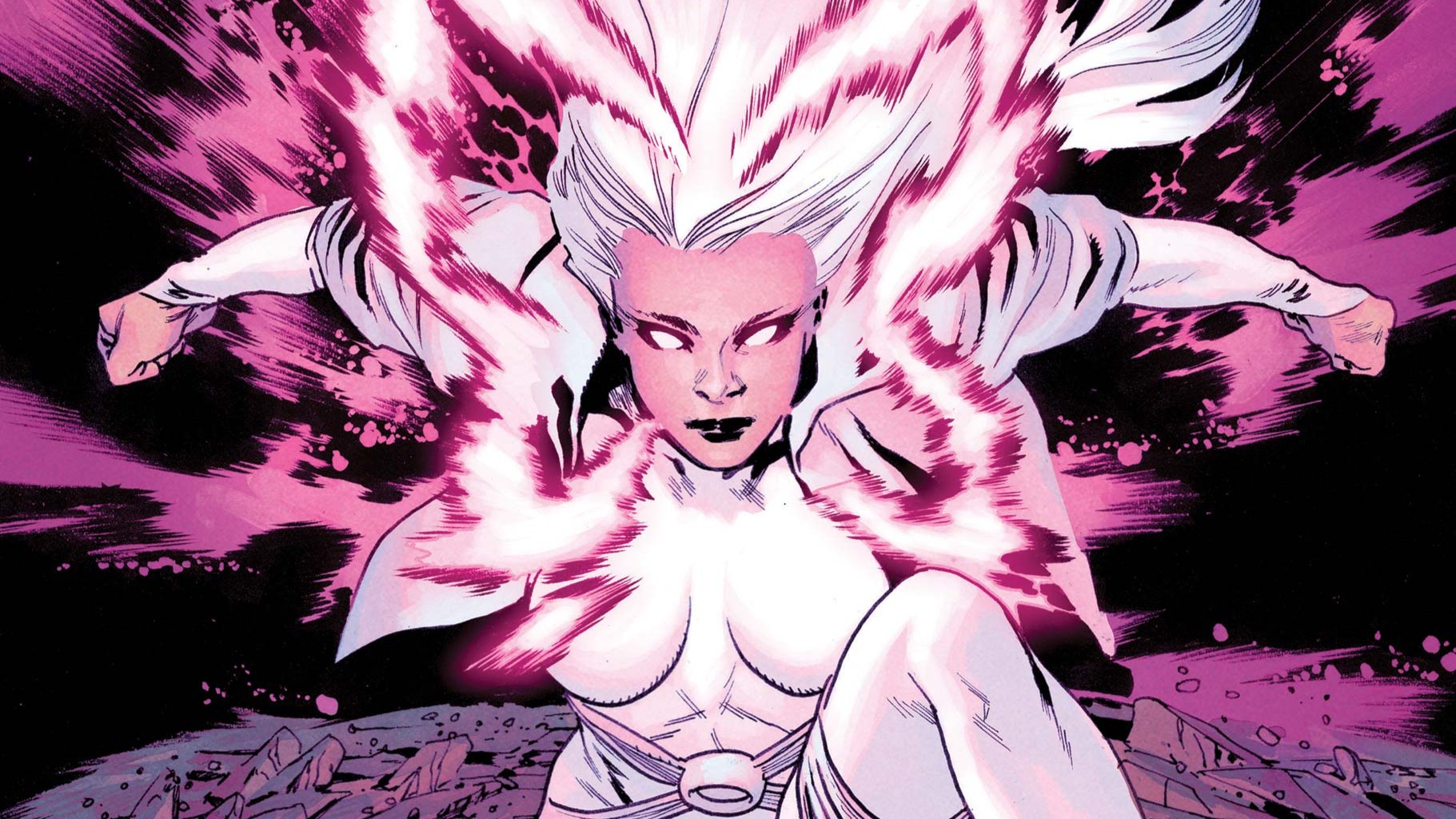
Kwannon fights the influence of the Lady in White as Mitsuki launches her assault on the Hand.
- The letters page (the series’ first) makes it clear this is the final issue of the series.
- Under the control of the Lady in White, Psylocke seems to have powers that are a mix of Iceman’s and Emma Friost’s secondary mutations, turning people into crystal.
- Mitsuki’s motivations are a bit muddled; last issue, she talked about taking control of the Hand, but here, she’s mostly just interested in destroying them, then it turns out she’s after the Equinox Blade (which first appeared in issue #8).
- Devon recognizes the Equinox Blade (which doesn’t seem to have much in the way of identifying marks) from a post on a dark-web forum, which seems like a reach.
- Kwannon fighting back against the Lady in White’s possession by drawing on her frustration at having her body being once again used as a weapon is a good use of the character’s history.
- She cuts a very vague deal with the Lady in White to get her to turn on Mitsuki; presumably, had the series continued, we would have seen the ramifications of that in a future story.
- Carratù gets in one last, great, De Luca Effect panel.

- The Hand’s children trainees are said to be taken to the Factory the headquarters of Psylocke’s faction of X-Men), though we don’t see them in the closing montage and I doubt we’ll ever see or hear of them again.
Some of the plotting here feels a bit rushed — particularly the resolution — likely due to it being the final issue, but it’s still a decent ending for the story arc.
Of course, it’s a much better story conclusion than series conclusion, through little fault of its own. Of all the various “throw ’em at the wall and see what sticks” solo series in this era, this was one of the better ones. Consistently good-not-great, but grading on the “From the Ashes” curve, that made it one of the great ones (and certainly, the best of the litany of solo titles outside Magik). It’s a shame it didn’t stick. All in all, its just one more thing that invites questions about the direction of the line at this point.
Wolverine #12 by Saladin Ahmed & Martín Cóccolo

Wolverine learns the truth about his mother.
- The trick with Cóccolo recreating the backgrounds of the panels as Wolverine and Mastermind “drive away” from the Howlett home (when Mastermind actually has them driving in circles) is a neat effect that puts readers and Wolverine on the same page as we figure it out.

- Mastermind losing control once Wolverine mentions bringing Elizabeth to “his friends” sets up an instance of the classic “I never said that…” realization after “Elizabeth” mentions the X-Men.
- His ability to seemingly read minds is attributed to Mastermind having learned to “listen to the minds of my victims for inspiration in creating my illusions” while on Krakoa, which is essentially what Emma Frost enabled him to do in the lead-up to the “Dark Phoenix Saga.” He still insists he’s not a telepath, so I guess we’re meant to recognize a distinction still between that and Mastermind’s power set, but it seems like a narrow distinction. Then again, it always kind of has (since we see plenty of telepaths creating illusions as part of their power set as well). It all seems terribly convenient, but I at least appreciate Ahmed addressing the fact that Mastermind’s power aren’t just telepathy and shouldn’t have worked the way they did in this story based on our previous understanding of them.
- Mastermind’s motivations in this story fit a similar “addressed, but not really answered” approach; he says he first attacked Wolverine to get revenge on the X-Men, I guess for vague “they defeated me reasons (though one of the problems with forcing everyone back into traditional hero/villain roles post-Krakoa is that old grudges suddenly matter after being more or less laid to rest, though at least Mastermind’s big Krakoa Era story involved him working with Sinister, who was certainly still an antagonistic force). [Ed. Note: Also, Mastermind always has been and will be a major @$$hole.]
- There’s also at least the implication that after getting inside Wolverine’s mind and experiencing his trauma, Mastermind would have settled for living as Wolverine’s mother in perpetuity.
- In the end, it’s not entirely a wash, as Wolverine seems to have come to peace with his mother’s rejection as result of Mastermind’s manipulations.
Outside of Wolverine’s mother issues getting resolved (which, for the most part, were really only raised here), the big hook of this story is the Mastermind reveal, but this issue does little to sell it as anything other than a cliffhanger ending. This conclusion also fails to address some of the other lingering “what was real, what was an illusion?” moments from earlier (remember the anti-mutant guy from the bar who said his sister was being held captive? Was all that an illusion too?). The lack of generic motivation for Mastermind and the too-cute, “was it all real or just an illusion?” ending (which is undercut by the next issue tease making it clear, “yes, it was real, we’re moving on from Mastermind) ends the story on a note of “what was even the point?”