
A Look At The 50th Annual Toronto International Film Festival
by Koom Kankesan
Summary
The Toronto International Film Festival (TIFF) ran from September 4-14. Koom Kankesan was on hand to catch films by veteran filmmakers as well as talented newcomers. The festival marked its fiftieth anniversary this year.

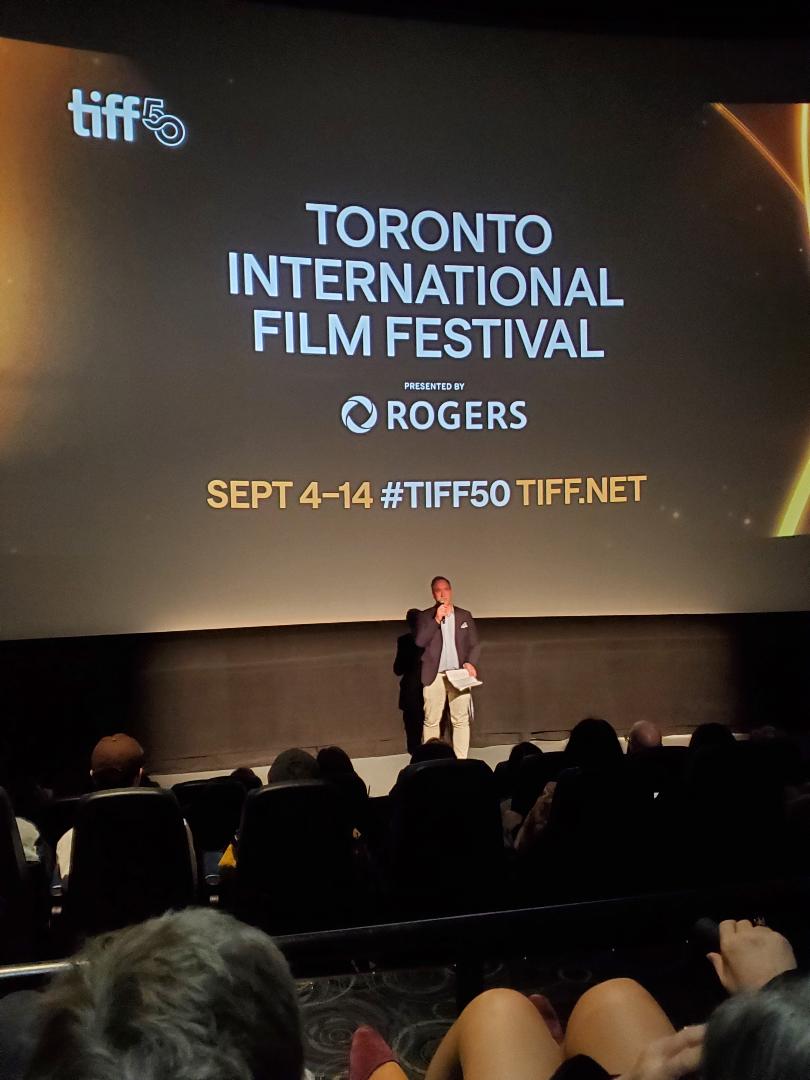
The Toronto International Film Festival (TIFF) turned 50 years old this year. The original name for the festival was The Festival of Festivals. In the years since, TIFF has turned into a behemoth of celebrity appearances, industry hobnobbing, and various people using the festival as a launch pad to premiere their films. This year’s event seems to be the busiest yet since the return to in-person programming after the pandemic. Here’s a rundown of the films I saw in the order that I saw them:

1. Nouvelle Vague, directed by Richard Linklater — I’m not usually a fan of biopics, but this wasn’t a conventional one. About the French New Wave film scene in 1959, centering specifically on the shooting of Jean-Luc Godard‘s Breathless, this film was written by two of Linklater’s friends and he revived the project after Godard’s death. It’s excellent, both for its cinematography, which goes beyond simply recreating 1959 Paris but somehow seems to inhabit it, and its insouciance and wit, much in the style of New Wave films of that time. It’s really well written and acted. It’s also in French with subtitles, which is frankly amazing for an American filmmaker. Both Linklater and star Guillaume Marbeck were there alongside a couple of producers. The festival also premiered Linklater’s film Blue Moon, but I didn’t get a chance to catch that; as a Linklater fan, I can enthusiastically recommend Nouvelle Vague.

2. Bayaan, directed by Bikas Ranjan Mishra — this is an Indian film in Hindi with English subtitles. It focuses on the sexual abuse of inductees by a religious cult leader. The charismatic personalities like the one depicted in the film are not marginalized people like Charles Manson, but revered individuals within Indian society who often are influential figures and local powers. They run the schools and places of worship; the community is beholden to them, their influence and wealth keeps the police in their pockets. Therefore, women find it especially hard to report abuses and are often shunned, attacked, or otherwise mistreated if they do. The film follows a female inspector charged with investigating the report of one such crime. It has strong production values, but is definitely in melodramatic territory. There are no musical numbers, but to most western audiences, the handling of the theme and characters will feel broad or forced.

3. The Fence, directed by Claire Denis — Denis has made a name for herself crafting films that aren’t easy to watch but are powerful. Fairly subtle, indicating more than they spell out, her work often looks at the legacy of colonialism and the relationship between Black and white people. This new film is based on a play and features Denis veteran Isaach de Bankole and Matt Dillon as the manager of a construction company in West Africa. Bankole arrives at the fence of the compound to claim the body of his dead brother (killed by a close associate of the character played by Dillon), and various discussions, arguments, and conflicts play out over the course of one night. Besides the characters played by Dillon and de Bankole are the associate of Dillon’s played by Tom Blyth and Mia Mckenna-Bruce as Dillon’s new wife. There is much to like in this film. 79-year-old Denis was on hand afterward to answer questions.

4. The Wizard of the Kremlin, directed by Olivier Assayas — another aging French filmmaker I like very much, Assayas doesn’t only make political films but can be known for them. The new film is based on a novel of the same name by Giuliano da Empoli. Paul Dano plays a Russian who starts off craving freedom and artistic expression after the fall of Yeltsin’s Russia, but ends up working for state-sponsored television as the oligarchs take over. Enter Putin, played by Jude Law. Most buzz about this movie centers on Law’s performance as Putin, but I think all of the actors are fine including Dano, Jeffrey Wright, and especially Alicia Vikander. Assayas’ films can be long (this one is almost three hours), are dialogue heavy, and can involve a lot of set-ups and moving camera. Therefore, this won’t be for everyone and criticism seems to center on how much history is packed (or over-packed) into the film. That’s another way of saying it’s rich, it’s dense, and even a less-effective Assayas film is a dizzying and sumptuous treat. Both Dano and Assayas were present to answer questions and I especially appreciate Assayas getting down on his hands and knees (the filmmaker is 70 years old!) on the stage afterwards so that fans could talk to him, ask him to sign their tickets, and take selfies with him while security tried to rush him off. Recommended.

5. Frankenstein, directed by Guillermo del Toro — this film got a lot of buzz at the festival and getting a ticket was not easy. It was also the runner up to the People’s Choice Award, so I had high hopes for it. The film definitely has strong production values and has been a passion project for the filmmaker for many years as the tale of Frankenstein is his favourite story. Starring Oscar Isaac as the titular Victor Frankenstein and Jacob Elordi as his creation, the story deviates from the original novel, placing even greater emphasis on the pathos of the creature. I’m not a huge del Toro fan. I find his writing and handling of scenes to be too heavy-handed, dramatically speaking, and his signature style of constant wide angles and oblique moving camera can be tiring. I found the film so-so, but it looks good and I’m sure the melodrama will appeal to many. I did appreciate that del Toro drew some inspiration for the look of the monster from comic artist Berni Wrightson‘s Frankenstein plates. Del Toro and company were present earlier in the festival, but were no longer in town by the time I saw a later screening.

6. Nirvanna The Band The Show The Movie, directed by by Matt Johnson — following the hapless exploits of two doofuses (Johnson and Jay McCarroll playing themselves) trying to score gig at a prominent Toronto venue, Nirvanna The Band The Show has become something of a cult phenomenon. Low budget episodes featured improvisation, Toronto locales, and creative copyright infringement, and some very creative flouting of the rules around public spaces. I’d say that the movie, though, is significantly stronger — one of those glorious comedies that come along once in a blue moon and live forever due to their freshness. This is the third film that I’ve seen the talented Johnson act in now and I wouldn’t be surprised if this film makes him into a household name and opens all kinds of doors in Hollywood. The film has been picked up for release in February and won the Midnight Madness People’s Choice award at the festival. I won’t say anything about the plot, but I will recommend watching some of the web series and then watching the movie. It puts Toronto (and Toronto happenings) front and centre on the screen and that’s something I also love. It’s excellent and I couldn’t recommend it more highly. Unsurprisingly, being local, Johnson and McCarroll were there to joke around and answer questions.

7. Miroirs No. 3, directed by Christian Petzold — I’m a fan of German filmmaker Petzold’s previous collaborations with actress Paula Beer (Undine, Afire), so I was looking forward to this one. It was decent but lacked the more nuanced characterization and mysterious depth of their previous two films. Beer’s character is a woman who survives a car accident with minor scrapes. Her boyfriend dies instantaneously. Rather than return to her apartment in Berlin, she asks to stay with the older woman who found her and called for an ambulance. Things seem fine at first, but become troubled once the older woman’s estranged husband and son visit. There are echoes of some of Petzold’s earlier themes, including identity and people relating or connecting to each other. The person sitting beside me, who hadn’t seen any of Petzold’s films, quite liked this one but I would say it’s middling for me, despite strong actors and good cinematography.

8. Modern Whore, directed by Nicole Bazuin — even though she’s not the filmmaker, this is really Andrea Werhun‘s movie. It’s based on her memoir of the same name about being a sex worker and stripper. Werhun narrates as well as plays herself in different iterations and at different times of her life. Though the ‘documentary’ tries to be unconventional and funny, using a very bold palette and stylistics, it ultimately feels unfulfilling. The project aims to normalize sex work and argues for its decriminalization. There were aspects which would have been more rewarding and revealing, especially for a documentary, if they had been explored more fully. I understand that my saying this flies in the face of one of the main points of the film — that clients and people in general often try and get under the skin and psyche of sex workers in a condescending attempt to typecast, label, psychoanalyze, categorize, and ultimately dismiss them and their choices — but the power of the documentary format is its ability to investigate a topic. Here, it feels as if Werhun, despite her openness and eagerness as a sex work activist, is trying to control the image, feel, and framework of the film too much, and consequently her own image. It feels a bit shallow at times, though it does briefly touch on important and troubling aspects of the job. It feels more like a performance than an actual documentary, though documentaries come in many different formats nowadays. Werhun and Bazuin were on hand to answer questions.

9. Maddie’s Secret, directed by John Early — the presenter introduced this film as camp and riffing on the conventions of bygone Afterschool Specials. I’m glad this introduction was given or I’d have been at a loss for how to approach it. Early both directs and stars as the titular Maddie, a foodie who gets the chance to become a food influencer on a channel geared towards “creating content.” However, her bulimic condition threatens to erupt and derail her chances of success as well as happiness in her personal life. Early is surrounded by a solid cast of comedic talents (I went to the film for Vanessa Bayer, but Bayer’s role is fairly short) and the film pulled me in about a third into it as Maddie’s problems mount. The audience was laughing throughout, although I found the humour too broad to really enjoy until Maddie’s chances for success become derailed and the stakes become more meaningful. This is Early’s debut film and will probably find an appreciate audience that enjoys both its Afterschool Special melodrama as well as its campy humour. The film gives Kate Berlant a major role and this is a great choice.
Well, that’s it for this year! Diehard filmgoers will go to thirty films or more during the festival, attending multiple screenings a day. But if I see too many films close together, they tend to blur together. Nine was a manageable number for me and I saw entries in a variety of genres and styles. The real standouts for me were Linklater’s Nouvelle Vague (the established talent stretching his creative muscles) and Johnson and McCarroll’s Nirvanna The Band The Show The Movie (the new talent, announcing their comedic chops). I was also quite touched to see Denis and Assayas in person. Although I only grazed the surface of the hundreds of films exhibited at the festival, I feel very lucky to see what I saw and fortunate to live in this city which boasts such a splendid festival.


