
Characterization In The Buffyverse — ‘Angel’ Season 2, Episode 11
by Benjamin Hall
This is part of a bi-weekly series concerning the characterization of Buffyverse characters. Arguably the best place to begin reading this series is at the beginning, but that is up to each reader. As a reminder this column will cover major and some minor characters from the shows Buffy The Vampire Slayer (1997-2003) and Angel (1999-2004). Other Buffyverse media, such as the graphic novel Spike: Into The Light (2014) are not pertinent to this series. Also there will be no referencing real world events that have direct relation to either show in this bi-weekly series. Although this series does reference things that have no direct relation to the show in order to examine things such as metaphors and literary analogues.

This week: Angel (David Boreanaz) and his former allies from Angel Investigations continue down separate paths. While this occurs, Lilah Morgan (Stephanie Romanov) and Lindsey McDonald (Christian Kane) share a promotion at Wolfram & Hart.
(Warning of spoilers from this point on!)
Angel does a lot of narrating throughout this episode. This goes against the visual storytelling rule concerning non-verbal actions being more potent than verbal. Notably, the narration results in things like repeatedly stating he is not ready to be at odds with his previous actions (Season 2, Episode 10, “Reunion”). Whether, he thinks he is not ready because of guilt or some notion of love is unclear. What is clear: Angel burns a bunch of boxes containing his drawings of Darla (Julie Benz). Although this is a way to mentally ready himself, it comes off a bit creepy when one questions who else he still has drawings of. Lastly, his attempt to let out “his darkness” suggests a lack of proper thought since a crossbow bolt or stake — plus a trap — should do.
Drusilla (Juliet Landau) has her psychic powers activate in a way that seems similar to telepathy with a basis in strong emotions. This occurs when Angel, in a thin disguise, passes behind her in the demon fight club. Her powers presenting this way is not new seeing as it happened in her first encounter with Angelus (Season 2, Episode 5, “Dear Boy”). The amount of times it activates is up for this episode, which seems more for episodic foreshadowing than for anything else. What results from some of this foreshadowing is that Drusilla and Darla look less intelligent when falling for Angel’s trap, especially after noting the motor oil smell.
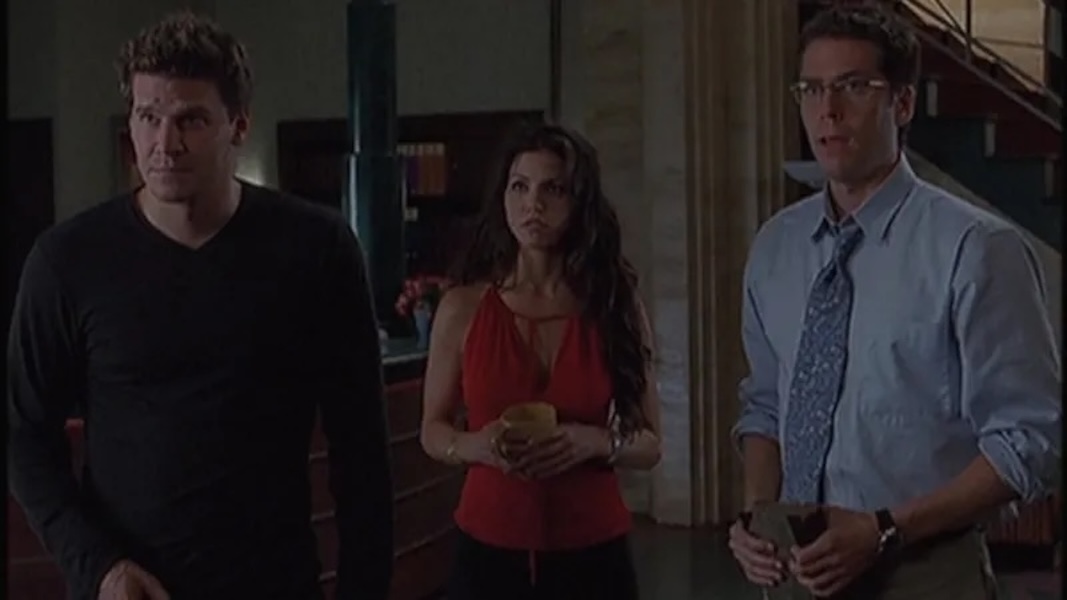
Wesley Wyndham-Pryce (Alexis Denisof), Cordelia Chase (Charisma Carpenter), and Charles Gunn (J. August Richards) all express some amount of shock and disappointment in regard to Angel’s recent actions. Arguably, the only change to their roles is Wesley stepping into the position of group leader.
Darla has conflicting emotions about Angel affecting her mental state. This is apparent when others bring him up. Yet, one can also say this is another reason she falls for his trap. Otherwise, she acts more like the mature villainess viewers recognize from prior episodes’ flashbacks. She is cunning and deadly in a somewhat wise way from a long life.
Lindsey thinking there is a purpose for why he is a survivor of Darla’s and Drusilla’s wine cellar massacre is correct. He is incorrect about their main reasoning, but he might not be entirely wrong altogether. Darla displays some trust in him, both as a human and a vampire. Yet, whether there is any type of legitimate affection beyond what he supposedly has for her is a matter of opinion. His interactions with Lilah illustrate where she is afraid, he is angry. It foreshadows who will win the full promotion.
Lilah’s justifiable fear of Wolfram & Hart demonstrates the impact past and current events are having on her psyche. Her attempt at deceiving Lindsey, along with her referencing someone else’s method of dying, highlights her fear.
Lorne (Andy Hallett) exists to provide a tiny amount of levity. Other than that, there is no reason for him to appear here.
Virginia Bryce (Brigid Brannagh) is mostly just a supportive girlfriend to Wesley in this episode. Also, the valid point she makes about Wesley doing good is debatably one of the reasons he continues on.
Merl (Matthew James) mostly serves as a plot device to highlight Angel acting “dark.” He also serves to provide exposition to help Angel locate Darla and Drusilla.
Hunt Acrey (Nicolas Surovy), the bartender (David Wolfson), Vampire #1 (Joel Stoffer), the EMT (Brad Kalas), and the demon (Jamie McShane) who doesn’t have knowledge of Darla and Drusilla are all stock characters. Yes, Hunt serves as a high level Wolfram & Hart employee, but he only exists to serve a single message.
There are theoretically at least three episodes worth of plots competing to be the main one in this episode. Thus, the amount of character development sees severe limitations because of the lack of focus. Additionally, Angel has arguably a rather pointless arc in this episode since he does some rather pointless training montages while narrating inner struggles he should be past. If one looks at his inner struggles from a Buffy Summers (Sarah Michelle Gellar) and Angel shipping viewpoint, he should be acting differently. Namely, he should be worried that Darla will go after Buffy again (Buffy The Vampire Slayer Season 1, Episode 7, “Angel”). Since he does not act this way, one could say that his later appearances on Buffy The Vampire Slayer are just teasing the fans of that couple in a cruel fashion.