
Interview: Artist M.K. Perker Discusses ‘The Stoneshore Register’
by Rachel Bellwoar
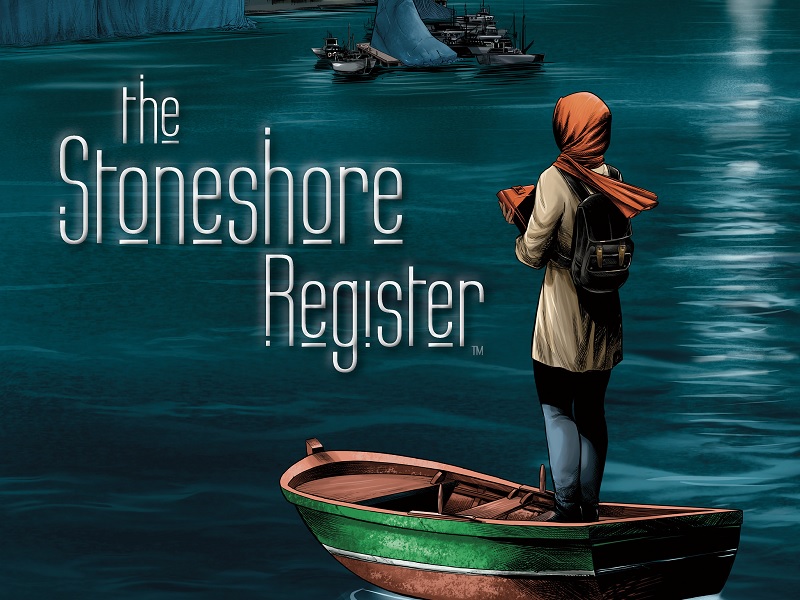
A giant statue doesn’t just show up in a town overnight, but a reporter looking for answers about that giant might in writer G. Willow Wilson and artist M.K. Perker‘s graphic novel, The Stoneshore Register for Berger Books. With letters by Richard Bruning, here’s what Perker had to share about the seaside town and its residents:

Rachel Bellwoar: I know it can be easy to bring up Twin Peaks whenever a story is set in a small town where strange occurrences are common but throw in the Washington connection and Stoneshore definitely shares some of that show’s atmosphere. At one point Fadumo even quotes Lewis Carroll (“Curiouser and curiouser”). What’s the trick to creating a small town from scratch and filling it with colorful townspeople?
M.K. Perker: I always remember a quote from Stephen King. He once wrote: “In little towns things are kind of connected under the surface and the past dies slower.” Willow has written a beautiful story with very strange characters. But they’re strange to us, to city folk maybe. To me, working on their body language was very important as well as the locations. Because what is around them shapes them. And the ones who are not happy with the shape they’re shifting into, usually run away from those places. Someone who comes to a place where everybody is leaving must have been unhappy at where she is coming from.

Bellwoar: There’s definitely a noir, mystery vibe to this graphic novel. Fadumo even uses a typewriter at her new job with The Stoneshore Register. What made you decide to go with a grey wash instead of color for this graphic novel?
Perker: Like most of us, I love black and white movies. Every director wants to give it a shot one day. The Coen Brothers did it with The Man Who Wasn’t There, [Martin] Scorsese did it with Raging Bull, David Fincher did it with Mank, Alfonso Cuaron did it with Roma which I watched 50 times. And then Steven Zaillian came up with Ripley and blew my mind. So I asked Willow and Karen [Berger] if I could ‘color’ it with grey tones and they liked the idea. We had taken a similar approach when we did Cairo almost 20 years ago. Back then gray tones were less popular. Probably it resonated with the black and white indie comics boom era. People unfortunately associated black and white with less budget and small press. It might be true up to a point but it was never the case for us. This is an artistic choice.


Bellwoar: What I love about the town’s stone giant is it’s never quite clear whether it’s supposed to be alive or not, or whether it can move. Was that ambiguity intentional?
Perker: It was. And also people in the statues are rarely in a sitting position. They’re mostly standing and look victorious. When I was working on the preliminary character sketches I initially drew him standing. Then Willow said he should be sitting and should make us feel that he is a part of the soil. I loved the idea. After starting actual pencils I even loved it more.

Bellwoar: The Stone Register also has an important point to make about chosen family. Do you think small towns sometimes get a bad rep for being more small minded than they are?
Perker: It might be but it’s actually about preserving what they have. It could be your traditions, your music, your art or your right to protest. And this is mostly in response to outside interferences. But wherever you are, in a small town or a big city, you always have a chosen, extended family. It’s not regional it’s a mindset. That’s why Greenwich Village, Montmartre, Camden Town, Cihangir or Castro exist.
Bellwoar: Thanks for agreeing to this interview, M.K.!
The Stoneshore Register is on sale now from Dark Horse Comics.

