
Pick A Card, Any Card: TCM’s ‘Film Fashion Icons’ Deck And Guidebook Reviewed
by Rachel Bellwoar
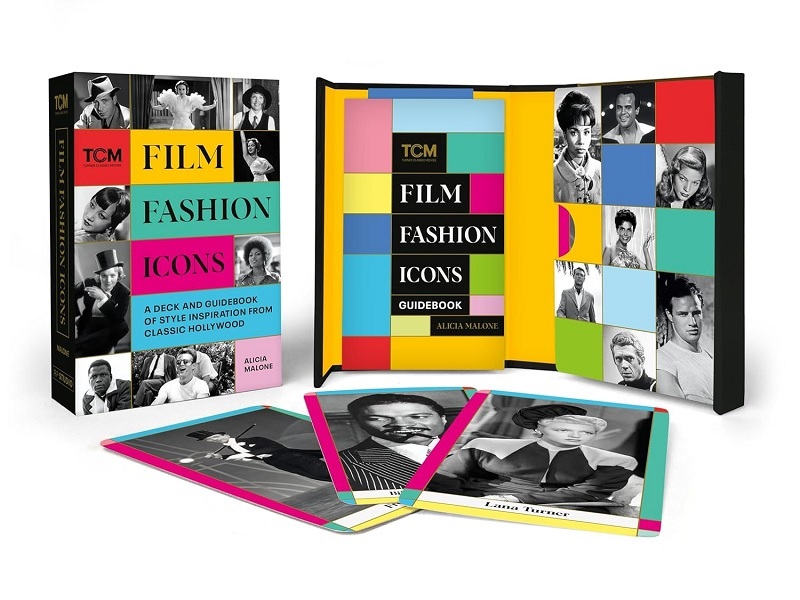
Size isn’t everything, but I’d be lying if I said I wasn’t surprised when I realized how small the cards in TCM’s Film Fashion Icons deck and guidebook are. It’s the kind of gift item you would find at a Hallmark or the spinning rack near the cash registers at a Barnes and Noble. Online, it’s hard to ascertain what size the cards are going to be. In-person, they’re both too small and not small enough.

For some reason, my original expectation was that the cards would be photo size — the kind of image you would tape on a mirror for inspiration. Then it occurred to me that they might be playing-card-size and that seemed the most promising, making them even tradable. The biggest disappointment, though, was realizing none of the cards had anything printed on the back of them. I was expecting a quote. Some stats. Information about the specific outfit worn in the photo or the costume designer who made it. Instead, the only thing on the back of each card is the same geometric print. It’s boring and doesn’t embrace the novelty of printing cards.
One thing you can’t take away from the packaging: it’s definitely compact and portable — the kind of hard cardboard that would take a lot to damage with a strong magnetic closure. The book is also removable, so you can read it in the box or slip it out and carry it separately.
In the intro for the book, TCM host Alicia Malone lays out the parameters for the actors she chose. All 40 cards are of Hollywood actors who worked in America (so no international stars) within the time frame of the 1910s and the 1970s.
The same photos from the cards are reprinted inside the book, except with the actor and costume designer (when known) credited in the caption. Some of the photos chosen are questionable. Image rights can be tricky, so undoubtedly that had an impact, but for each actor Malone names their fashionable film. For example: Lauren Bacall. Her fashionable film is Designing Woman, but the image on her card is from To Have and Have Not. It’s unquestionably a flattering photo and I appreciate that Malone kept her answer as Designing Woman even though (presumably) an image from that film wasn’t available and changing her answer to To Have or Have Not might’ve been more convenient, but it doesn’t really mesh.
On other occasions the photo picked seems like an odd choice, like the one chosen for James Dean. Instead of the iconic jacket from Rebel Without a Cause, we get a photo of him in sunglasses and a white t-shirt from the set of Giant. Another example: Joan Crawford. Yes, it’s a photo from Mildred Pierce, but not one where she’s wearing the mink coat like you’d expect.
Given the size of the book, there isn’t a lot of space for text and there isn’t really a pattern to the bios. The back of the box, for instance, promises style tips. About the closest is for Cary Grant, when it’s noted that he didn’t always wear pricey suits, but they were tailored impeccably.
Again, there’s not enough talk about the costume designers and what specifically their signatures were or what set their work apart from other designers. Learning Diana Ross designed her own costumes in Mahogany was cool. Hearing things like how the Kitty Foyle dress was popularized and named after Ginger Rogers’ character in Kitty Foyle was really interesting because that’s a movie changing fashion. Ultimately, though, this deck and guide are on the lackluster side. Malone knows what she’s talking about, but doesn’t have the room to expand accordingly on what is a fascinating subject.
Film Fashion Icons: A Deck and Guidebook of Style Inspiration from Classic Hollywood is on sale now from TCM and Running Press.

