
Previously On X-Men: ‘Amazing X-Men’ #1 Kicks The Plot Into Gear
by Austin Gorton
It’s a jam-packed week as “Age of Revelation” kicks into high gear, with both “replacement” series debuting as well as tie-in miniseries and one-shots. And at least a couple comics set in the “regular” reality manage to sneak in as well, because you can never get enough Spider-Man and/or Wolverine!
Amazing X-Men #1 by Jed MacKay & Mahmud Asrar – Book of the Week
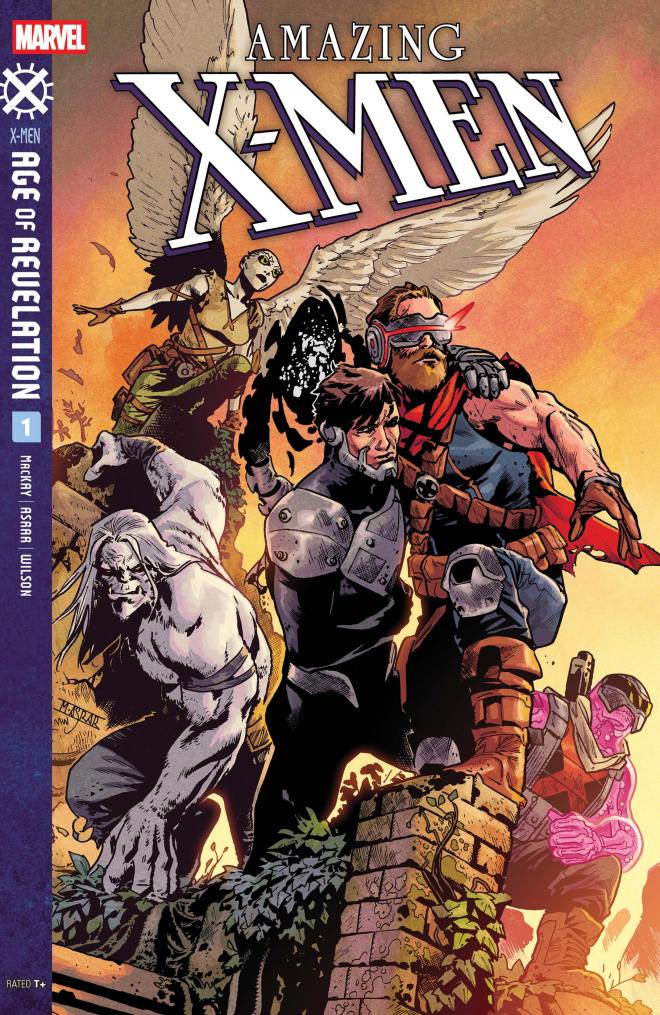
The X-Men battle Wolverine again as they execute the next step in their plan to defeat Revelation.
- This is the third volume of Amazing X-Men; the first came, similarly to this, as the replacement series for X-Men (technically, the second volume) during “Age of Apocalypse”, while the second was an ongoing series which ran from 2013 to 2015, launched by Jason Aaron and Ed McGuiness, with its initial arc concerned with resurrecting Nightcrawler.
- The opening recap blurb in several of these issues refers to the deployment of revelation’s mutant virus as a “gene bomb”, which just makes me think of the “Jean Bomb”, a bomb in the form of a naked Jean Grey, from the Rob Liefeld-drawn parody of DC’s “Invasion!” in Uncanny X-Men #245.
- Jen Starkey is using the name “Anamalia,” which I don’t believe she’s adopted yet in the present.
- It’s pretty clear here that neither Cyclops nor Beast were actually Babels before their past consciousnesses were pulled forward. What happened to their minds remains to be seen.
- Similarly, there’s several possible indications throughout the issue that Beast is not the Beast hanging out at the factory with the rest of the X-Men (he says he wouldn’t expected Doug to be able to do the things Revelation has done, despite pointedly abstaining from the vote on his membership in issue #22 due to not knowing enough about him, seems largely uninterested in Jen, finds the new world fascinating, etc.).
- Revelation’s previously seen Choristers Khora and Fitzroy are joined by Change, from the late 80s Fallen Angels miniseries. It’s worth noting that it ultimately takes being boosted by all three Choristers for Revelation to get Wolverine back under his control.

- Deathdream, one of the Outliers from Gail Simone’s Uncanny X-Men, is keeping watch over the former Xavier Institute/Graymalkin prison, which connects this issue to Uncanny X-Men arguably more than any other since “The Hunt for Xavier.”
- Deathdream notes that he’s always been afraid of Wolverine, which isn’t something we have really seen (yet) in the present.
- Glob isn’t just more violent in the future, he’s also more prone to taking charge, which is honestly a much more interesting evolution of the character.
- I love when Revelation gives Wolverine new clothes, the sleeves of his tunic are already torn.
- Psylocke appears at the end alongside the demonic Illyana and Juggernaut after her encounter with Bei in the Overture issue, when Bei told her something that would change her life forever.
Of all the “Age of Revelation” books, this is the most plot-iest, in terms of being concerned with moving whatever the overall narrative arc is forward (the rest are more about adding texture to the world/showing what specific groups of characters are up to). That makes it the most relevant, if not the best, of the bunch. It’s also nice to Asrar doing work for the X-office again beyond the occasional covers
Astonishing X-Men #39 by Alex Paknadel, Tim Seeley & Phillip Sevy

Banshee’s X-Men and the X-Cutioner converge at Morph’s trial.
- After revealing Cassandra Nova’s involvement last issue, Carl Denti, the X-Cutioner, shows up here, arming a group of followers with this weapons, creating at least the sensation of the book’s various threads starting to come together.

- Never forget, it is from the Cassiday Keep leprechauns that we first heard the name, “Logan.”
- It’s tough to buy the trial of Morph as the mutant trial of the century when both Magneto and Cyclops have been put on trial.
- Roxx News, both in its name and its approach to the news, is clearly a Fox News analog.
I continue to applaud this series’ commitment to ignoring Age of Revelation. I also haven’t heard if its been been cancelled or not, but the various plot threads coming together (and the return of Paknadel) makes it seem like it might have been.
Avengers #31 by Jed MacKay & Javier Pina

A flashback issue detailing Kang’s transformation into Myrddin.
- Kang references “that old fool Petrov”, the professor of superhuman studies whom Kang abducted in Timeless #1 (2021) to prove he was the better villain than Doctor Doom.
- Several pages of this issue amount to lots of closeup panels of Kang drinking, which is…a choice.
- Myrddin says he created the Twilight Court in the image of the Avengers, which included setting them up in “absurd love triangles and melodramas.” Which, fair.

- Kang later questions the abilities of the Avengers to overcome the King of Magic, Cannibal Culture, and Death Moon tribulation events; these are three of the events cited in issue #29 as no longer likely to occur.
- In a neat technique, as Kang and Myrddin’s personal timelines cross paths, when moments we’ve previously seen in earlier issues depicted that moment, footnotes point to it.
A decent enough, if sometimes visually-staid, bit of exposition. Without the benefit of hindsight, I’m not sure how necessary it is to devote an entire issue to filling in these details, but I’m also down for timey-wimey Kang shenanigans, and this issue does some fun things within the trope.
Binary #1 by Stephanie Phillips & Giada Belviso

After almost ten years of using the Phoenix Force to protect a small town from the Age of Revelation, forces move against Binary.
- This takes over from Phoenix, but brings over Giada Belviso from Laura Kinney: Wolverine as the artist.
- Phillips does a good job of laying out the history of Carol’s use of the name “Binary” in the issue, but it’s worth noting that this is the first time it’s been a title of book starring her; for the most part, her time as Binary fell during a more fallow period of Carol Danvers’ popularity, when she wasn’t carrying a book on the regular.
- This issue does a thing that far too many stories do nowadays, where they start with something interesting, then jump back in time to before the interesting thing happened to fill in the details that led to it. Just start with the interesting thing and go from there! Usually, the setup isn’t that important — its certainly not here, where we get everything we need to know up front, and the town hall meeting adds little.
- Carol was indeed born in Beverly, Massachussetts, as established in Ms. Marvel #13.
- She says she’s been operating as Phoenix for almost ten years; since this story takes place ten years in the future, this suggests Jean doesn’t make it very far into the Age of Revelation.
- How exactly Jean could die but the Phoenix Force persist amidst the notion that Jean is Phoenix and Phoenix is Jean isn’t clear, though the Tom Brevoort X-office doesn’t seem to like that idea much, so it may not be a concern to this story.
- In Amazing X-Men, Cyclops notes that he can’t reach Jean and no one will tell him where she is; this issue posits that she’s dead (with Carol Danvers having taken up the Phoenix Force), though I suspect it’s more complicated than that.
- The mechanics of all this are a bit dicey: what is this town eating? Is someone on the outside passing them food? Why hasn’t Revelation tried to take it out, or why hasn’t Carol just used her power to up and move everyone
- The tease at the end of the issue — of a red-haired woman sinisterly watching Carol from afar — is likely either Jean or Madelyne Pryor. My money is on Maddy (based on the mixed Biblical metaphors and talk of serpents), but it probably depends on how you interpret the intention: are we supposed to think it’s Jean, in which case it’s Maddy, or is it being Maddy SO obvious that it thus must be Jean? We’ll see, probably!

Even though this a “replacement” book and not just an “extra” tie-in (though only sort of, since Phoenix isn’t coming back), it sure reads like an ancillary fill-in book. Carol just hanging out trying to keep one city safe simply isn’t all that interesting.
Laura Kinney: Sabretooth #1 by Erica Schultz & Valentina Pinti

Laura reunites her estranged siblings in order to move her son out of the Revelation territories.
- Erica Schultz continues to write Laura Kinney as this replaces Laura Kinney: Wolverine, though with a new artistic collaborator.
- For whatever reason, this book gets a slightly different recap, leaving out the “gene bomb” summation most of the other titles have.
- Laura is a “Seraph” to Revelation, which I believe is roughly equivalent to Apocalypse’s Horsemen, though she’s only recently been elevated to that position.
- The father of her son Alex, Zane Creed, son of Sabretooth, is a new character, though just based on the timing of it all, he would have to be alive in the present day even if Laura (and us) haven’t met him yet. Having her adopt the Sabretooth moniker in honor of her dead lover/father of her child is at least a little better than having her suddenly be all about Victor Creed, but the fact that Zane chose to take up the name in the first place isn’t great, either.

- It’s not entirely clear if Alex has no powers because he’s human (and hasn’t been infected by the X-virus yet) or is just a pre-manifesting mutant because he’s so young. If it even matters.
- Akhirio is still Hellverine, which is a nice bit of continuity.
- Both Shark Girl (late of Dazzler’s band) and Sage (late of the “From the Ashes” X-Force) pop up here.
- “Scout and Fang” were Gabby and Akihiro’s codenames during the Krakoa Era.
- Gabby and Akihiro hanging out at the end of the issue makes me wonder what life is like for “normal” mutants in the Age of Revelation. During the Age of Apocalypse, it was pretty clear life was pretty awful for everyone except the top echelons of Apocalypse’s society, whereas in Age of X-Man, most everybody seemed to have a decent (of sex-less and child-less) life. It’s as yet unclear in this event to which of those two extremes the bystanders who aren’t serving Revelation directly or fighting to defeat him fall.
The art is rough (like many other artists, Pinti struggles to draw Alex realistically and consistently as a roughly seven to ten year old child). But I like a lot of everything else this is doing. Having the star of one of these books at least start out on Revelation’s side is a smart deviation, and its supported by the way Schultz connects it to Laura’s mission in the present — she’s no zealot, but sees Revelation as the best means to accomplish her goals of protecting mutants (which makes this the only book of the bunch this week to really like an extension of its “original” series). There’s also clear emotional drama at the core of this: all other trappings aside, the conflict between Laura and Gabby is realistic and believable.
Longshots #1 by Gerry Duggan, Jonathan Hickman & Alan Robinson

With Revelation clamping down on filmed entertainment, Mojo assembles a team of superhero bounty hunters in a reality show to capture ratings.
- Full disclosure: I have very little patience for Mojo stories. The good ones (of which there are few) are sharply whimsical and smartly satirical, while the bad ones try to do both and end up some combination of loudly unfunny and hamfisted. This…doesn’t seem like one of the good ones.
- Doing a comedy book in the midst of Age of Revelation doubles down on some of my questions from Sabretooth re: the state of the average bystander. If people are meant to suffering in this reality, it seems crass to do a book that tries to be funny in that setting (there was no comedic Age of Apocalypse book, for example). If things aren’t that bad, then it weakens the stakes of the more serious stories focused on defeating Revelation.
- It also doesn’t help that because Mojo (and to a lesser extent, Longshot) are used so often in these kind of fourth-wall-breaking, loose continuity stories, it’s hard to criticize (or appreciate) the characterization. Is Longshot being a prima donna here inconsistent with his last appearance? It doesn’t matter, because it’s all a gag anyway!
- One gag I do enjoy is having Mojo’s “greatest hits” of backstories include the ones where he’s drawn by Art Adams and gets defeated, a reference to the various Mojo-centric X-annuals from the late 80s (like X-Men Annual #10, #12 and Mojo Mayhem).
- Bishop’s cybernetic arm in this story is the arm of Bucky/Winter Soldier/the Revolution.
- The “Pop Up Bar With No Name” is a riff on “the Bar With No Name”, a criminal hangout from Daredevil comics (though again, the gag underscores how messy this story is – are pop up bars still a thing ten years in the future during the Age of Revelation? Is the Mojo of that future creating these captions, which, if so, why is he making ten year old jokes? If Mojo is a vehicle for jokes and satire, and this story takes place in an alternate future, should they be built around the present day of the creators writing the comic or the in-universe culture of the future world?).
- More references: the stage for Mojo’s show is at Project: Pegasus, a secret energy research lab that was a big deal in the 80s era Marvel-Two-In-One team-up book, the “Mojo Plus” streaming service is clearly a reference to “Disney Plus”, “Hall M” is a Mojo-ized riff on “Hall H”, where all the big panels are held at San Diego Comicon, and the mission briefing is a loose parody of the Rebel’s Death Star briefing in Star Wars. (Ed. Note: This also shows that Mojo is still operating out of Earth-616 as well as the Mojoverse, a status quo that started back in X-Men Black: Mojo and has continued through NYX most recently.)
- All else aside, I do like the art in this, which has an almost Nick Bradshaw quality to it in places.

There is an existential question as to why this particular event needs a comedy book, but an even larger one as to why Gerry Duggan and Jonathan Hickman (a key and the key author of the Krakoa Era) came back to the X-books to write it. Nothing about this reads like either of their work, there’s no real satire to it outside of some weak fourth-wall-breaking gags and winks to readers (“it’s funny because the streaming services in the real world don’t reveal their ratings just like Major Domo said!”), and it’s also not really that funny. What are we even doing here? Are Duggan and Hickman punking us?
Spider-Man & Wolverine #7 by Marc Guggenheim & Gerardo Sandoval

Spider-Man and Wolverine discuss the ethics of killing while battling a Vermin hoard.
- The Sales Gods know no Age of Revelation, and thus, this series starring two of Marvel’s top-selling characters drawn by one of their top artists continues as normal.
- Said artist is on a break this issue, with Sandoval filling in once again.
- Vermin is an old Spider-Man villain (who actually debuted in Captain America), probably most well-known for the role he played in the seminal “Kraven’s Last Hunt” story.
- Wolverine references his experiences during the Morlock Massacre, specifically when battling Sabretooth for the life of the Morlock Healer in Uncanny X-Men #212, which gets a little flashback panel.

- Varys, the Morlock who triggers the pack of Vermin (and whom Wolverine ultimately mercy kills), is a new character.
- Spider-Man suggests calling in Damage Control, the Marvel Universe’s “superpowered fight” clean-up crew.
Once again, it’s always tough when the artist of an artist showcase books needs to be spelled, but plot-wise, this is maybe the best issue of the series yet? It tells a mostly self-contained story driven by the differences in approach and mentalities between its two characters without devolving into the kind of nonsense personified by Dreadshadow.
World of Revelation by Al Ewing & Agustin Alessio, Steve Foxe & Jesús Merino and Ryan North & Adam Szalowski

Apocalypse receives Bei’s message from an unlikely messenger, Wiccan serves as a tragic object lesson to other heroes, and HERBIE carries out a mission from a tragically-mutated Franklin Richards.
- An anthology featuring three different stories, the first is the only one with a direct impact on the plot of “Age of Revelation.”
- It also serves as a recap/status check-in for Arakko (which Al Ewing did the most work to develop), including references to the Genesis War from X-Men Red, Sugar Man claiming the Spire in X-Men #21, and the human settlement of Port Prometheus.
- Ewing seems to be expressing some commentary on the use of AI in art, talking about how art is sacred in the Morrowlands of Arrako, and the thought which created the art is also sacred and private, with telepaths who steal ideas being harshly punished.
- In other fourth wall breaking moments, Apocalypse, upon receiving Bei’s news, says he should have chosen Rictor (who was more or less Apocalypse’s apprentice in Tini Howard‘s Excalibur) as his heir, a sentiment shared by many readers (as well as, presumably, Ewing).

- Professor X turns out to be the messenger, which is a fun twist. For whatever reason, he’s wearing the Frank Quietly-designed leather jacket uniform from Grant Morrison‘s New X-Men.
All three of these stories are pretty solid (though there is something a little odd in setting a story at least partially 71 million years in the future of a timeline we all know is going to be averted in less than three months), but the clear standout is the Apocalypse one. Even in brief, it’s a delight to have Al Ewing back writing about his Arakkoan wierdos, Alessio’s painted art gives it a sense of grandeur (as does starting off the story as a block of text alongside full page spreads), and it’s a hoot to see Xavier and Apocalypse both lamenting how they biffed it with Doug.
