
An Interview With ‘Space Scouts’ Writer Matt Kindt
by Rachel Bellwoar
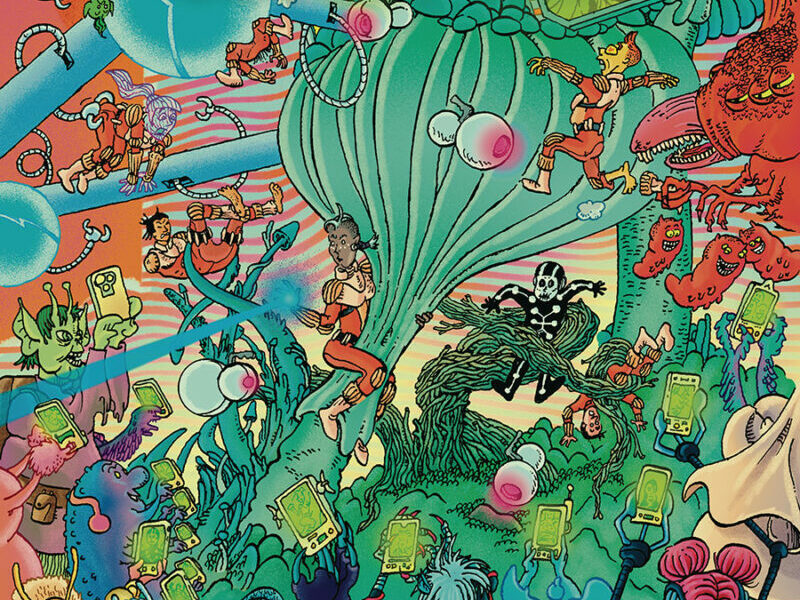
Being a hero’s not all it’s cracked up to be. At least that’s what Ember’s always believed. Leave it to others to dream of becoming a space scout someday except — despite Ember’s best efforts — she’s been chosen to compete to become a space scout anyway in writer Matt Kindt and artist David Rubín‘s new series Space Scouts. For more on Ember’s plight, check out this interview with Kindt below:

Rachel Bellwoar: You and David Rubín previously collaborated on Ether. What was it about Space Scouts that made you want to make that your next project together?
Matt Kindt: David and I are always talking about what project to work on next. We’re such a good fit creatively that as far as I’m concerned, I always want to be working on something with David or planning what the next thing is. I usually have five or six ideas I’m working on at various stages. Just short story ideas or vague outlines. So every once in a while, I’ll send those to David to look at and let him pick one or sometimes he kicks back ideas based on things I’ve sent him. With Space Scouts in particular, I think we both had a love of ’70s and ’80s superhero comics in the vein of Legion of Super Heroes and that kind of thing, with a huge cast of colorful characters. The joy of this project was coming up with a huge cast with alien backgrounds and insane superpowers. I won’t say the story and plot was incidental — it wasn’t — but the reason to do this book was to create a bunch of fun characters and then put them through the most terrible things we could think of.
Bellwoar: As Ember herself acknowledges, rejecting the call to adventure is a classic early step of the hero’s journey. However, Ember never really moves past that stage in the first issue. What do you think it is about the idea of the reluctant hero that’s so appealing and do you think it’s true that the best leaders are the ones that aren’t looking for power?
Kindt: The reluctant hero is such a trope — the hero’s journey, etc. I really wanted to just hang a lantern on that idea and then go forward. How can you subvert that hero’s journey? I wanted to break that concept and still have a story that works. There are some ideas out there that you can’t avoid. They’re everywhere — and the fun for me is to find a way to play on that expectation and then subvert it in a fun and interesting way. I remember someone reviewing the first issue of a series I did years ago — Ninjak for Valiant and the first issue is basically a play on the rich guy who becomes a hero — Batman essentially. And the review of issue one was talking about how it was just kind of rip-off of Batman … which I thought was funny. I’ve been working in comics for twenty-five years, and you think I’m not aware of Batman’s origin story? Do you think I’m just mirroring that for no reason? Ideally, you’d keep reading it and realize the trick I was pulling in that series. And it’s the same here. I’m actually counting on you also being very familiar with Batman’s origin. And I’m counting on you being very aware of the hero journey trope…it only works if you’re somewhat versed in those ideas..and most of that is now in the general pool of knowledge. It’s not inside-baseball. I think readers are more intelligent and aware of genre and tropes than they ever have been before.
Bellwoar; Thanks to Ember’s narration we get to know her well in the first issue. Did you ever consider not letting readers have access to her interior monologue?
Kindt: You could/can read this entire series and skip all of the captions and still get the plot. The art and dialogue tell you all you need to know. It’s designed to work that way and you could finish an $8 comic in five minutes. I guess I want more out of my comics. I want a longer experience. I want to stay with the characters a little bit more and maybe dig a little deeper into one of them. As much as I love comics and for all the amazing things they can do that other mediums can’t…they lack something that prose has and that’s depth and immersion. Rarely has a comic book actually moved me. Twice in my life as a matter of fact. It’s hard and nearly impossible to do. Those two books were Brian Bendis during his run on Avengers and Kent State by Derf Backderf. I’ve read thousands of comics over the last forty years and those are the only two that got me. The argument, I guess I’m making, is that if you strip out internal monologue or captions, you end up with a comic that isn’t using all of the powers that comics can employ.
Bellwoar: Ember is competing to become the next space scout. Unlike other series where there’s a competition, though (like Hunger Games and Squid Games), death isn’t held up as the cost of losing. Why did you want to allow your eliminated players to survive?
Kindt: That’s a bit of a spoiler. I’ve been a huge fan of the “contest of champions” since that old Marvel series … Contest of Champions. Then Secret Wars … and when I saw the movie Battle Royale — I realized that’s one of my favorite genres. I love every form it takes, from Survivor to Squid Games and everything in between. I love playing Fortnite (with my friends) — I like the idea of those kind of stakes – you get one life and that’s it. You win or you’re out. Again, I’m playing on the trope of that elimination event in a way that won’t be quite apparent to the reader until the end of issue #2 and the beginning of issue #3. I guess I’m asking for the reader’s trust that, yes, I’m aware of those other stories and I’m playing with your expectations, trusting that you’re aware of those things as well. The twist in this series was really the spark that made me take it from the “maybe” list of ideas to the “for sure, I’m doing it” list.
Bellwoar: A lot of dystopian stories tend to gravitate towards dull or muted color palettes, or at least that’s the cliche. Was it always your intention to make your future colorful?
Kindt: If you’re working with David — it’s going to be colorful. David does everything you see on the page and that’s why we kind of agree on the story we’ll work on together, because he brings such a unique personality to the story that it has to be just the right thing. I remember on Ether — I was going to draw that book and it was going to be this really dark and somber thing … and then we agreed to collaborate and it turned into this fantastical visionary work which was completely the opposite of what I was picturing — but it worked so much better! The story is really kind of dark and sad and the contrast with the art is what makes it palatable. Like putting salt on watermelon, but in reverse.
Bellwoar: During orientation we get to briefly meet three of the four original space scouts. How did you set about making them stand out and could there be a prequel series someday?
Kindt: A prequel and/or sequel would definitely be fun. We’ll see how this book does, but I know we both love the characters and the universe. The older characters were essential to the story and we also wanted the world to [feel] lived in. The Scouts have been around for a long time. We just chose this moment to tell this one story, so it’s really ideal to jump forward or back. I think one of the big inspirations for this story was when DC relaunched the Legion back in the ’90s. Keith Giffen’s run was so crazy for me at the time. I had no idea who the Legion was and all of the characters were in normal clothes and using their real names instead of code names, and I was completely lost. And that was the appeal to me — there was all this history. All of this past drama, and I was just dropped into the middle of it and forced to try to figure it out — and without the help of the internet or access to any back issues!
Bellwoar: One character we haven’t been told much about yet is the MC who keeps announcing the challenges via video screen. He looks a bit like Rasputin. Is there anything you can tell us about him?
Kindt: Ha! Sure — he’s a character that recurs in all of my books — taking on various names (Verve, Verge, Corridor, etc.) – usually as the villain. He starred in his own book Subgenre that came out last year that the amazing Wilfredo Torres drew.
Bellwoar: With the rise of reality TV shows and competitions, there’s been a lot more awareness around production interference on those programs. Has that been an interesting topic to explore?
Kindt: I liked playing with the idea of mass media and the viewers driving the narrative … choosing who lives and dies. And I don’t think there’s anything really new there or in what we did while handling it. It’s a popularity contest and whoever gets the most likes and views wins … but what we do with that and the twist in issues #2 and #3 is where we do something original, I think … you’ll have to keep reading to find out.
Bellwoar: In the backmatter dossier, we get to meet some of the other competitors. Do you have those backstories written before David draws them or does he design the characters first, or both?
Kindt: I had an outline for the story, and then we both came up with a bunch of character names, designs, and powers to populate the story and then I wrote back story and origins and details for all of them. It was really nice to have all of that done before going into the full scripts. And the back matter was a great way to add a little more depth and world-building without interrupting the main narrative. Yeah — we had a ton of fun with that.
Bellwoar: Thanks for agreeing to this interview, Matt!
Space Scouts #1 goes on sale November 5th from Dark Horse Comics.

