
‘Transformers’ #25 Review — Striking A Balance Between Old And New
by Austin Gorton
Overview
With Transformers #25, the new creative team of Robert Kirkman and Dan Mora smartly thread the needle between continuing what was working and putting their own stamps on things, with an issue that follows on directly from the end of the last arc while also pointing the series in some new directions.
Overall
8/10Transformers #25 marks the first significant creative shakeup in the Energon Universe, with writer Daniel Warren Johnson — who launched the book — giving way, alongside artist Jorge Corona, to the incoming creative team of Robert Kirkman and Dan Mora.
But given Kirkman’s role as the de facto “executive producer” of the Energon Universe, readers have reason to believe the transition will be relatively seamless. For the most part, this first issue under the auspices of the new creative team confirms that belief, picking up perhaps more directly than anyone expected from the end of Johnson’s story, while also changing things up, in ways both direct and subtle.

It is all too common in the modern comic book landscape for a new creative team to come onto a book and initiate a clean break — not completely disregarding what came before, but jumping ahead in time, or opening in media res in the midst of new status quo (often with a fresh new #1 issue to goose sales). To Kirkman’s credit, that doesn’t happen here, with Transformers #25 opening in the immediate aftermath of Johnson’s final issue, with the defeated Decepticons rallying in their underwater base while the Autobots help pick up the pieces of the shattered Chicago.
It helps that Corona is on hand for the opening of the issue, depicting the Decepticon rally before giving way to Mora for the Autobot portion of the issue, creating a kind of visual handoff from the old creative team to the new.
As the same time, both Kirkman and Mora make it clear they have their own takes on the characters and story. Megatron’s opening excoriation of the Decepticons, in which he calls each out by name and criticizes them by calling attention to a specific personality trait, seems like an homage from superfan Kirkman to the opening issue of the original Marvel Transformers series, in which scripter Ralph Macchio crams a ton of introductory character exposition for both factions into tiny captions that fill the pages (one example of which reaches across a double page spread, as here; thankfully, the level of detail Corona puts into his characters keeps the whole thing visually engaging in this issue).
The transition from the Decepticon portion of the issue to the Autobot-led one is punctuated by a Decepticon logo on one page followed by an Autobot logo on the next, which I have to image is an attempt to recreate the scene transitions of the original 80s cartoon. Both Johnson and Kirkman are longtime fans of these characters, and Kirkman is quickly establishing his bonafides.

He also lays the groundwork for his own take on the series as well. The arrival of some fan favorite characters gets teased while Kirkman somewhat abruptly (and randomly) reverses one of the big status quo changes Johnson executed in his final story. Meanwhile, the threads of the Energon Universe are also pulled tauter, as Kirkman connects one of Hasbro’s lesser properties to this book (after being introduced via G.I. Joe in an Energon Universe one-shot earlier this year), making it clear the property going to play a key role in this series going forward.
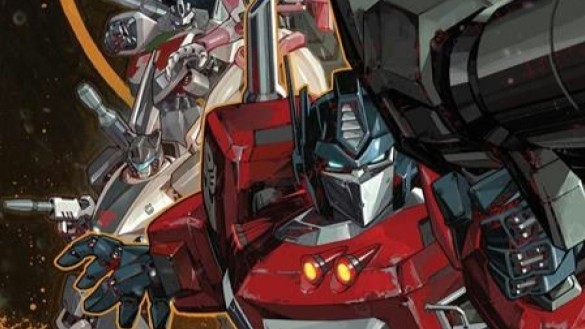
Perhaps most pronounced is the visual aesthetic of the series. Whereas Corona gave the book a darker, almost grimy, hue, Mora’s take on the characters and their world is much brighter, in terms of both the backgrounds and the characters themselves (colorist Mike Spicer remains, so the change is clearly driven by Mora).
While it would be unfair to say that Mora’s work lacks detail (he takes the time to draw in all the various loose wires and hoses in Optimus’ damaged arm, for example), his Transformers are, generally, much smoother-looking than Corona’s (whose Transformers always looked like the sum of their parts, as if a loose bit could fly off at any moment). At the same time, the visual language of the book remains consistent; a brawl between Optimus and Soundwave features the same kind of up-close, wrestling-inspired kineticism that the Johnson/Corona team brought to their action sequences.

That, then, is Transformers #25 in a nutshell: different enough to make it clear that the new creative team has some ideas of their own for where to take the series going forward, but not so different that its jarringly-disconnected from the established aesthetics of this world. It’s a smart move, opening the door to new story ideas and creative styles, while also recognizing what was working in the series and not throwing that out in the interest of a completely fresh start.
