
Danish Melodramas: ‘Angst By August’ Reviewed
by Rachel Bellwoar
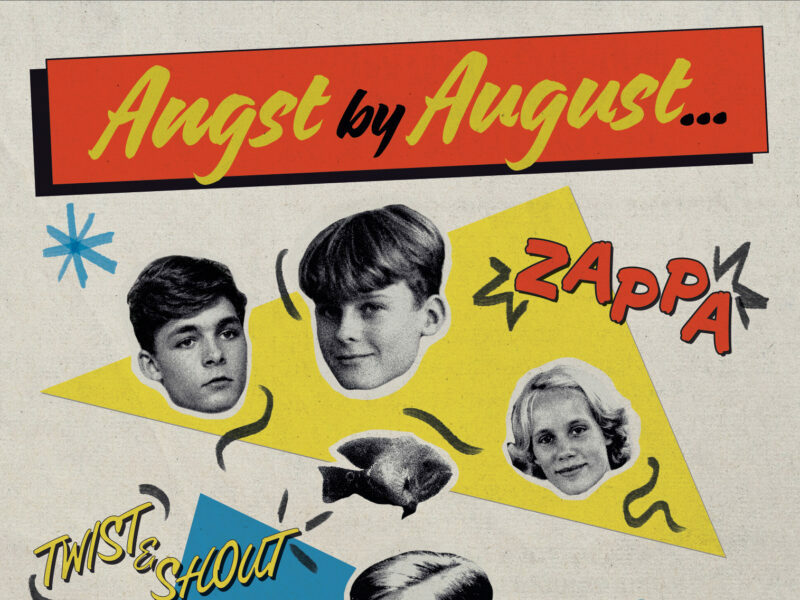
Once you know what Angst by August is you can really appreciate the cover art Beth Morris designed for this Blu-ray from Altered Innocence — a double feature of two of director Bille August‘s films, Zappa and Twist and Shout. Released in the early 1980s but set in the early ’60s and featuring a ’50s aesthetic that hadn’t yet been replaced, the floating heads identify the main characters in both films as well as show how only a few years can make a difference, as Adam Tønsberg and Ulrikke Bondo reprise their Zappa roles in Twist and Shout. The trouble is, while both of these films did well in the United States at the time I don’t think it’s unfair to say they might not be as recognizable to fans of ’80s movies today and the first impression I got from the cover is that this was one of those ’60s rock and roll movies like Beat Girl that are light on plot and heavy on scenes of young people dancing.

That’s not the case at all. For one thing, Bille August is a Danish director and both of these films are in Danish. Turns out America and the UK don’t have a monopoly on teenagers sporting pompadour hairstyles and doting on the Beatles. Secondly, there’s a reason this set is called Angst by August. This is basically a Danish take on the melodramas by Douglas Sirk and starring actresses like Joan Crawford. They’re very different. For instance, take Bondo’s put-upon love interest, Kirsten, who unfortunately carries a torch for Bjørn (Tønsberg) in both of these movies. Rather than get hysterical when Bjørn disappoints her (as would be the expectation in an American melodrama like Peyton Place), her reactions are much more controlled and chilling in a different way.
August’s use of color filters, particularly in Zappa, definitely recalls Sirk and even the horror films of Mario Bava and Hammer Studios. For instance, green becomes associated with the fish tanks that Bjørn’s friend, Steen (Peter Reichhardt), has in his house — particularly the one that houses his favorite fish, Zappa, who eats other guppies for lunch. That Zappa was chosen to be the title of the first film basically tells you this isn’t going to be your lighthearted teenage film where it’s all hijinks and first loves. Those elements are there but the tone is much darker (and intune with a carnivorous fish) and, because these films are European, there’s a frankness about sex and violence that’s not always in American movies, which can be sanitized.
Indeed, while Zappa opens with the “boys on bikes” trope that’s been a favorite of nostalgic fare like Stranger Things, Zappa is much more Rebel Without a Cause and Stand by Me but with a protagonist in Bjørn who’s a lot more flawed than James Dean or River Phoenix. Like his parents (who are impressed with Steen’s family’s money), Bjørn is infatuated with Steen and eager to establish a gang with him, even if that means looking the other way when Steen is cruel to his less monetarily well-off friend Mulle (Morten Hoff). As Steen starts suggesting they commit more serious crimes, however, Bjørn doesn’t know how to stand-up to him, especially as his parents seem unwilling to contend with the possibility that class might not dictate a person’s worth.
Bjørn’s main strategy is avoidance and given that trouble seems to slide off his back, it’s a strategy that’s working even if it doesn’t endear him as a character viewers would want to follow. That’s what makes Twist and Shout such an interesting sequel. While both Bjørn and Kirsten are back, the film works as much as a standalone movie as it does a sequel. No knowledge of Zappa is needed to understand what’s going on, but Zappa does very much color your opinion of Bjørn in Twist and Shout and whether he’s given a blank slate or whether his past (and how few consequences he’s had to face) make him less sympathetic from the start.
August (who co-wrote the screenplays with Bjarne Reuter, whose novels the films are based on) isn’t afraid to experiment with structure. The first image of Twist and Shout, for example, gains a greater significance by the end of the movie and at one point in Zappa we see the boys carry out one of their crimes, only for the film to then jump and show them spending their ill begotten gains. The impression is that they got away with it. What they did was wrong but ultimately not a big deal, except it turns out their crime didn’t go as smoothly as their celebrating would indicate. When the film goes back to show what really happened, it makes their partying afterwards seem even more callous than if it had played out in chronological order
Where music was used sparingly in Zappa, Twist and Shout begins with Bjørn wanting to be a drummer and surrounded by music. The rest of the film then proceeds to crush those dreams and turn them into a distant memory. Twist and Shout also introduces a new best friend for Bjørn in Erik (Lars Simonsen), whose family responsibilities keep him home a lot. To this day mental illness isn’t covered often in movies, let alone in a period piece, and this storyline feels particularly powerful.
Altered Innocence’s Blu-ray comes with a new 30-minute interview with August in English and a visual essay by critic Jordan Cronk. For cinephiles whose only reference to Scandinavian cinema is Ingmar Bergman (who August names as an influence), this set is a great opportunity to expose yourself to another culture’s conception of melodrama.
Angst By August is available on Blu-ray starting October 28th from Altered Innocence.

