Advance Review: ‘The Dragons Of Paris’ Slumber No More
by Benjamin Hall
Summary
Summary: Mix some dragons, a friar, a mermaid, plus a fighting princess from the Hawaiian islands. Next throw them into a past period of Parisian history. Finally stir in a lot of danger and romance. Now let’s see what the results are in The Dragons Of Paris. Is it a folkloric pleasure read for you?
Overall
9.5/10The creative team includes writer Joann Sfar, illustrator Tony Sandoval, and letterer Chris Northrop. Also, there is translation from the original French to English by Dan Christensen.
When it comes to the writing, there is a lot of humor to offset the dire situation the characters face. Oddly, the supporting and main characters are practically one-and-the-same. They all play a major factor in concluding the story. Also, their respective character arcs end up converging. Thus, it is hard to say that there is an actual separation between the two types. Luckily, they each seem to have differing perspectives on the world, along with distinct personalities.

The art and writing come together in a near perfect combination. Depending on the reader’s personal opinion, though, the art may be better than the writing or vice versa. No matter what opinion one may have, it is easy to see that the plotting and visual pacing are definitely in tune with each other. One clear instance of this is how the characters’ paths converge. Another example: the omniscient narration occurs in a way that goes well with both the visuals and the dialogue. Although this latter point is also thanks to the excellent lettering of Northrop.

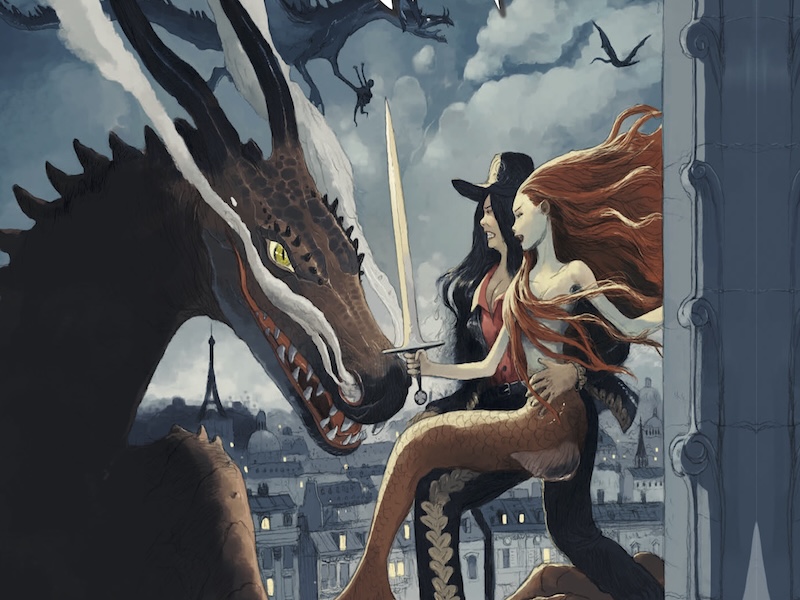
The illustrations evoke in this reviewer’s mind a smattering of styles, but primarily the works of artists Sergio Aragonés and George Prosper Remi, alias Hermé (Groo Special #1 [1984]), and The Adventures Of Tintin [1975]). In the case of the former, it is because of how weird and wild some of the designs get while having more curvature to the line work. The latter is a possible inspiration since the primary location is in France and the sense of realism is about the same as Hermé’s style. Yet, the range of colors and their application are more fantastical than either of the probable inspirations for the art. Nevertheless, the entire visual narrative is a thing of beauty.
The Dragons of Paris comes out from Magnetic Press on December 3rd.