
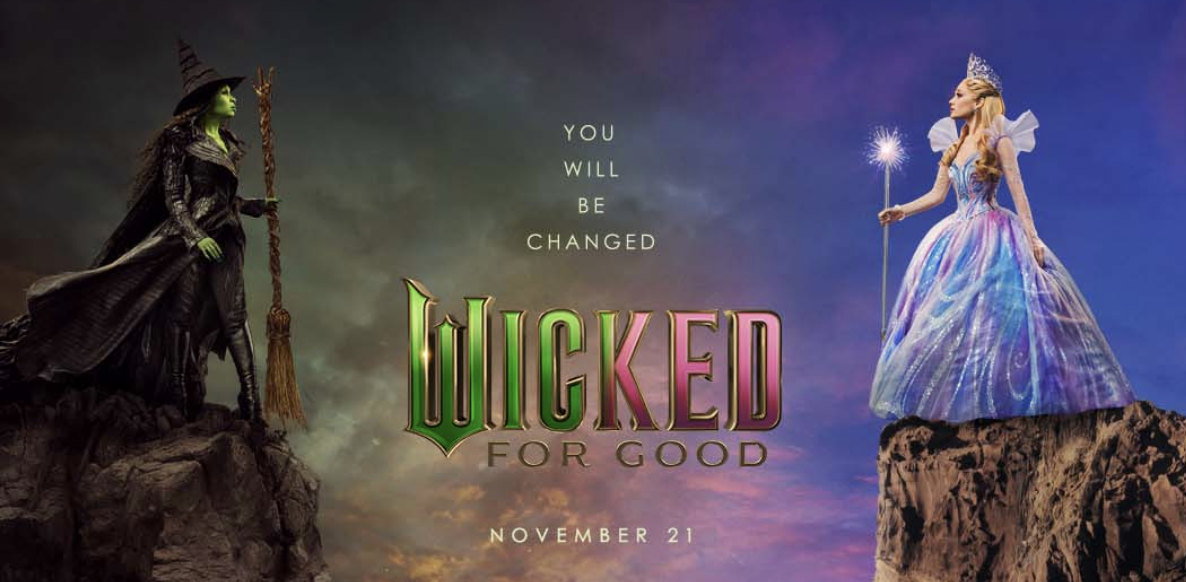
Review — ‘Wicked: For Good’
by Anton Kromoff
Welcome to the table,
Are you familiar with the turn of phrase “inside you, there are two wolves”? It’s meant to illustrate that we all have multiple forces at work inside of us; in most instances, the intent is to show that one is “good” and one is “evil.” The lesson we are supposed to take away from it is that whatever force we foster, focus on, and “feed” is the one that grows strong and becomes who we are.
I don’t have wolves inside me. For the majority of my life, I have never really been able to find a duality that made sense to my particular sensibilities. The closest I have ever come is an anarchistic green-skinned sorcerer and a people-pleasing lover of pink who turns into an absolute gangster when her spell-slinging besty is threatened.
Elphaba Thropp and Galinda Upland — or “The Wicked Witch of the West” and “Glinda the Good” as they eventually come to be known after name changes and a ton of trauma — are absolute icons. The most recent addition of their story has recently been released to the silver screen, and I was there for a multudodious (wicked words) amount of time watching the double feature with absolute delight.
This is going to be my spoiler-filled review of Wicked: For Good. Let’s get into it…


The film is the second in a two-part series based on the stage play musical titled Wicked, which is itself very loosely based on Gregory Maguire‘s novel Wicked: The Life and Times of the Wicked Witch of the West. That novel, in turn, is based on L. Frank Baum‘s novel The Wonderful Wizard of Oz and elements from MGM’s 1939 film, The Wizard of Oz.
All of which means the new release is the newest iteration of a story based on other stories in a legacy that spans over 100 years of history. And much like stories told through that classic game of telephone — or the iterations we see of Batman or Spider-Man — where the story starts and what it evolves to through each retelling can be very, very different.

The first film, simply titled Wicked, ends with Elphaba (Cynthia Erivo) finding her voice and realizing she can fly with the aid of an iconic witch’s broom. The guards of Oz — a idyllic kingdom with an unscrupulous leader — are hot on her trail; attempting to capture her because she stands in opposition to the racist and xenophobic views the “Wizards of Oz” has been using to control the population and turn them against each other. Elphaba’s best friend, Galinda (Ariana Grande) , is complicit in the current totalitarian regime and is embraced as a new mouthpiece for the “Wizard” (Jeff Goldblum) by his advisor, the weather witch Madame Morrible (Michelle Yeoh).
Wicked: For Good kicks off with animals being forced into manual labor prison camps by the forces of Oz. The animals, once part of day-to-day society complete with jobs, speech, and a seat at the table, have been turned into political scapegoats by the “Wizard” and subjected to an awful smear campaign where they have been blamed for any and all of society’s ills.
Elphaba shows up with her broom and magics, freeing the animals from bondage and knocking the forces of Oz about before rushing off to avoid being caught by Oz’s secret police.

The messaging is anything but subtle, and it continues to flow as the film progresses.
The “Wizard” is a charlatan with no real power other than the media network he uses to manipulate the populace and blame the more vulnerable for their woes. He does this in an attempt to distract from his own shortcomings and lack of magic, using his lie-smithing in reckless abandon so he can maintain control.
The “Wizard” continues to gaslight and condemn anyone who speaks out against him. The population of Oz, for the most part, just goes along with it, seeing Elphaba as a villain because she stands in opposition to his campaign of hate.

Things get even more emotionally compromised when Galinda is constantly put to use as the “Wizards” mouthpiece. Her life is one where she has been afforded everything she has wanted. She has had praise heaped upon her, and her takeaway from all of this is that she should smile, be grateful, and give the people what they want: something pretty and thankful and popular.
This seed of lack-of-self is played upon by the “Wizard” and Madame Morrible, further gaslighting Galinda that her soul purpose in life is to make the people smile and spread “good.”
Galinda’s world fractures when the man she loves, a prince and the head of Oz’s police force by the name of Fiyero (Jonathan Bailey), admits something the audience has known all along: he is in love with her best friend and the film’s main anti-hero, Elphaba.
This causes Galinda and Elphaba’s relationship to fracture, and the crack between these two is exacerbated by the constant hate messaging from the “Wizard”.
Overall, Wicked: For Good is a delightful romp of fantasy and music tied together with some stellar performances. It also shifts in tone slightly as the story injects the events of Baum’s novel, The Wonderful Wizard of Oz, and aspects of MGM’s The Wizard of Oz.
Dorthy (Bethany Weaver) — who is never really seen aside from some quick glimpses of a girl in a blue-and-white dress — acts as an impending doom for those who know she is coming to douse the “Wicked Witch” with a bucket of water and end her reign of “terror.”
And so it goes. With a beautifully heartfelt soundtrack where enemies turn to friends, then to enemies, and back to friends again, the film fills in lore blanks, explaining that while trying to do “good,” Elphaba accidentally turns her friends into the abominations we come to know as the Cowardly Lion (Colman Domingo), Tin Man (Ethan Slater), and her new lover — Prince Fiyero — into the Scarecrow.
The signs have been there since the beginning of the first film, with actions, deeds, and words foreshadowing these developments if you know where to look for them. The payoff is satisfying because the story comes to a close with Elphaba and Galinda reconciling before Elphaba makes Galinda hide, gets doused with water, “melts” and dies, and Dorothy, the lost girl from Kansas, goes back to Oz and tells the “Wizard” that she has killed the Witch.
Of course, that is not the whole story …
It’s not what actually happened that matters to the people of Oz.
The power in the apparent death of the “Wicked Witch,” though, allows Galinda to go back and usurp the “Wizard,” who — as you have seen me use quotes this whole time — is just a guy who has scammed everyone. Galinda realizes the true power of propaganda and starts to put it to use to change Oz for good.

Wicked is a powerful story of political rhetoric and social change in the best of times. In the current world climate, each note hits like a freight train hammering home that people, all people, should be treated with kindness and quality — not judged by the color of their skin or the nature of their birth.
The messaging is heavy-handed. The songs, save for a new addition called “Girl In The Bubble” that was just okay, ring true and make your heart swell and cause goosebumps to rise up on your arms. Well, if you are the type, like me, who loves musical theater.
I have seen a lot of hot takes that this movie is unpolished and does not deliver, but as someone who loves a story of friendship and a “fight the power” message laced in pink and sparkles with some magic and talking animals, this thing hits home in the best of ways. I loved every second of the almost seven hours I spent at the theater watching the double feature.

I also got the ridiculous sparkling popcorn, and that was just an additional level of extra I am here for.
This film is good if you are a fan. I don’t know if I can be objective about it because I love this kind of story, so your mileage may differ from mine, but knowing what was coming after seeing the stage play and knowing the story beats, I was not disappointed. And in this day and age, that is all I can really ask for when I go to the movies: silly snacks, heartfelt storytelling, solid songs, and smiles while crying.
Until next time, be kind to yourself, and do some good in this world if you can.
