
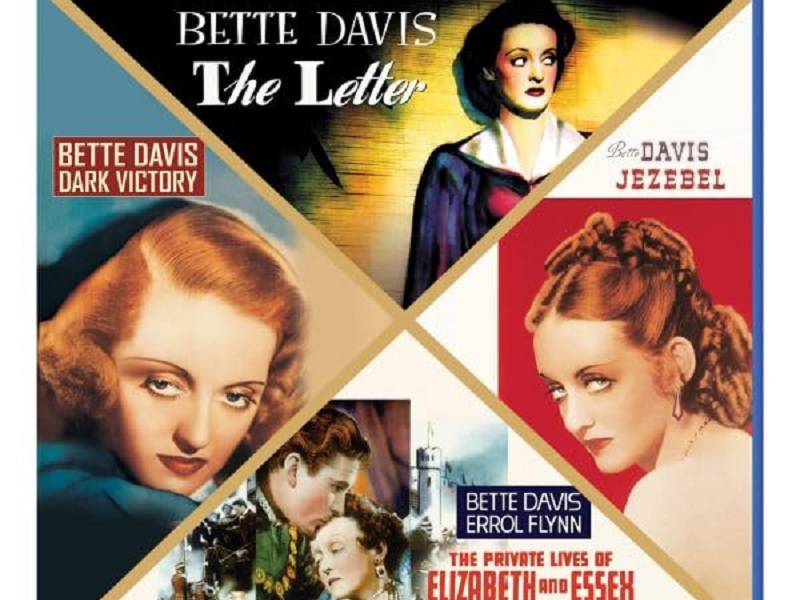
Reviewing Warner Archive’s ‘Bette Davis Collection’
by Rachel Bellwoar
Warner Archive provided me with a free copy of the Blu-Rays I reviewed in this article. The opinions I share are my own.
To anyone new to Bette Davis, Warner Archive’s Bette Davis Collection is the ideal starter pack.

William Wyler‘s Jezebel (1938)
There’s another film in this set where I’ll make a similar statement, but one thing I admire about Bette Davis films is that they tend to have that one identifiable scene – the scene where you might forget the other plot points, but you’ll always remember such-and-such film is the one that had that iconic moment. With Jezebel, this is the Bette Davis film where she wears the red dress and all hell breaks loose. Set on a plantation in the Antebellum South, Julie (Davis) is engaged to Pres (Henry Fonda) but, in typical ‘battle of the sexes’ film fashion, she’s irritated that he’s ignoring her and wants to teach him a lesson. Maybe “typical” is the wrong word, because this isn’t like in a Tracey-Hepburn movie, where Hepburn’s only crime is being a working girl. Julie is spoiled, and while that’s not what she’s being punished for – she’s being punished for flouting social conventions and making a riding crop fashionable – she’s no innocent, however much the sexism (and racism) of the time may be on full display.
In any case, being the virginal girl she is, Julie is supposed to wear white to the ball, but instead she shows up in a red Orry-Kelly number, causing quite the scandal. The way the film parallels her decision to wear red with the spread of yellow fever later on in the movie, in that they spark the same reaction from people despite (from a modern perspective) being completely unequal events, is really wild (and no doubt stands out more with this viewing due to the Covid-19 pandemic). I also really appreciated the way the screenplay handles Julie’s romantic rival, Amy (Margaret Lindsay), in that she’s not someone Pres is obviously going to cast aside as soon as he’s forgiven Julie.
While Davis plays Julie as written (and in her commentary, author Jeanine Basinger tries to make sense of the multiple names given screenwriting credit), the part I find less convincing is Julie’s loss of nerve at the ball and whether she would’ve retreated so much as stood her ground, only to regret her decisions later when faced with the consequences.
Warner Archive’s Blu-ray comes with the commentary by Basinger, where she considers Fonda and Davis’ different acting styles and how the film caters more to Davis (who was the bigger star at the time). There’s also a featurette on the film with film historians that goes over how Jezebel was a product of renewed interest in the Old South brought on by Gone with the Wind, as well as a Daffy Duck cartoon and a musical short.
Edmund Goulding‘s Dark Victory (1939)
According to the featurette on Warner Archive’s Blu-ray, Dark Victory was Davis’ favorite of her films for Warner Brothers and, to be sure, it gives her a massive character arc to play as Judith (Davis) goes from suffering headaches (which Davis overacts to the max), to getting brain surgery, to thinking she’s cured but maybe that’s not the full story. Like Rex Harrison in real life, when he opted not to tell Kay Kendall about her cancer, this film deals with the ethics of keeping health information from people, with the added cringe of Dr. Steele (George Brent) wanting to date his patient. Brent’s performance (if not his character) is actually the most measured, whereas Davis and Geraldine Fitzgerald (who’s touted as the newcomer in the trailer) go for dramatics (with Davis’ strongest scenes coming when she’s wearing a fur coat – the coat is irrelevant but I wanted to avoid spoilers, even if this film plays out exactly like you’d expect). Dark Victory is a very Hollywood idea of illness, with a miscast Humphrey Bogart occasionally appearing to attempt an Irish accent. Warner Archive’s Blu-ray comes with a shorts package to recreate the experience of seeing the film in a theater, a Lux Theater Radio broadcast with Spencer Tracey stepping in for Brent, and a commentary with film historians James Ursini and Paul Clinton (who are also talking heads in the featurette on the film).
Michael Curtiz‘s The Private Lives of Elizabeth and Essex (1939)
At times overly wordy, The Private Lives of Elizabeth and Essex works because it’s full of palace intrigue and politics with all the pettiness that entails, as Queen Elizabeth (Davis) bemoans the fact that there’s nobody in court who she can trust. The costumes by Orry-Kelly are gorgeously extravagant – Davis’ hair and make-up, too. The final conversation between Essex (Errol Flynn) and Elizabeth (Davis) is the most powerful, as ambition is pitted against love, but will honesty be able to change the course of history? Flynn matches Davis scene for scene, though according to a featurette on the film, Davis thoroughly disliked him in real life. In addition to the featurette (which also includes some great anecdotes by cast member Nanette Fabrey), Warner Archive’s Blu-ray provides another shorts package to recreate the theater experience. The highlight is “The Royal Rodeo,” a short that combines medieval times with American cowboys for no reason, except why not?
William Wyler‘s The Letter (1940)
This is the other film I was teasing earlier, as forever being the one where Bette Davis enters the film shooting. Her victim allegedly showed up uninvited. Now, Davis’ Leslie is being accused of murder, but will her lawyer (James Stephenson) be able to clear her name? It’s a film that requires an unusual performance by Davis, as Leslie’s whole thing is that she’s obviously lying, but, because she’s a white lady crying wolf, it’s taken for granted that she’s telling the truth. The fact that everything she says sounds rehearsed is intentional – she’s that assured of herself and her ability to wrap men around her finger, but the result is Stephenson’s dilemma as her lawyer (and Sen Yung‘s mechanizations as another law clerk, Ong) are more intriguing. Warner Archive’s Blu-ray comes with two Lux Radio Theater broadcasts. It also includes an alternate ending, which is significant not for offering new footage, but for what’s left out (a conversation that changes the ambiguity of the scene and makes Leslie’s fate retributive)
The Bette Davis Collection is on sale now from Warner Archive and to purchase from Movie Zyng.

