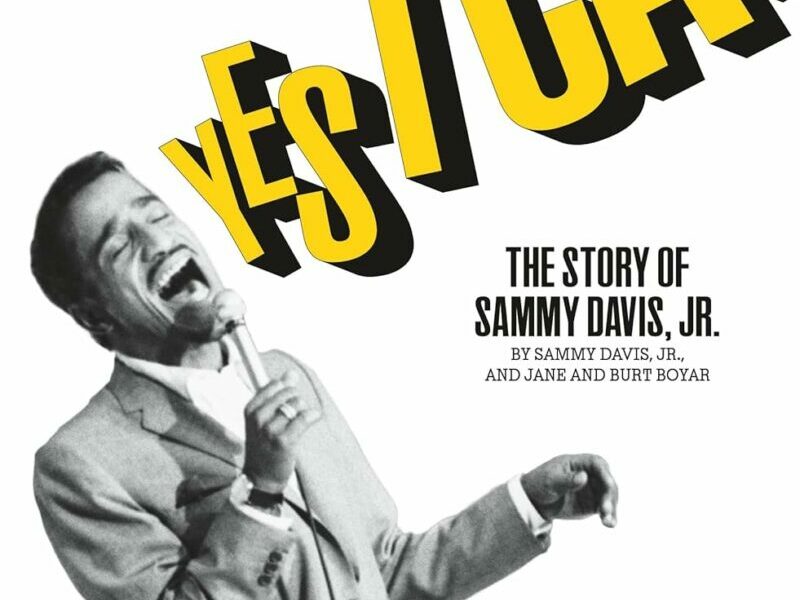
Memoir Review — ‘Yes I Can: The Story Of Sammy Davis, Jr.’
by Rachel Bellwoar
One thing you don’t think about until you’re trying to find a certain title and it ends up being difficult to track down is books go out of print. Even books written by big-time stars with stories to tell can become scarce or only available through libraries. At a whopping 612 pages, Yes I Can: The Story of Sammy Davis, Jr. covers Davis’s life from his childhood on the vaudeville scene to the birth of his first child in 1961 with Swedish actress, May Britt. Originally published in 1965, Davis co-wrote the memoir with Broadway columnist Burt Boyar and his wife, Judy Boyar. Now, for what would’ve been Davis’ 100th birthday on December 8th, 2025, Questlove’s imprint, Auwa, has republished the memoir so it’s readily available once more, both capturing a moment in time and a pervasive hate that almost cost the world one of its greatest entertainers. Davis’ undeniable talent triumphed, but at a terrible (and unnecessary) personal cost and the extent of the aggressions Davis had to endure, as almost every milestone is immediately marred by some act of racism, truly comes to light over the course of reading this book.

As if only dealing with segregation would’ve been too easy on him, Davis’ story is proof that real life can be crueller than fiction. The challenges keep coming, and the book actually opens with the car accident that cost Davis his eye before going back to show the events leading up to that moment. The timing of the accident alone is cruel — the uphill battle he fought unending, his career never completely secure.
While with a lot of memoirs there’s an awareness that you’re reading a memoir and being told about events that already happened, with Davis’ memoir, it’s actually easy to forget. It almost reads more like a novel than an autobiography. Where the artifice starts to show is in the dialogue. No matter how difficult and contentious the topic, Davis always has himself knowing the right words to say or being able to express his opinions perfectly, and, as a man who had to constantly field questions from not always friendly press and make a living talking on stage, Davis was that charismatic. He was able to come up with answers on the fly. There’s ample proof of that, but at the same time (and maybe this has to do with the length of the book, too) it all starts to sound a little too well-crafted and polished after a while.
Those looking for on-set and behind the scenes stories might be slightly disappointed. As a big fan of Davis’ turn in Anna Lucasta with Eartha Kitt, Davis shows how difficult it was for him to break into movies but then doesn’t spend much time on the production after securing the part. He does get into the nitty gritty of staging a nightclub act — how much time he spent in the wings, watching other performers like Mickey Rooney captivate an audience; the small tweaks and changes that allowed his act to grow and improve; the many ways it evolved, starting heavy on dance but then increasingly adding comedic bits. Those breakdowns are absolutely fascinating and specific and show how much thought went into every decision — not just natural ability and good instincts but real study of the craft.
You also see how show business affects Davis’ relationships, specifically those with his father, Sammy Davis Sr., and “uncle,” Will Mastin. Together, they made up the Will Mastin Trio, and that billing would continue long after Davis became the group’s breakout star, yet Davis shows their evolution from starving artists to breaking down barriers, playing at clubs that formerly didn’t allow Black acts or integrated audiences.
Because this book came out in ‘65, there is a sense of impending doom (which might be a too glib way of referring to the many notable figures who would be murdered by the decade’s end). Martin Luther King Jr. (whose quote the book opens with) was still alive when the book was published, but John F. Kennedy (for whom Davis postponed his wedding due to the pressure his best man and Kennedy supporter, Frank Sinatra, was under not to attend it) had been assassinated in ‘63. Davis’ marriage with Britt would end in divorce three years after the book’s release. Yet, by ending with the birth of their daughter, Tracey, Davis ends on a note of hope for a future that’s better than what came before, instead of trying to dredge up a past that never really existed (at least not for everyone).
Yes I Can: The Story of Sammy Davis Jr. is on sale now from Auwa.