
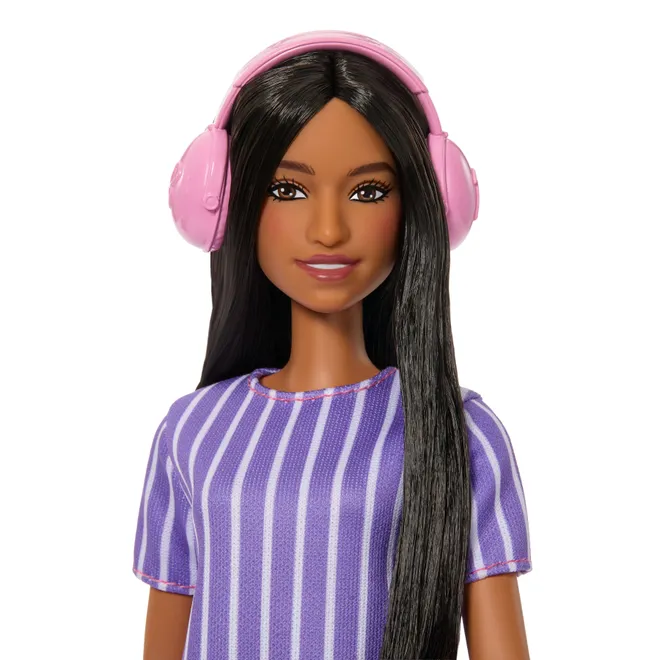
Mattel Announces First Autistic Barbie Doll Allowing Thousands Of Children To See Themselves In A Toy For The First Time
by Tony Thornley
Late last year, Mattel unveiled a Barbie with Type I Diabetes to better reflect the world around those who play with the world’s #1 doll. Earlier this week, they followed that up with the first ever Barbie with Autism Spectrum Disorder.

As revealed in USA Today, the newest entry in Barbie’s Fashionistas line is a young woman on the Autism Spectrum. The doll was developed with the non-profit the Autism Self Advocacy Network. It features flexible elbow and hand joints that would allow for stimming — a term for actions that those with autism use to self regulate, such as flapping their hands, clapping or other movements. It will also come with autism friendly accessories like a fidget, noise canceling headphones, loose fitting/seamless clothing, flat shoes and an AAC (or augmentative alternative communication) tablet.

“It is so important for young autistic people to see authentic, joyful representations of themselves, and that’s exactly what this doll is,” Colin Killick, executive director of ASAN, said in a statement. “Partnering with Barbie allowed us to share insights and guidance throughout the design process to ensure the doll fully represents and celebrates the autistic community, including the tools that help us be independent.”
This Barbie hits home for me. Last year, the diabetic Barbie was a big deal. Three years ago, I was diagnosed with Type I Diabetes, an often misunderstood autoimmune disease in which my immune system fought too hard against an infection and killed my pancreas. This meant that my body no longer produced insulin on its own and I would manually have to administer it before meals and snacks. (No, it doesn’t mean I need to exercise more — it’s Type II Diabetes that can be regulated by diet and exercise. And don’t bring me cures — they’re all bunk.)

Now to see this Barbie announced … they did it again. My oldest child was diagnosed with Autism Spectrum Disorder at two years-old. Autism is one of the most misunderstood developmental diseases out there, including misinformation actively spread by the current presidential administration about things like vaccines and over-the-counter medication causing the disorder.
Even better Mattel worked with a non-profit other than Autism Speaks, an organization accused of actions that have actively harmed individuals on the Autism Spectrum. It shows that the company took their time to find a partner that’s centering the voices of those affected by Autism, rather than one that’s allegedly done harm to the community.

It’s fantastic to see myself and my son represented in these toys. Diversity is important because it destigmatizes these differences. My disease isn’t because I did anything wrong, it’s because my immune system went into overdrive one day. My son’s disorder isn’t because my wife and I did anything wrong, it’s likely genetics. By making one of the most popular toys someone that looks like us, our differences are more normal.

And that’s important as hell.
Thanks Mattel.

