
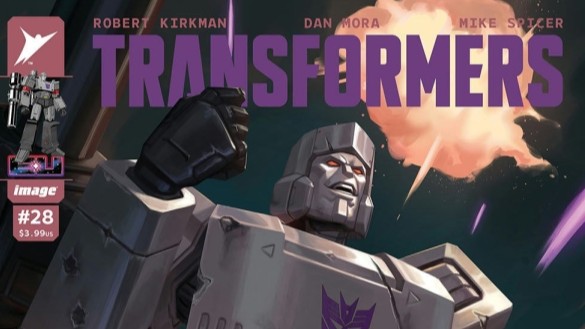
‘Transformers #28’ Review: Quiet Characterization And Big Transformations
by Austin Gorton
Overview
The fallout from the events of issue #25 and the creative team change continue in Transformers #28, as two characters undergo significant…transformations, while the expansion of the Energon Universe kicks into another gear.
Overall
7/10Since the big shakeup — creatively and in-story — in issue #25, the series has been in mostly fallout mode. Dealing with the aftermath of those events, cleaning up some loose ends from the previous creative team, and setting up some new plot threads. An unofficial detente of sorts has existed between the Autobot and Decepticon camps, as both sides retreat to their respective corners to lick their wounds and reassess.
That changes, or at least begins to change, in Transformers #28, as two key characters respond to recent events by undergoing changes which threaten to upend the nascent status quo. The end result is an issue with a little more narrative oomph than recent ones, leading to a shocker of an ending.

On the Decepticon side of things, Megatron has spent most of his time post-Battle of Chicago blaming others for the Decepticons’ defeat and sending out raiding parties for energy. Now, writer Robert Kirkman starts to show the strain this has put on Megatron, as he begins to, well, lose it.
Attacking his fellow Decepticons and calling out to Dezimir, the Quintesson prosecutor who tortured him in the flashback story in issue #19, Megatron seems a step out of reality. The “fit” passes quickly, but it, along with the return of Skywarp, seems to prod Megatron into action, upending the unspoken “down time.”
Meanwhile, Arcee has proceeded from “I want to be a Magnus” to undergoing the Magnus transformation process and emerging with a new Dan Mora-created redesign, featuring extra armor and little missile launchers on her shoulders, with remarkable narrative speed.
Perhaps the speed with which this transformation occurs is meant to setup the idea that Arcee is rushing into it and not thinking through the ramifications, the result of her own PTSD in the same way Ultra Magnus’ rush to give up the mantle of Magnus in the first place is an expression of his PTSD. For now, that’s nothing more than (wishful) subtext; as is, Arcee’s transformation feels a bit abrupt.
In other abrupt (but more satisfyingly so) plot developments, Miles Mayhem’s fall from General Flagg’s righthand man to super-villain takes a huge leap. Picking up where his arrest last issue left off, Mayhem triggers his M.A.S.K. helmet, disintegrates a bunch of soldiers, and escapes aboard his transforming Bladejet (a renamed recreation of the vintage Switchblade helicopter/jet toy). As of now, despite the Flagg connection, this feels more like setup for an inevitable M.A.S.K. book than a true subplot in service of Transformers, but given that, the speed with which Kirkman and company are moving it along is appreciated.

Art-wise, this might be Mora’s strongest issue yet — the double page spread of the Bladejet reveal channels the gutter-busting energy of Jorge Corona‘s earlier work on the series. So too does the *Spoiler* gruesome death of Trailbreaker that concludes the issue, as Megatron launches his attack by smashing Trailbreaker’s head and ripping him in two, before proceeding to “drink” his spark (an act which is meant to bestow permanent death, vs. the series’ usual “they’re destroyed and powered down but they just need some Energon and Wheeljack to get better” deaths).
The three page sequence effectively channels the kind of gory messiness of Spicer’s big battle scenes, while still allowing Mora to showcase his ability to render emotion even through robotic facial expressions (something he also does quite well in an earlier and quieter roll call sequence comprised of a sixteen-panel grid of Autobot headshots).

Ultimately, Transformers #28 is the most incident-packed issue yet of the short Kirkman/Mora era — Arcee is a Magnus! Megatron is losing it! Mile Mayhem has his M.A.S.K. toy! There’s a gruesome death, yet it succeeds because it continues to ground all that incident in characterization.
From the Arcee/Ultra Magnus perspectives on Magnus-hood to briefer moments, like Spike and Carly returning home and Spike revealing his earlier college aspirations have been somewhat squashed by his knowledge of giant space-faring transforming robots, or the captive Soundwave recalling the harsh treatment of Ravage at Starscream’s hands when newly-christened Autobot Thundercracker explains his face-turn, all the incident in this issue is grounded by the fact that the players involved are well-realized characters, and not just cogs in a storytelling engine.

