
An Interview With ‘Flip’ Author Ngozi Ukazu
by Rachel Bellwoar
Asking someone to go to a dance with you is a lot different from walking a day in their shoes. Somehow Chi-Chi’s wish got lost in translation because that’s what’s happening instead. In Ngozi Ukazu‘s Flip, Chi-Chi and her crush, Flip, keep switching bodies, and it all started after Flip publicly rejected Chi-Chi’s promposal. With letters by Chris Dickey, here’s what Ukazu had to share about Chi-Chi’s plight:

Rachel Bellwoar: In the author’s note, you describe Flip as your “most autobiographical work to date.” What made you want or feel you were ready to tell a more personal story?
Ngozi Ukazu: I worked on Flip during the pandemic, which — for many, including myself — was a time for deep reflection. I had worked on a number of graphic novel projects (Check, Please!, BUNT!, and Barda for DC Comics) and finally had the confidence to tell a more personal story with the skills I had developed as a graphic novelist.
Bellwoar: We’ve seen Freaky Friday situations before between parents and children. Usually, the characters swapping bodies have a relationship. How was it dropping two characters who are essentially strangers into this scenario?
Ukazu: Regardless of whether characters are strangers, friends, or related, body swap stories follow the same narrative beats. The moment the device of body swapping is introduced, characters must explore familiar spaces in a new context and view themselves in out-of-body experiences. Be they characters who know each other or complete strangers, the goal is empathy and self-awareness.
Bellwoar: Another way you play with expectations with regards to this set-up is that usually the resolution comes when the characters are able to swap back. Here Chi-Chi and Flip are switching back and forth the entire time, which is how we get the nightmare scenario of swapping bodies while driving. When did you know you wanted to add that element to the story, or was that “flipping” an essential part of the premise (hence the title and Flip’s name)?
Ukazu: Repeated body swapping makes the graphic novel more unique than the typical Freaky Friday story, raises the stakes immensely, and lets the characters “check-in” with their own bodies and current situation. It’s a factor that came with revision.

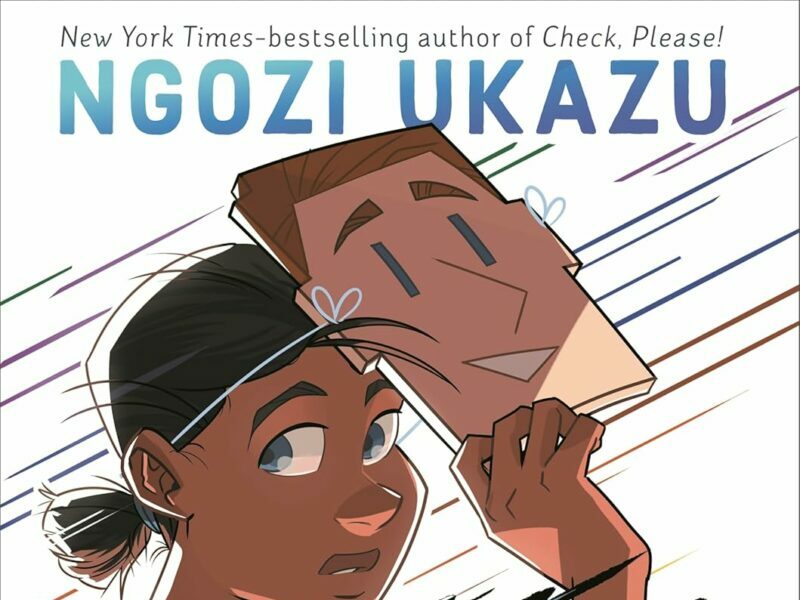
Bellwoar: There are certain visual giveaways you establish to tell when Chi-Chi’s Chi-Chi and when she’s Flip, like eye color or suggesting they’re wearing masks, as Chi-Chi does on the cover. Was it initially difficult to figure out how to pull off the “flip” visually?
Ukazu: The eye-color change and mask-wearing were early visual indicators of the flipping, and came with revision. The goal was to show the reader that these two characters were inhabiting the other’s bodies as seamlessly as possible.
Bellwoar: I love a book that can reference both K-Pop and TCM. Did you enjoy getting to incorporate those references?
Ukazu: Including pop-culture into the graphic novels I make is always a blast. Chi-Chi’s favorite fictional K-Pop group is modeled after BTS.
Bellwoar: While we learn more about Flip as the book goes on, Flip is first and foremost Chi-Chi’s story. Why did you want to focus on her and her experiences in Flip’s body and her own versus splitting the point-of-view?
Ukazu: The protagonist of a story is typically the character who has the greatest needs and who goes through the biggest change. Despite being the eponymous character, Flip is the story of Chi-Chi’s self-reflection and growth as a young Black girl who needs to learn self-acceptance to survive.
Bellwoar: Depression is often talked about in terms of mental health, not physical. Is that a misconception you wanted to address with Flip and how depression is tied to his body?
Ukazu: Living in Flip’s body meant that Chi-Chi would experience his height, his athleticism, his metabolism—and also the physiological impacts of depression. In depicting the swap as realistically as possible, the graphic novel had to address that depression affects the mind as well as the body.
Bellwoar: Thanks for agreeing to this interview, Ngozi!
Flip is on sale now from First Second.