
Fire & Blood Files: The Identity Of Egg And Why It’s Important
by Austin Gorton
<<Warning: spoilers follow for A Knight of the Seven Kingdoms Episode 3, “The Squire” (and, broadly, possible future seasons of the show based on novellas that haven’t been written yet). >>

True to its form as a smaller, lower stakes Game of Thrones spinoff, A Knight of the Seven Kingdoms isn’t a series structured to live or die by compelling plot twists or jaw-dropping surprises. Nevertheless, the novella on which this season of television is based contains one particularly significant twist, one which (like the best plot twists) both crystalizes and recontextualizes the thematic and character arcs of the story.
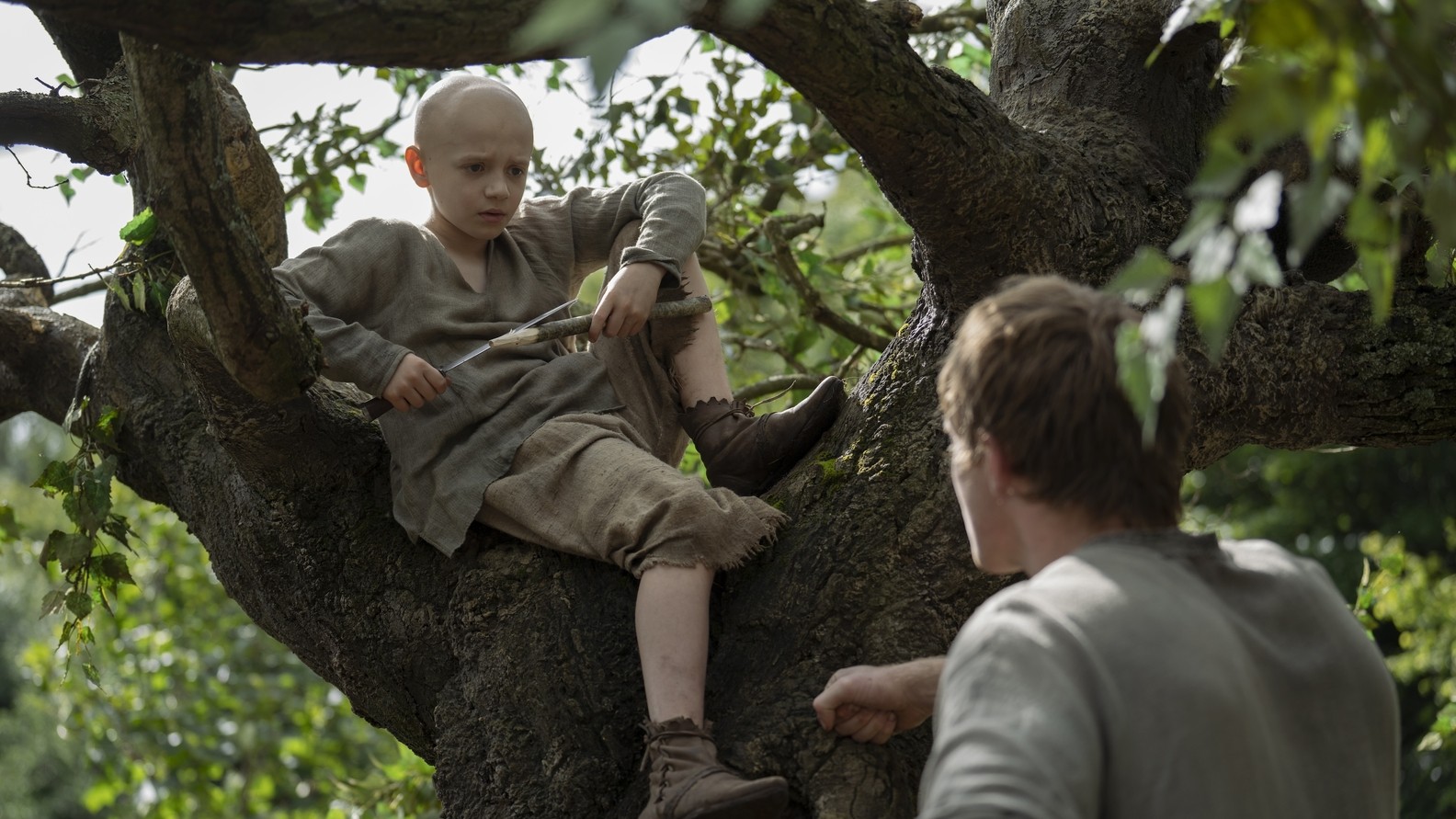
In the novella — as in, thus far, the TV show — the reveal of Egg’s (Dexter Sol-Ansell) true identity as Aegon Targaryen, fourth son of Maekar (Sam Spruell), one of the missing brothers of world-class shitheel Aerion Brightflame (Finn Bennet), both kicks the plot into high gear and gives it a little extra narrative weight. Yet to understand why the latter is true requires an understanding of where exactly this Aegon Targaryen fits in the context of Westerosi history.
Though Egg is the fourth son of a fourth son, thereby making him just about as far removed as possible from the line of succession while still being in the line of succession, a series of events will, as the fortune teller in this episode suggested, lead to him being crowned Aegon V Targaryen, with the sobriquet “Aegon the Unlikely.”
This means that the lineage of later Targaryen rulers will flow down from him. Thus, the Targaryens we will meet later in Game of Thrones are all descendants of Egg. His grandson is Aerys II, the Mad King whom Jamie Lannister (Nikolai Coster-Waldrau) executes, after which Robert Baratheon (Mark Addy), the king when Games of Thrones starts, ends the Targaryen dynasty. This means that Egg is the great-grandfather of Daenerys (Emilia Clarke), and the great-great-grandfather of Jon Snow (Kit Harrington), the secret Targaryen child of Daenerys’ older brother Rhaegar and Lyanna Stark (at least according to the Game of Thrones TV show).
It is Egg’s lineage which also, ironically, supports Robert’s claim to the throne after the Mad King is killed. Egg’s daughter Rhaelle marries Ormund Baratheon, Robert’s grandfather, giving Robert “the blood of the dragon.”
Because Egg’s only pureblood Targaryen grandchildren are Aerys and his sister-wife Rhaella, once they’re killed, Robert’s claim is on the same generational level as that of Aerys’ children. It doesn’t really get spelled out on the show, but Robert is second cousin to all of Aerys’ children, including Daenerys.
Once he kills Aerys’ heir Rhaegel at the Battle of the Trident, the climatic battle of Robert’s Rebellion (as well as Rhaegel’s heir, the infant Aegon, shortly thereafter) and Viserys (Harry Lloyd), the second son of Aerys, goes into exile with Daenerys (where they are at the start of the series), Robert’s claim is strong enough for the necessary lords to accept; particularly after all the Mad King’s shenanigans soured the realm on Targaryen rule.

Beyond being the progenitor of key players in Game of Thrones, Egg even gets name dropped directly later in the series. As mentioned in last week’s column, Maekar’s third son is Aemon, who will go on to become Maester Aemon (Peter Vaughn) of Castle Black in Game of Thrones.
In season 1, when Jon is contemplating abandoning the Night’s Watch and riding south after his father is imprisoned, Maester Aemon talks him down in part by telling him of Aemon’s own heritage, name-dropping his father as well as his brother Aegon, Egg, and how his vows were tested during Robert’s Rebellion when his family was wiped out (the show makes Aerys the son of Aegon, and thus Aemon’s nephew, presumably to make the connection more direct for viewers).
Later in the series, Aemon’s dying words are “Egg, I dreamed … that I was old…” as he hallucinates that he’s talking to his younger brother as a child, name-dropping the co-star of AKOTSK over ten years before the show began.
The reason Aemon is the Maester of the Night’s Watch in the first place is even tied to Egg. Before being bestowed on Egg (whom many of the lords distrusted despite being the legal next-in-line to the throne because of all his time spent palling around the smallfolk with Dunk), the crown was offered to Aemon, Egg’s older brother, with the offer to release him from the vows he took as a Maester. Aemon declined, and the crown passed to Egg, after which Aemon took the black to strip himself from all legal connection to his family so he couldn’t be used as a potential weapon against his brother’s legitimacy.
And if you’re curious, coming at it from the direction of HBO’s other Game of Thrones spinoff, Egg is five generations removed from Rhaenyra Targaryen (Emma D’Arcy) and her half-brother Aegon (Tom Glynn-Carney). He is the great-great-great-grandson of Rhaenyra and Daemon (Matt Smith), descended from Viserys, the second son of Rhaenyra and Daemon (who has appeared briefly on House of the Dragon as a small child).

A Knight of the Seven Kingdoms (and the “Dunk and Egg” novellas on which the series is based) is not a show pitched at the political level of House of the Dragon and Game of Thrones, and the reveal of Egg as someone much closer to the halls of power those shows inhabit than both Dunk and unsuspecting viewers could have known won’t change that.
But the reveal of Dunk’s diminutive, sassy and ultimately well-meaning squire as a Prince of the Realm, and a figure of significant importance to its future, is nevertheless important because it affirms the series as part of the broader narrative unfolding across all those stories. While this season and future ones will retain the refreshingly more ground level, “man of the people” point of view, the reveal of Egg’s true identity heightens the stakes of these tales, ensuring that the actions of Dunk and Egg, no matter how small-scale, will reverberate through history.
