
Is It Wind Or Is It Supernatural?: ‘The Red House’ Reviewed
by Rachel Bellwoar
Until now Pete (Edward G. Robinson) has gotten by on his farm without any help, but that doesn’t mean he couldn’t use it. When he finally agrees to hire someone, Meg (Allene Roberts) already has a classmate in mind — Nath (Lon MacAllister) starts work right away. The problem comes when he wants to go home. After sharing his intention to take a shortcut through the woods, Pete is horrified. He tells Nath he’ll never make it and, as his warnings coincide with some nasty winds, he ends up being right, yet Pete’s insistence that the woods are dangerous only serves to pique Nath and Meg’s interest and together they decide to investigate.

Delmer Daves’ The Red House gets its name from “the red house” Pete claims is somewhere in the woods. Finding that house becomes Nath and Meg’s mission. From starting out very Peyton Place, it’s a film that banks hard on atmosphere to create a sense of unease that’s compelling.
Featuring teenagers as curious as Jughead () and Betty () were on Riverdale, it’s a true coming-of-age story and, for being her first movie, Roberts does an amazing job conveying Meg’s intelligence and growing confidence as she learns to assert herself. This is a character who’s anything but gullible, yet that comes through not in the dialogue (where Meg isn’t always free to speak her mind) but entirely from Roberts’ performance.
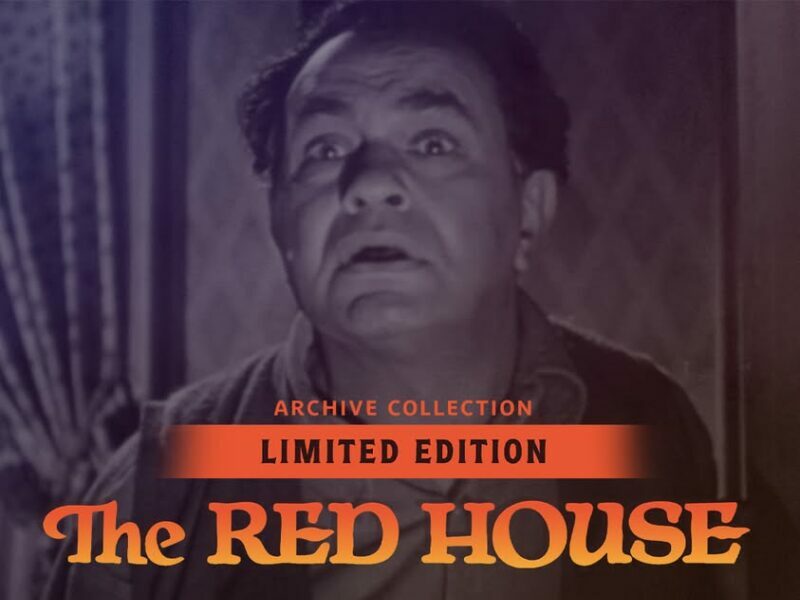
Flirting with horror and the supernatural, the film’s one flaw is that it doesn’t keep that option on the table. Instead, it starts offering explanations for everything that’s going on. Maybe the wind was always just the wind but it’s not for nothing that Miklós Rózsa uses a theremin in his score and the film could’ve played into that possibility more instead of being realistic. At times Robinson is filmed like a monster in a fairy tale — keeping his adoptive daughter Meg locked away — while cinematographer Bert Glennon exaggerates the shadows. Even the casting of Judith Anderson as Pete’s sister, Ellen, feels self-aware and meant to play into the notoriety of her role as Mrs. Danvers in Alfred Hitchcock‘s Rebecca.
Film Masters’ Blu-ray comes with a commentary by Karen Burroughs Hannsberry, the author of two books on film noir (one on actors, the other on actresses). It’s an extremely professional and considered commentary, with Hannsberry deliberately timing her pauses to highlight certain sections of dialogue and to point out differences between the film and George Agnew Chamberlain‘s source novel. One of my favorite moments: Hannsberry takes time to explain what the word “runaway” means in the context of Pete explaining what happened to Meg’s parents. It’s a question I had while watching the film but then forgot about. The fact that Hannsberry picks up on those details shows how much thought she put into this commentary. Also, all credit to Film Masters for continuing to offer subtitles for their commentaries as well as the feature. Other labels should take note.
Also included is a booklet essay by writer Chad Kennerk that provides some background on the production and considers the film in the context of the Red Scare, which was already having an impact on Robinson’s career and would make Albert Maltz — whose contributions to Daves’ screenplay would go uncredited — one of the Hollywood Ten.
The Red House is a film that seems to go over well with anyone who’s seen it (even contemporary reviews were positive), but it doesn’t come up a lot. Hopefully Film Masters’ release will help stop it being overlooked.

