
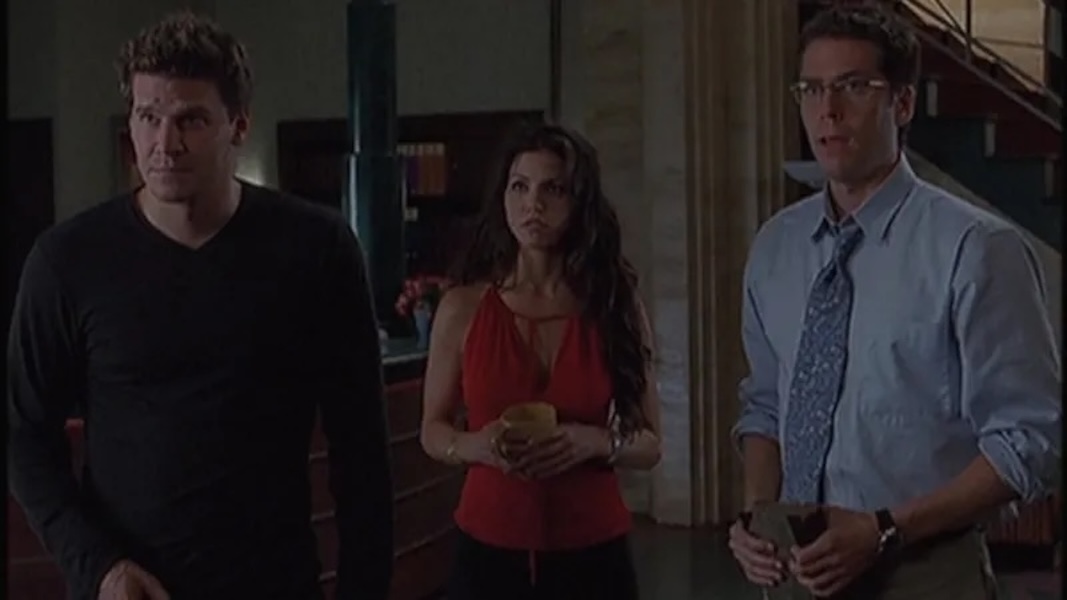
Characterization In The Buffyverse — ‘Angel’ Season 2, Episode 16
by Benjamin Hall
This is part of a bi-weekly series concerning the characterization of Buffyverse characters. Arguably the best place to begin reading this series is at the beginning, but that is up to each reader. As a reminder this column will cover major and some minor characters from the shows Buffy The Vampire Slayer (1997-2003) and Angel (1999-2004). Other Buffyverse media, such as the graphic novel Spike: Into The Light (2014) are not pertinent to this series. Also there will be no referencing real world events that have direct relation to either show in this bi-weekly series. Although, this series does reference things that have no direct relation to the show in order to examine things such as metaphors and literary analogues.

This week: Angel (David Boreanaz) rushes to save the lives of others after a realization. Meanwhile, a Skilosh Demon (Kevin Fry) and his kin seek revenge on Angel Investigations.
(Warning of spoilers from this point on!)
(Trigger warning for mentions of suicide and rape)
Angel reacts much like he does on Buffy The Vampire Slayer after sleeping with Buffy Summers (Sarah Michelle Gellar) in Buffy The Vampire Slayer, Season 2, Episode 14, “Innocence”. However, since he feels hopeless at the time of being with Darla (Julie Benz), his reaction is psychosomatic rather than a breaking of the curse. Consequently, Angel is a jerk for using Darla to get rid of his curse, and not telling Buffy that she is not at fault. Also, his breaking of Lindsey McDonald’s (Christian Kane) fake hand after beating him and giving hollow apologies to Lindsey is just unnecessary. Additionally, Angel comes across as a prideful nihilist regarding what he now believes about the struggle between good and evil. Lastly, his repetitive statement about Darla saving him is baseless since there is no explanation for how she supposedly does this.
Detective Kate Lockley (Elisabeth Röhm) is arguably just a plot device in this episode despite her suicide attempt being a major character moment. Unfortunately, any exploration of the aftermath will not come to pass because this is her final appearance, and it only occurs to restore Angel’s faith in the Powers That Be.
Wesley Wyndham-Pryce (Alexis Denisof) does not get any major development except for a status quo change to being Angel’s boss. His characterization in this adventure boils down to providing exposition and being a living comedy prop.
Cordelia Chase (Charisma Carpenter) is mostly just a damsel-in-distress in what amounts to a horror movie scenario. She also suffers another demonic pregnancy (Season 1, Episode 12, “Expecting”) via what amounts to rape by the lead Skilosh demon.
Charles Gunn (J. August Richards) acts as part of a comedy duo with Wesley in terms of their dialogue and physical interactions. Other than that, there is just his justifiable distrust of Angel at play when it comes to Gunn’s character traits.
Francine Sharp (Marie Chambers) and Stephanie Sharp (Leah Pipes) make their final appearances as corpses along with Mr. Sharp (unknown) and the parental Sharps’ nameless son (unknown). They are not really plot devices so much as connective tissue to explain why Cordelia is entering a house near this episode’s beginning (Season 2, Episode 15, “Reprise”).
Lindsey attacking Angel out of jealousy over Darla — plus anger over everything in their collective past — is logical. But his desire to know Angel’s side of the story after probably learning it from Darla makes Lindsey seem more irrational than he should be. Ultimately, he invests emotionally more into both Angel and Darla than they do him. The fact he has only three suits in his closet suggests he either has only four suits in total or he houses three extras in one of two closets. Finally, his old and beat up truck is a plot device that does not really seem to fit his current lifestyle.
Darla (Julie Benz) basically mimics Buffy post-sleeping with Angel in that both Buffy and Darla react with despair and depression. Other than that fact, there is no real reason for her to be taking up so much of the episode when the rest of her time could be a simple “Dear John” letter to Lindsey.
The Skilosh demon, along with his family members, are pretty much just villain-of-the-week types. Yes, they are making a final recurring appearance while seeking revenge, but they lack deep motivations that could give them substance.
Lorne (Andy Hallett) admits to not being Angel’s tie to the Powers That Be while acting similar to a therapist who is at their wits-end dealing with an overly stubborn patient. Otherwise, he is his usual self in terms of his personality and delivering exposition.
The entirety of this narrative relies on every prior episode — along with potential future episodes — while wrapping up plots from the past several. Thus, every character fails to achieve actual growth. Especially Angel, who seemingly only conceives of a new personal belief to justify his prior actions failing him.

